Many UK travellers still make the same costly mistake every year: they queue at an airport currency kiosk minutes before boarding, accept whatever rate is on offer, and quietly lose a significant chunk of their spending money before the holiday has even begun. Airport exchange rates are often much worse than pre-ordering currency online or on the high street. In 2026, ‘holiday money’ means far more than a wallet stuffed with foreign notes. This guide cuts through the confusion, covers all your real options, and gives you practical steps to make every pound work harder abroad.
Table of Contents
- What does holiday money actually mean?
- How do most UK travellers get and use holiday money?
- The real cost of holiday money: fees, rates, and hidden pitfalls
- Expert tips for making your holiday money go further
- A smarter approach: Why planning your holiday money really pays off
- Find the best holiday money deals before you travel
- Frequently asked questions
Key Takeaways
| Point | Details |
|---|---|
| Holiday money defined | ‘Holiday money’ means cash, prepaid travel cards, and cards used abroad, not just foreign notes. |
| Compare to save | Comparing rates and options before your trip prevents costly mistakes and hidden fees. |
| Mix your methods | Using both cash and cards offers the best flexibility and value when you travel. |
| Avoid airport rates | Never buy currency at the airport unless absolutely necessary—online or high street rates are usually much better. |
| Mind leftover cash | Plan how you’ll handle leftover foreign money, as buyback rates can be poor if you don’t compare your options. |
What does holiday money actually mean?
With so many options available, it helps to start by understanding what ‘holiday money’ actually covers in 2026.
For most people, the phrase conjures up images of crisp foreign banknotes picked up from a bureau de change. That picture is outdated. Today, holiday money includes foreign currency cash, prepaid travel cards, and the use of regular credit or debit cards abroad. Each option carries its own costs, conveniences, and risks.
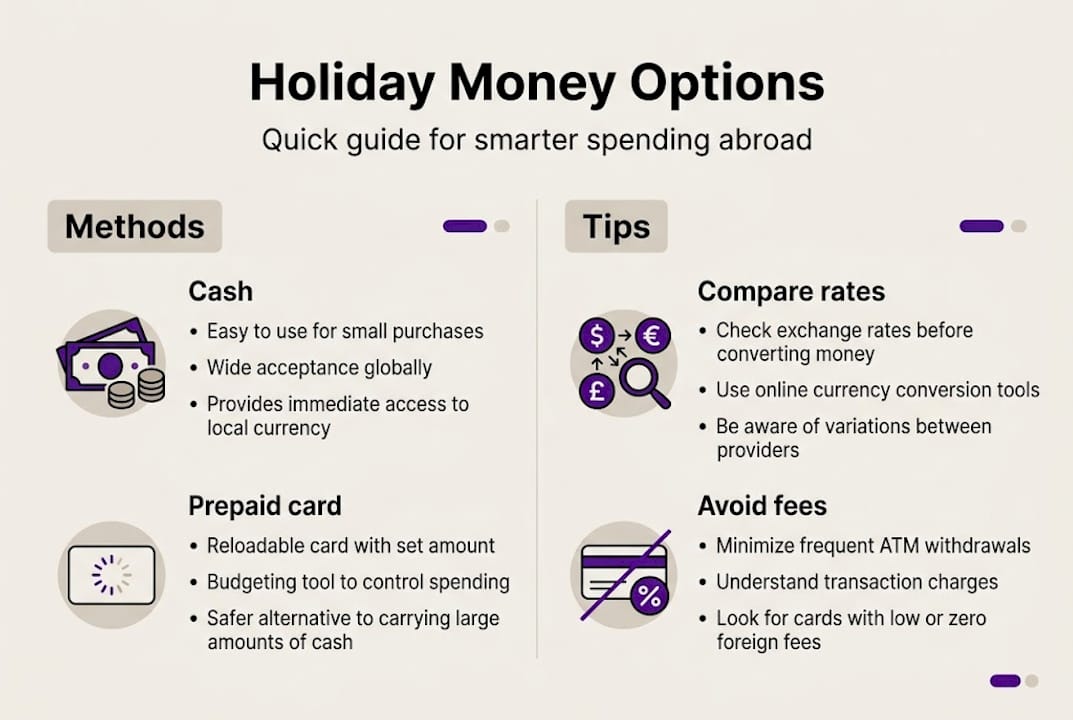
Here is a quick summary of the core options available to UK travellers:
- Foreign cash: Physical currency exchanged before or during your trip. Useful for markets, taxis, and small local purchases where cards are not accepted.
- Prepaid travel cards: Loaded with foreign currency at a fixed rate before you travel. Widely accepted and useful for budgeting.
- Regular credit or debit cards: Used directly abroad, though many charge foreign transaction fees or ATM withdrawal fees.
- Traveller’s cheques: Once a staple of overseas travel, these are now rarely used. Most destinations no longer accept them, and replacement services have diminished sharply.
The variety of currency exchange options can feel overwhelming, but the right mix usually depends on your destination, spending habits, and trip length.
| Option | Pros | Cons | Typical cost |
|---|---|---|---|
| Foreign cash | Widely accepted; no tech needed | Risk of loss or theft; poor airport rates | Exchange margin of 2–5% |
| Prepaid travel card | Locks in rate; budget control | Loading fees; possible inactivity charges | Low to moderate fees |
| Regular debit/credit card | Convenient; widely accepted | Foreign transaction fees; ATM charges | Up to 3% per transaction |
| Traveller’s cheques | Replaceable if lost | Rarely accepted; slow to process | High commission on exchange |
As a practical example, cash tends to work best in rural or less developed destinations, prepaid cards suit city breaks in Europe or the US, and travel credit cards with no foreign fees are ideal for those who pay off their balance each month. Consulting a holiday currency checklist before you travel can help you decide the right combination for your specific trip.
Worth noting: buying currency online almost always beats buying in person at a bureau de change, and it is far better than leaving it until you reach the airport.
How do most UK travellers get and use holiday money?
Once you know your options, it helps to see which ones real travellers actually use and why.
Cash remains popular among older travellers, while cards are a major part of the travel spend mix for younger generations. Behaviour varies a great deal depending on age, destination, and personal preference.
Here are the main ways Britons typically obtain their holiday money:
- Order online in advance: Often the cheapest method, with competitive rates and home delivery available.
- High street bureau de change: Convenient for last-minute needs, though rates vary significantly between providers.
- Airport kiosks: Extremely convenient but almost always the worst value option.
- Travel agents: Sometimes offer packaged currency deals, though rates are rarely market-leading.
- Prepaid travel cards: Growing in popularity, particularly among travellers who want to lock in a rate and control spending.
“Cash remains popular among older travellers, while cards form a growing share of travel spending for younger Britons.” — Mintel, UK Travel Money Market Report
The table below gives a general picture of how payment preferences tend to differ by traveller type:
| Traveller type | Preferred method | Reason |
|---|---|---|
| Older travellers (55+) | Cash | Familiarity; accepted everywhere |
| Young adults (18–34) | Cards and apps | Convenience; low fees with right card |
| Families | Mix of cash and card | Flexibility; cash for kids’ spending |
| Business travellers | Credit cards | Expense tracking; reward points |
In practice, most UK holidaymakers use a combination. Cash covers small purchases such as coffee, street food, or tips, while cards handle larger spends like restaurants or hotel payments. Before you commit to a method, it is worth using a tool to compare exchange rates so you know what a fair deal looks like. Understanding why comparing exchange rates matters can shift how you think about the whole process.

The real cost of holiday money: fees, rates, and hidden pitfalls
Knowing what is available and what others do is only half the battle. Understanding real costs helps you avoid expensive surprises.
Every method of spending money abroad comes with costs, but they are not always obvious. The main charges to watch for include:
- Exchange rate markup: The difference between the mid-market rate and the rate you are offered. This is how providers make their profit.
- Commission fees: A flat or percentage charge applied at the point of exchange.
- ATM withdrawal charges: Your bank may charge a fixed fee plus a percentage for overseas cash withdrawals.
- Dynamic currency conversion (DCC): When a foreign terminal offers to charge you in pounds rather than the local currency. It sounds helpful but almost always uses a worse rate.
The three most expensive holiday money mistakes most travellers make:
- Using airport kiosks. Airport kiosks can offer up to £200 less value on a £1,000 exchange compared to online rates. That is a significant loss for what feels like convenience.
- Accepting dynamic currency conversion. Always choose to pay in the local currency when given the option abroad. Letting the local terminal convert to pounds hands control of the rate to the merchant.
- Not comparing rates before buying. Choosing the wrong payment method can cost hundreds of pounds in unnecessary fees across a two-week holiday.
Prepaid travel cards can help sidestep many of these charges. Because the rate is locked in when you load the card, you avoid fluctuating exchange rates during your trip. Many prepaid cards also block dynamic currency conversion by default.
For the clearest picture of how to get the best rates, it pays to research before your departure date, not at the terminal. Reading up on foreign exchange tips is a good starting point.
Pro Tip: Before buying any travel money, ask specifically whether a ‘no commission’ deal still includes a markup in the exchange rate itself. It usually does.
Expert tips for making your holiday money go further
Once you understand the pitfalls, you are ready to squeeze more value from every pound. Here is how.
Smart travellers do not leave currency planning to the last minute. These five habits consistently save money:
- Order early. Rates can change daily. Ordering at least two weeks before you travel gives you time to monitor rates and act when they improve.
- Mix your methods. Carry some cash for small purchases and use a low-fee card for larger ones. Do not rely entirely on one approach.
- Check prepaid card expiry dates. Some prepaid cards expire after 12 months. If you loaded one last summer and did not use it all, check whether the remaining balance is still accessible.
- Keep a small amount of GBP accessible. Useful for emergency situations on return, such as transport from the airport when foreign currency is no longer needed.
- Use a buyback service where possible. If you over-order, a buyback guarantee can protect you from a poor return rate.
Pro Tip: Unused currency buyback often means a poor exchange rate unless you planned ahead. If you regularly visit the same destination, simply keeping leftover currency for your next trip is usually a smarter move than selling it back immediately.
Safety matters too. Cards with travel protection cover can offer an extra layer of security if your wallet is lost or stolen. Always notify your bank before travelling to avoid having your card blocked for suspicious activity. For a full breakdown of avoiding travel money fees, there is plenty of practical guidance available before your trip.
A smarter approach: Why planning your holiday money really pays off
With all the options and tips covered, here is a real-world perspective on what actually saves money over time.
Most holiday money guides tell you to compare rates. Fair enough. But what they rarely say is that the biggest savings come from consistency, not one-off effort. The traveller who builds a habit of comparing rates, mixing payment methods, and ordering early does not just save on one trip. They save on every trip for years.
The old approach of exchanging cash at the travel agent the day before departure was never ideal. In today’s environment, with exchange margins, ATM fees, and dynamic currency conversion all working against you, it is genuinely costly.
What most advice misses is the value of flexibility. Locking into one method, whether that is always using cash or always relying on a debit card, means you will be caught out at some point. A market in rural Portugal will not take your card. A city hotel in Tokyo may add a cash handling surcharge. The travellers who come out ahead are those who compare options regularly and treat currency planning as part of their overall trip budget, not an afterthought.
Find the best holiday money deals before you travel
If you are ready to put these strategies into action, the right tools make all the difference.
CompareTravelCash.co.uk brings together live rates from multiple providers so you can see at a glance who is offering the best deal on your currency today. Whether you want to compare travel money deals, explore prepaid travel cards, or check currency buyback rates before selling your leftover foreign cash, everything is in one place.
Stop settling for whatever rate happens to be on offer at the airport. A few minutes of comparison before you travel can save you a meaningful amount of money, and that is money better spent on your actual holiday.
Frequently asked questions
Is it better to carry cash or use a card abroad?
A mix is usually best. Use cash for small, local purchases where cards may not be accepted, and rely on a low-fee prepaid or travel card for larger spending abroad, where using a card is more practical and often cheaper.
What is the best way to avoid holiday money fees?
Always compare rates before buying, and avoid airport kiosks at all costs. Airport kiosks offer significantly worse rates than online or prepaid alternatives, and choosing a card with no foreign transaction fees will save you money throughout your trip.
What should I do with leftover foreign currency?
Either keep it for your next visit to the same destination or use a buyback service. Selling it back at poor rates is rarely the best outcome, so planning your spending amount more carefully before you travel is the most effective fix.
Are traveller’s cheques still useful for UK trips abroad?
No, not in any practical sense. Travel money now mainly means cash, prepaid cards, and regular bank cards. Traveller’s cheques are rarely accepted and involve a slow, inconvenient exchange process that most destinations no longer support.