Every year, UK travellers lose hundreds of pounds to poor exchange rates, unnecessary fees, and avoidable charges they never even noticed. It’s not carelessness. It’s a lack of the right information at the right time. The good news is that a handful of straightforward strategies can make a significant difference to how much you actually spend abroad versus how much you planned to spend. This article walks you through the most practical, proven money-saving tips for UK travellers, from comparing exchange rates before you fly to spotting the hidden costs that quietly drain your holiday budget.
Table of Contents
- Compare exchange rates before buying foreign currency
- Use prepaid multi-currency cards and avoid card fees
- Dodge ATM fees and overseas withdrawal charges
- Save beyond currency: Cut hidden travel costs
- What most travel guides won’t tell you about saving on holiday money
- Get the best travel money deals before your next trip
- Frequently asked questions
Key Takeaways
| Point | Details |
|---|---|
| Always compare rates | Comparing exchange rates online before you buy saves you from losing out to poor high street offers. |
| Use prepaid cards | Prepaid multi-currency cards help you avoid unnecessary bank fees and offer safer spending abroad. |
| Watch for hidden fees | Be aware of ATM charges, dynamic currency conversion, and extra travel surcharges that add to your real holiday costs. |
| Pay in local currency | Choose the local currency when spending abroad to avoid inflated conversion fees. |
| Review spending habits | Consistently checking travel money options and habits leads to bigger long-term savings. |
Compare exchange rates before buying foreign currency
Now that you know what’s at stake, let’s start with the easiest way to keep more of your money before you even leave.
Exchange rates are not fixed. Every provider, from your high street bank to an online specialist, sets its own rate and adds its own margin on top of the mid-market rate (the rate you see on Google). That margin is where they make their money, and it varies enormously. On a €500 purchase, the difference between the best and worst provider can easily be £20 to £40. Over a family holiday, that gap adds up fast.
Comparing travel money rates online is one of the most effective ways to save, and it takes less than five minutes. Avoid buying currency at the airport. Airport bureaux de change are consistently among the worst-value options, often adding a margin of 10% or more above the mid-market rate. High street banks are rarely much better.

A good currency exchange options guide will show you that online specialists and comparison platforms regularly beat both. Here’s a snapshot of what different providers might offer on €500 in 2026:
| Provider | Rate (GBP to EUR) | You receive | Cost (GBP) |
|---|---|---|---|
| Online specialist | 1.18 | €500 | £423.73 |
| Hays Travel | 1.15 | €500 | £434.78 |
| The Currency Club | 1.16 | €500 | £431.03 |
| High street bank | 1.10 | €500 | £454.55 |
| Airport bureau | 1.05 | €500 | £476.19 |
The differences are stark. Ordering online and collecting in store, or having currency delivered to your door, is almost always the smarter move.
Key habits to build before every trip:
- Compare at least three providers before committing
- Avoid buying currency on the day of travel
- Check whether delivery or collection fees apply
- Look for providers with no minimum order or commission charges
- Read the small print on rates that require a minimum spend
Pro Tip: Many online providers let you lock in a rate in advance. If you spot a strong rate a few weeks before your trip, book it. Currency markets shift daily, and locking in early protects you from an unfavourable swing.
Use prepaid multi-currency cards and avoid card fees
Once you’ve compared exchange rates for cash, consider how your cards can work harder for you on your travels.
Using your standard UK debit or credit card abroad is convenient, but it usually comes with a cost. Most high street banks charge a foreign transaction fee of around 2.75% to 3% on every purchase. That’s a quiet drain on your budget that most travellers don’t notice until they check their statement at home.
Prepaid multi-currency cards can significantly reduce transaction fees and offer competitive exchange rates. You load the card before you travel, often at a rate close to the mid-market rate, and spend abroad without per-transaction fees. They also give you better control over your budget, since you can only spend what you’ve loaded.
Here’s how some popular UK multi-currency card options compare:
| Card | Monthly fee | ATM limit (free) | Currencies supported |
|---|---|---|---|
| Wise | None | £200/month | 40+ |
| Revolut (Standard) | None | £200/month | 30+ |
| Caxton | None | Unlimited | 15+ |
| Currensea | None | £500/month | 180+ |
Things to check when choosing a card:
- ATM withdrawal limits before fees kick in
- Whether the card charges a fee to load funds
- How many currencies are supported
- Whether the rate is guaranteed at the time of loading or at the time of spending
- Customer support quality if a card is lost or frozen abroad
Security is another strong argument for prepaid cards. If a card is lost or stolen, your main bank account remains untouched. You can freeze the card instantly via an app and request a replacement.
Pro Tip: When a foreign card terminal or ATM asks whether you’d like to pay in pounds or local currency, always choose local currency. Paying in sterling triggers dynamic currency conversion (DCC), a process where the merchant applies their own exchange rate, which is almost always worse than your card’s rate. It can add 3% to 5% to every transaction.
Dodge ATM fees and overseas withdrawal charges
Not every travel spender wants to rely solely on cash or prepaid cards. For ATM users, timing and strategy are key.
Withdrawing cash abroad sounds simple, but hidden ATM fees at foreign cash machines can quietly erode your budget. UK travellers face two types of charges: fees from their own bank for using a foreign ATM, and surcharges added by the ATM operator itself. Both can apply at the same time.
Your bank’s foreign ATM fee is typically a flat charge (often £1.50 to £2.00) plus a percentage of the amount withdrawn (usually 2% to 3%). Some banks, particularly app-based ones like Starling and Monzo, charge no foreign ATM fees at all, making them a far better choice for cash withdrawals abroad. You can avoid ATM charges abroad by switching to one of these accounts before you travel.
ATM operator surcharges are separate and set by the machine’s owner. In tourist-heavy areas, these can be significant. Some ATMs in popular European and Asian destinations charge a flat fee per withdrawal regardless of the amount.
Before you travel, take these steps:
- Notify your bank of your travel dates to prevent your card being blocked
- Research which ATM networks in your destination charge the lowest fees
- Check whether your bank has international partner networks with reduced fees
- Download your bank’s app so you can monitor transactions in real time
- Consider opening a fee-free travel account if you travel more than twice a year
Pro Tip: Withdraw larger amounts less frequently. If your bank charges a flat fee per withdrawal, taking out £200 once costs far less than taking out £50 four times. Plan your cash needs for a few days at a time rather than visiting the ATM daily.
Save beyond currency: Cut hidden travel costs
Of course, the smartest UK travellers save in more ways than just securing the best rate. They avoid avoidable charges and costly surprises.
Currency is only one piece of the puzzle. Hidden costs like data roaming and dynamic conversion can turn a cheap deal expensive quickly, and many travellers don’t realise how much they’re losing until they’re back home reviewing their bank statements.
Data roaming is one of the most common culprits. UK networks no longer guarantee free EU roaming following Brexit, and charges vary widely by provider. A local SIM card for your destination can cost as little as £5 and offer far better value than roaming on your UK plan. Alternatively, a travel eSIM lets you switch networks digitally before you even board the plane.
Common hidden fees to watch out for:
- Dynamic currency conversion charges (see above)
- Resort or destination fees charged by hotels at check-in
- Baggage fees for budget airlines that aren’t included in the headline price
- Tourist taxes levied by local authorities (common in Italy, France, and Spain)
- Booking fees added by third-party hotel or activity platforms
- Tipping expectations that vary significantly by country
Steps to avoid tourist traps and unnecessary costs:
- Read your airline’s full fee schedule before booking, not after
- Book hotels directly rather than through third-party platforms to avoid extra charges
- Use public Wi-Fi in cafés and hotels rather than relying on mobile data
- Research local tipping customs before you arrive
- Check whether your destination charges a tourist tax and factor it into your budget
UK travellers can save an average of £200 to £400 per trip simply by addressing currency, roaming, and booking fees before they depart. Small decisions made at home have an outsized impact on your actual holiday spend.
For a broader look at where your money goes, the holiday money savings advice from MoneySavingExpert is a useful reference. Pair it with solid travel cost reduction tips and you’ll approach every trip with a clearer financial picture.
What most travel guides won’t tell you about saving on holiday money
Having covered practical steps and common pitfalls, it’s worth challenging a few assumptions and offering the sort of advice most travel guides skip.
The biggest mistake UK travellers make isn’t choosing the wrong provider once. It’s adopting a ‘set and forget’ approach to travel money. They find a card or a provider that works reasonably well, and they stick with it indefinitely, never checking whether something better has emerged. In a market where rates, fees, and card offers change constantly, loyalty to a single provider can cost you more than you’d expect over a year of travel.
Even seasoned travellers can improve their savings by comparing providers for each trip. The best deal in March for a trip to Lisbon may not be the best deal in August for a trip to Bangkok. Currency markets shift. Providers adjust their margins. New card products launch. The landscape is not static.
Spending five extra minutes comparing rates and fees before every trip is not a one-time hack. It’s a habit. And habits compound. Travellers who make this a routine consistently spend less on currency and fees than those who don’t, without any extra effort beyond the initial comparison. That’s the kind of value holiday currency advice that genuinely makes a difference over time.
Get the best travel money deals before your next trip
You’re now equipped with the best strategies to save on holiday spending. Here’s how to put it all into action.
CompareTravelCash.co.uk brings together real-time exchange rates from multiple UK providers in one place, so you can see instantly who’s offering the best deal on your currency. Whether you’re buying euros, dollars, or Thai baht, the comparison tools do the hard work for you.
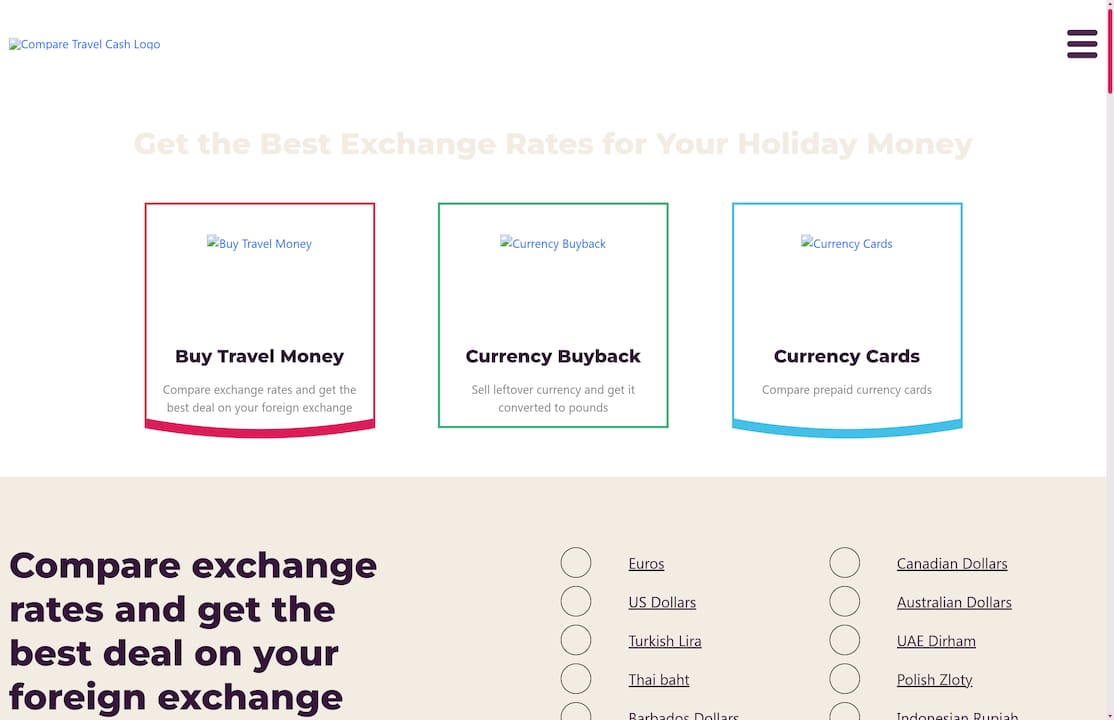
You can compare Hays Travel rates alongside other leading providers, explore currency card deals to find the right prepaid option for your trip, and access more money saving tools including buyback rate comparisons. Checking rates before every trip takes minutes and consistently delivers better value than walking into a bank or bureau de change without doing your research first.
Frequently asked questions
What’s the best way to get travel money for a holiday abroad?
Online providers generally offer better exchange rates than high street options, so comparing rates and ordering currency ahead of travel usually delivers the best value for UK travellers.
Are prepaid travel money cards better than cash?
Prepaid cards are a secure and cost-effective alternative to carrying large amounts of cash, though keeping some cash on hand for emergencies or smaller vendors is still a sensible precaution.
How do I avoid ATM fees overseas?
Careful bank and ATM selection can minimise withdrawal costs. Use cards with no foreign transaction fees and choose ATMs affiliated with major networks rather than standalone tourist-area machines.
Is it cheaper to pay in pounds or local currency when abroad?
Always pay in local currency. Paying in sterling results in worse exchange rates and extra fees through dynamic currency conversion, which is applied at the merchant’s discretion and rarely in your favour.
What hidden travel costs do people usually overlook?
Travel costs extend beyond currency exchanges. Data roaming, dynamic conversion fees, baggage surcharges, tourist taxes, and third-party booking platform charges are among the most commonly missed expenses.
Recommended
- How travel money shapes your budget for international trips
- Best Value Holidays in the Sun
- Travel money explained: Best rates and avoiding fees
- Travel Tips Archives – Compare Travel Cash Blog
- Besparen doe je zo: 8 eenvoudige tips die echt werken
- ¿Cómo hacer un viaje de surf barato en Tenerife? Guía local