A shift of just 2% in the USD exchange rate can cost a UK traveller an extra £100 on a £5,000 holiday budget. Most people never notice until they’re already abroad. Whether you’re heading to New York, Los Angeles, or a road trip across the American South, the rate at which your pounds convert to dollars will shape every purchase you make. This guide breaks down how the USD exchange rate works, what drives it up or down, and how you can make smarter decisions when buying your travel money before you fly.
Table of Contents
- What is the USD exchange rate?
- How is the USD exchange rate set?
- What affects USD/GBP rates for UK travellers?
- How can UK travellers get the best USD exchange rate?
- Our take: What most exchange rate guides miss
- Compare and save on your next USD purchase
- Frequently asked questions
Key Takeaways
| Point | Details |
|---|---|
| Exchange rates fluctuate | Small changes in the USD/GBP rate can affect your travel budget by hundreds of pounds. |
| Spot and retail rates differ | The actual rate you receive is often less favourable than publicised market rates due to provider margins. |
| Compare providers | Shopping around for the best exchange rate and lowest fees can save you money on your next trip. |
| Understand market factors | Interest rates, central bank actions, and global events all influence currency trends. |
What is the USD exchange rate?
The USD exchange rate tells you how many US dollars you receive for each pound you exchange, or conversely, how many pounds it costs to buy one dollar. When people talk about the USD/GBP rate, they’re referring to a currency pair that shows the relative value of the two currencies. For example, if the rate is 1.27, your £100 buys you $127. Simple enough on paper, but the reality for travellers is more complicated.
The rate you see quoted online is usually the mid-market rate, sometimes called the interbank rate or spot rate. This is the midpoint between the buying and selling prices used by banks when trading with each other. It’s the rate you’ll see on Google or XE.com. It is not the rate you’ll get at a bureau de change, a high street bank, or an airport kiosk. Those providers add a markup, which is how they make their money.
Here’s a practical illustration. If the spot rate is 1.27 and your airport bureau applies a 5% margin, you’d receive closer to $120.65 for your £100, not $127. That gap is the provider’s profit. Understanding this distinction is the first step to avoiding unnecessary losses on your travel money.
Our currency exchange options guide covers the different types of providers in detail, but for now, here’s a quick summary of how rates vary:
| Provider type | Typical rate (£100) | Dollars received |
|---|---|---|
| Mid-market (spot) rate | 1.2700 | $127.00 |
| Online specialist | 1.2500 | $125.00 |
| High street bank | 1.2200 | $122.00 |
| Airport bureau | 1.1800 | $118.00 |
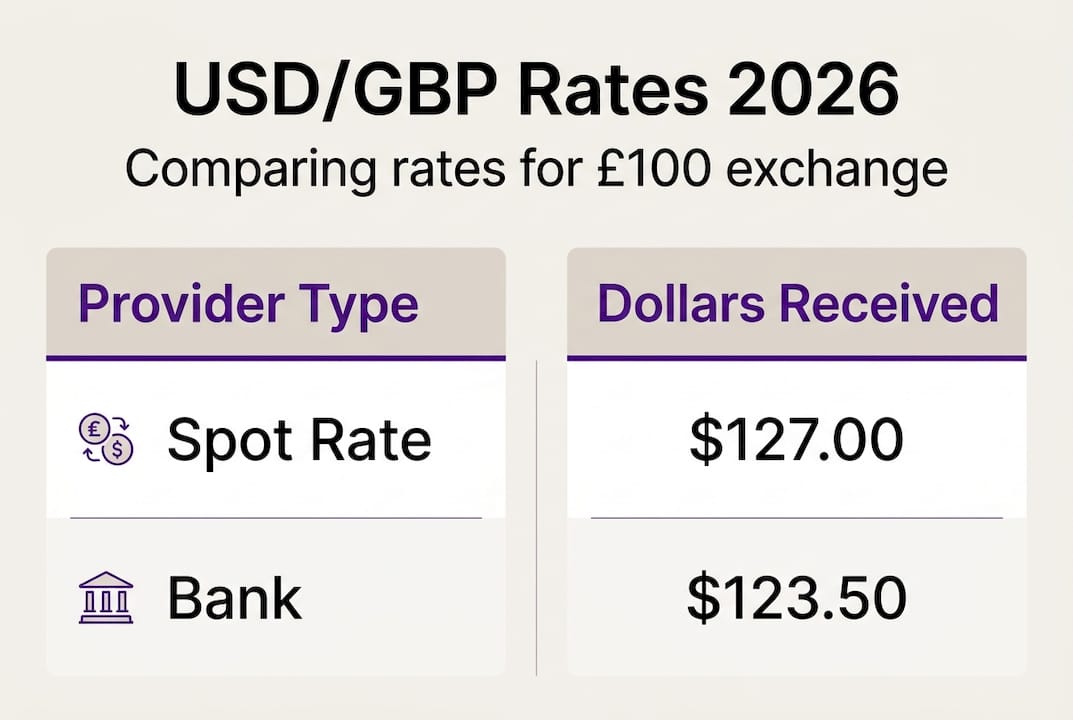
These figures are illustrative, but they reflect real-world differences you’ll encounter.
Some common misconceptions are worth clearing up:
- The rate is the same everywhere. It isn’t. Every provider sets its own rate.
- Today’s rate will still apply tomorrow. Rates move constantly throughout the day.
- All online providers offer near-spot rates. Some do, many don’t. Always check the actual rate, not just the headline figure.
- Commissions are the only extra cost. Markups built into the rate itself often cost more than any visible fee.
Exchange rates are determined in the forex spot market by supply and demand among banks, institutions, and central banks in a decentralised over-the-counter market. That means no single body controls the rate you see.
How is the USD exchange rate set?
With the basics clear, it’s vital to understand why USD exchange rates change and who drives those changes.
The USD/GBP rate is set in the foreign exchange (forex) market, the largest and most liquid financial market in the world. It operates 24 hours a day, five days a week, across major financial centres including London, New York, and Tokyo. Rates are described as floating, meaning they move freely based on supply and demand rather than being fixed by a government.
The forex market processes over $7.5 trillion in daily volume, making it far larger than any stock exchange. This scale means individual trades rarely move the market, but collective sentiment absolutely does.
Here’s how the rate you actually receive is formed, step by step:
- Interbank rate: Major banks trade currencies between themselves at the tightest possible spread. This is the true market rate.
- Wholesale rate: Larger institutions and currency specialists access rates close to the interbank level, with a small margin added.
- Retail rate: Banks, bureaux, and online providers buy currency at wholesale rates, then apply their own markup before selling to you.
- Final quote: The rate displayed to you already includes the provider’s profit margin, whether or not a separate commission is charged.
Several forces push rates up or down. Interest rate decisions from the Bank of England and the US Federal Reserve are among the most powerful. When the Fed raises rates, the dollar often strengthens because investors seek higher returns in dollar-denominated assets. Trade flows, inflation data, and employment figures all play a role too. Understanding how exchange rates impact your travel budget can help you plan more effectively.
Pro Tip: Central bank interventions make headlines, but they rarely shift the USD/GBP rate in ways that matter for a short-term travel money purchase. Focus your energy on understanding currency conversion fees rather than trying to predict central bank moves.
What affects USD/GBP rates for UK travellers?
Understanding the mechanics is key, but what about the factors that make rates rise or fall in the real world?
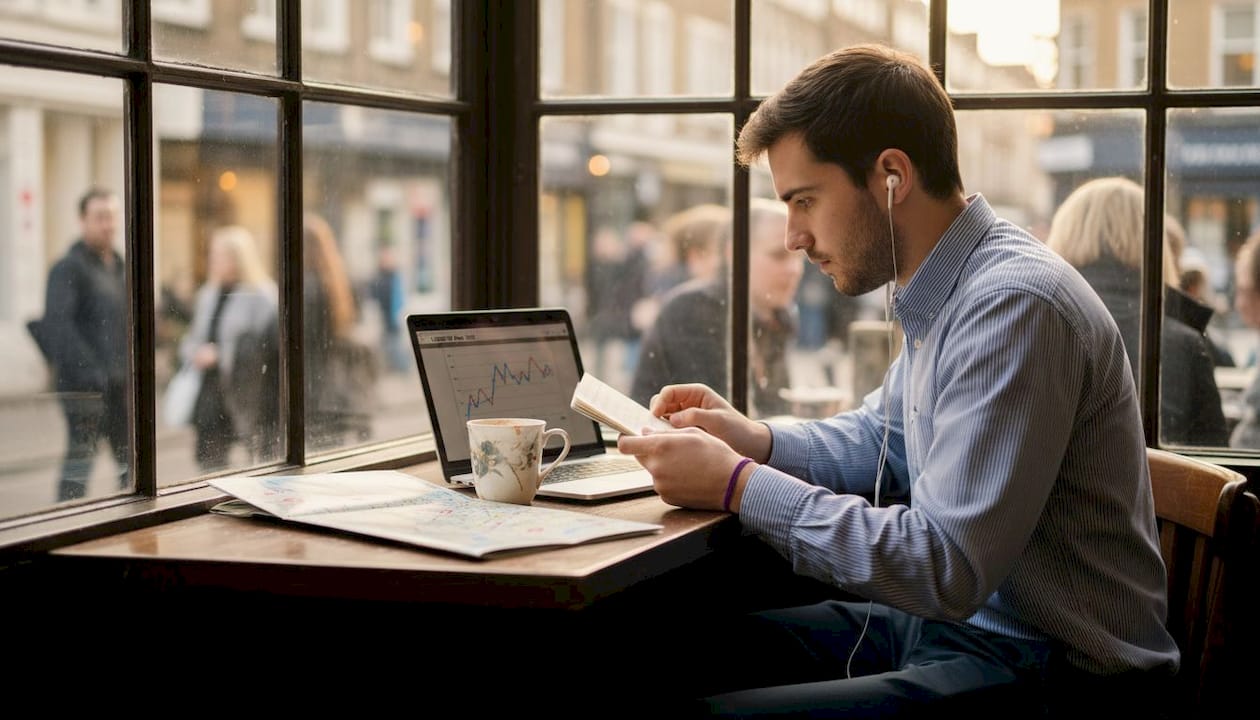
In 2026, the USD/GBP rate has shown monthly volatility of roughly 1 to 4%, with the January benchmark sitting around 1.3536 USD per GBP. That level of movement might sound modest, but for a traveller exchanging £500, a 4% swing means the difference between receiving $677 and $650. That’s $27 fewer dollars in your pocket, simply because of timing.
To put this in concrete terms:
| Rate movement | £500 exchanged | USD received | Difference |
|---|---|---|---|
| Base rate: 1.3536 | £500 | $676.80 | — |
| Rate drops 1% | £500 | $670.03 | -$6.77 |
| Rate drops 2% | £500 | $663.26 | -$13.54 |
| Rate drops 4% | £500 | $650.13 | -$26.67 |
The events that trigger these shifts are varied. Some are predictable, others are not:
- US Federal Reserve interest rate decisions often cause sharp, immediate moves in the dollar’s value.
- UK economic data releases, such as inflation figures or GDP reports, affect pound strength.
- Political headlines, including elections, trade negotiations, or geopolitical tensions, can cause sudden volatility.
- Global risk sentiment, where investors move money into or out of the dollar as a safe-haven currency during uncertain periods.
- Trade flow data, reflecting the balance of imports and exports between the US and UK.
For practical guidance on getting the best USD rates for UK travellers, understanding these triggers helps you recognise when the market might be particularly volatile.
How can UK travellers get the best USD exchange rate?
Armed with knowledge of what moves rates, it’s time to see how travellers can use this information to their advantage.
The good news is that you don’t need to become a forex trader to get a fair rate. You just need to know where to look and what to avoid. Spot rates use bid/ask spreads, and travellers using specialist cards or online platforms often access rates much closer to wholesale levels than those buying cash at a bureau.
Here are the practical steps to follow:
- Compare providers before you buy. Rates vary significantly between banks, online specialists, and airport kiosks. Always check at least three sources.
- Buy online where possible. Online currency providers typically have lower overheads and pass savings on through better rates. Avoid leaving it to the airport.
- Check the all-in rate. Look at what you’ll actually receive in dollars, not just the headline exchange rate. Factor in any delivery fees or minimum order charges.
- Consider a specialist travel card. Many prepaid currency cards and travel-focused debit cards offer rates close to the interbank rate, with no foreign transaction fees. Compare travel cash vs currency card options to find what suits your trip.
- Set a rate alert. Some platforms let you track the USD/GBP rate and notify you when it hits a target level, giving you a chance to buy at a favourable moment.
Pro Tip: Provider margins matter far more than most travellers realise. A provider advertising no commission might still be applying a 4% markup to the rate itself. Always calculate the total dollars you’ll receive per £100 spent, and use that figure to compare deals. You can compare currency card deals and cash options side by side to find the best value.
The best place to buy US Dollar exchange rates will depend on how much you’re exchanging, how soon you’re travelling, and whether you prefer cash or card. Flexibility is your greatest asset.
Our take: What most exchange rate guides miss
After exploring all the practicalities, our experience reveals a few truths most guides skip over.
Most exchange rate articles tell you to watch the market and wait for the right moment. That advice sounds sensible but is largely impractical for the average UK traveller. Timing the forex market is something professional traders struggle with. You’re not going to outmanoeuvre it with a few days of rate-watching before your holiday.
What actually moves the needle is choosing a low-margin provider. The difference between a 1% and a 4% markup on £1,000 is £30. That’s a decent dinner in the US. Focusing on that gap, rather than trying to predict whether the pound will strengthen next Tuesday, is where your energy is best spent.
There’s also a persistent blind spot around the difference between cash, cards, and digital options. Most guides treat them as interchangeable. They’re not. The right choice depends on your destination, your spending habits, and your ability to manage a card abroad. Exploring your currency exchange options properly before you travel is genuinely worth 20 minutes of your time.
As we see it: the best rate is the one that puts more dollars in your pocket, not just the one on the board.
Compare and save on your next USD purchase
Now that you understand how the USD exchange rate works and what to watch out for, the smartest next step is to see what rates are actually available to you right now. Rates change daily, and the gap between the best and worst providers can be surprisingly wide.
At CompareTravelCash.co.uk, you can compare live USD rates from multiple providers in seconds, with no guesswork. Check how Marks and Spencer USD rates stack up against online specialists, or explore prepaid currency cards if you’d rather avoid carrying large amounts of cash. The tools are free, the comparison is instant, and the savings are real.
Frequently asked questions
Why do USD exchange rates change so often?
Rates move because the forex market responds constantly to supply and demand shifts, driven by economic data, interest rate decisions, and global market sentiment. Even minor news events can trigger noticeable movement.
When is the best time to buy US dollars?
There is no single perfect moment, but monthly USD/GBP volatility of 1 to 4% means monitoring trends over a few weeks can help. Choosing a low-margin provider consistently delivers better value than trying to time the market.
Do banks and bureaux de change use the same USD exchange rates?
No. Each provider sets its own rate and margin, so the retail rate differs from spot rates and can vary considerably between a high street bank, an online specialist, and an airport kiosk.
Is it cheaper to buy US dollars online or in person?
Online providers typically offer better rates because their lower overheads allow for tighter margins. Airport bureaux add higher commissions and markups, making them one of the most expensive places to buy travel money.