Two UK travellers exchange £1,000 before a holiday. One visits their high street bank, the other books online through a currency specialist. Same amount, same destination, same day. Yet one walks away with nearly £68 more in foreign currency. That gap is not a fluke. It reflects the very real difference between a careless exchange and a considered one. Assuming rates are roughly similar wherever you go is one of the most expensive mistakes a traveller can make. This guide explains what the ‘best exchange rate’ actually means, how to calculate it, and how to consistently get it before your next trip.
Table of Contents
- What does ‘best exchange rate’ actually mean?
- How to calculate and compare exchange rates
- Best currency exchange options: Cash, cards, apps, and brokers
- Hidden pitfalls: Dynamic currency conversion, weekend markups, and large transfers
- UK expert perspective: What really matters when chasing the best exchange rate
- Compare and secure the best rates with ease
- Frequently asked questions
Key Takeaways
| Point | Details |
|---|---|
| Mid-market benchmark is key | The best exchange rate is closest to the mid-market rate after all fees are included. |
| Compare total costs | Always calculate the full cost including hidden markups and charges, not just headline rates. |
| Digital and online lead | Apps and online services typically offer much better rates than banks, airports, or hotels. |
| Avoid DCC and extra markups | Decline dynamic currency conversion and beware weekend fees and large transfer pitfalls. |
What does ‘best exchange rate’ actually mean?
Most people assume the exchange rate is a fixed number, the same at every bureau de change, bank, or airport kiosk. It is not. Rates vary wildly depending on the provider, the channel, and the moment you exchange. Understanding what is an exchange rate at a fundamental level is the starting point for making smarter decisions.
The fairest benchmark is the mid-market rate, sometimes called the interbank rate. It is the midpoint between the global buy and sell prices for a currency, the number you see if you search on Google or XE.com. No provider gives you this rate. What they give you is that rate minus their margin. But the best exchange rate is defined as the rate closest to the mid-market rate, after accounting for all fees, markups, and spreads.
The gap between mid-market and what you actually receive is the provider’s markup. This is where things get costly. Many travellers focus only on the headline rate displayed in a window or on a website, without realising there may also be a service fee, a delivery charge, or a commission layered on top.
Markup examples across provider types: banks typically charge 3 to 4%, specialist online providers 0.8 to 1%, digital apps such as Wise charge 0.35 to 2%, and airport kiosks charge 5 to 15%.
That 15% airport markup on a £1,000 exchange means you lose up to £150 before your holiday has even begun. Understanding why compare exchange rates is no longer an optional exercise. It is essential.
Factors that define what ‘best rate’ truly means:
- Proximity to mid-market: The closer the offered rate is to the interbank rate, the better the deal.
- All fees included: A great headline rate with a £10 delivery fee or 2% commission may cost more overall.
- Transparency: Reputable providers show the all-in cost upfront. Opaque providers often hide charges in the spread.
- Speed and security: The best rate is useless if the provider is unreliable or the delivery takes too long.
- Channel used: Online specialists, digital banks, high street banks, and airports all operate on different margin structures.
Knowing how to read and compare these factors is the difference between a genuinely good deal and one that merely looks like one. Reading more about avoiding exchange rate fees is a useful next step once you grasp the basics.
How to calculate and compare exchange rates
With an understanding of what makes an exchange rate the ‘best’, let’s look at how you can work this out for yourself—quickly and reliably.
The formula you need is straightforward. To calculate the all-in cost of an exchange, use this approach: all-in cost = (mid-market amount you should receive) minus (actual amount received) plus any fixed fees. This tells you, in plain numbers, exactly how much a provider is taking from you. According to currency conversion methodology, always verify the offered rate against the live mid-market rate and use comparison sites for real-time quotes.
Here is a worked example. Suppose you want to exchange £1,000 into Euros. The mid-market rate is 1.17, meaning you should ideally receive €1,170. Different providers will offer something lower.
| Provider type | Offered rate | Euros received | Markup % | Effective cost vs mid-market |
|---|---|---|---|---|
| Online specialist | 1.160 | €1,160 | ~0.9% | £9 lost |
| Digital app (Wise) | 1.158 | €1,158 | ~1.0% | £10 lost |
| High street bank | 1.130 | €1,130 | ~3.4% | £34 lost |
| Airport kiosk | 1.080 | €1,080 | ~7.7% | £77 lost |
The numbers speak clearly. The airport kiosk costs you over eight times more than an online specialist on the same transaction.
Here is how to run this check yourself, step by step:
- Search Google or XE.com for the current mid-market rate for your currency pair.
- Get a quote from the provider, including any fees or delivery charges.
- Calculate how much foreign currency you will actually receive.
- Subtract that from the mid-market equivalent to find your total loss.
- Divide the loss by the mid-market amount and multiply by 100 to get the markup percentage.
- Repeat for at least two or three providers and compare.
Pro Tip: Never accept the first rate you are offered. Spend five minutes on a multi-provider comparison tool before committing. A short search on getting the best rates could save you a meaningful sum, especially for larger exchanges.
For those securing travel money online, always refresh the rate on the day you plan to exchange, as rates can shift materially overnight. And when you start comparing exchange options side by side, patterns become obvious very quickly.
Best currency exchange options: Cash, cards, apps, and brokers
Once you know how to calculate and compare rates, the next step is to choose the right method for your needs.
Not all exchange channels suit every situation. A family collecting Euros for a fortnight in Spain has different requirements from a solo traveller spending across multiple Asian countries with a mix of cash and card transactions.
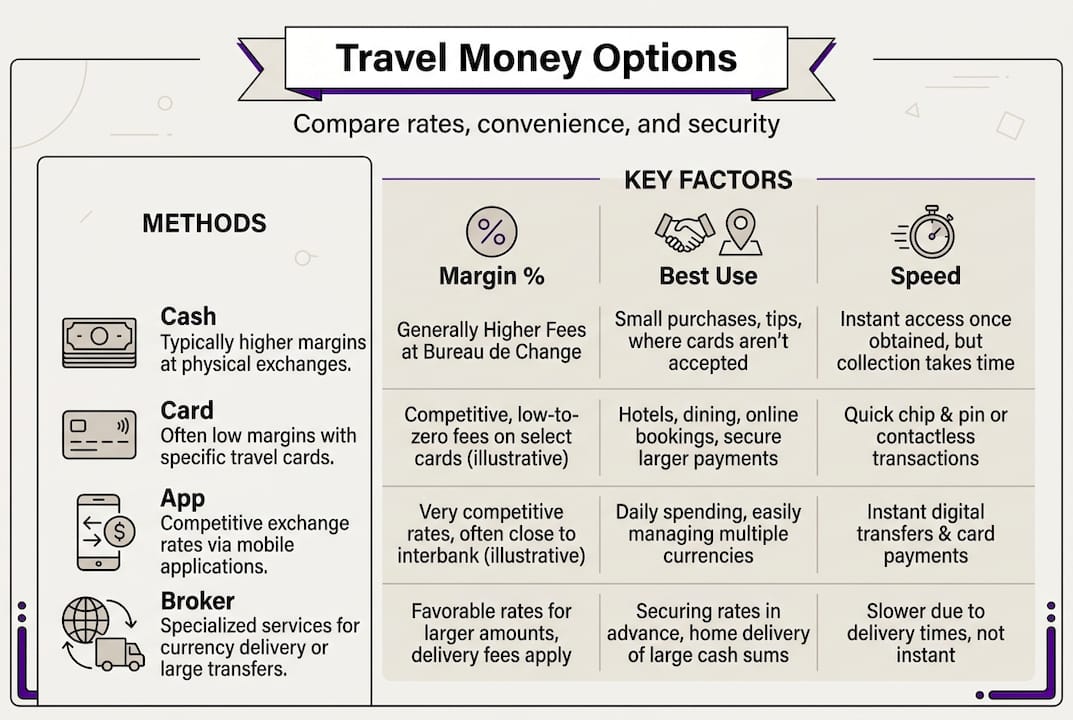
| Method | Typical margin | Convenience | Best use case |
|---|---|---|---|
| Online currency specialist | 0.8 to 1% | Moderate (delivery needed) | Bulk cash before travel |
| Digital bank or app (Wise, Revolut, Starling) | 0.35 to 2% | High | Everyday card spend abroad |
| High street bank | 3 to 4% | High | Convenient but costly |
| Airport or hotel kiosk | 5 to 15% | Very high | Emergency use only |
| Currency broker (large sums) | 0.1 to 0.6% | Lower | Transfers above £10,000 |
The real-world impact of these differences is stark. A mystery shop converting €600 found that top online providers cost around £525, high street banks ranged from £555 to £563, and airport exchanges reached £593. That is a £68 difference on a single transaction.
Quick breakdown of the key options:
- Online specialists such as TravelFX and the Post Office click and collect service offer competitive cash rates and are best booked a few days ahead of travel.
- Digital apps like Wise, Revolut, and Starling Bank track close to mid-market for card transactions but may apply weekend fees or monthly limits.
- High street banks are familiar but consistently among the most expensive channels for travel money.
- Airport kiosks should be treated as a last resort. Their convenience carries a very high cost.
- Currency brokers are ideal for large transfers, offering margins that banks simply cannot match.
Pro Tip: Use a card or digital app for the majority of your spending abroad, and carry only a small amount of well-sourced cash for markets, taxis, or destinations where cards are less accepted. This hybrid approach, covered in more detail when avoiding travel money fees, balances cost with practicality.
For a fuller breakdown of all the available currency exchange options suited to UK travellers, including prepaid cards and buyback deals, it is worth exploring each category before you commit.
Hidden pitfalls: Dynamic currency conversion, weekend markups, and large transfers
Even the savviest traveller can get caught out by a few less-visible tricks. Here are the most costly ones, if you do not know them.
The most common trap is Dynamic Currency Conversion, or DCC. This happens at card terminals or ATMs abroad when the machine offers to charge you in your home currency (pounds) rather than the local currency. It sounds helpful. It is not. The merchant applies their own exchange rate, which adds 5 to 13% to the transaction. Always choose to pay in the local currency. Always.
DCC example: a £100 purchase processed through a merchant rate can cost 5 to 7% more. On a two-week holiday with £2,000 in card spend, that is up to £140 lost to a single easily avoided choice.
The second pitfall is weekend and public holiday markups. Some digital apps, including Revolut’s free plan, freeze their exchange rates over weekends and apply a 1% surcharge. The free monthly limit before that fee kicks in is £1,000 per month. If you exchange on a Friday evening or a bank holiday, you may pay more than you expect. A quick check of your provider’s terms before you travel sidesteps this issue.
Third, large sums deserve a different approach entirely. Sending or converting more than £10,000 through a standard bank is genuinely costly. Banks charge 3 to 4% on these sums. Specialist currency brokers typically charge just 0.1 to 0.6%, a difference that on a £50,000 transfer could mean saving over £1,500. There are further currency exchange tips worth reading if you are managing a property purchase or large international payment.
Common pitfalls to avoid:
- DCC at terminals or ATMs: Always decline and pay in local currency.
- Weekend exchanges on digital apps: Check your provider’s weekend rate policy before travelling.
- Walking into a bank for a large transfer: Use a broker for anything over £10,000.
- Assuming 0% commission means no fees: The cost is often hidden in a worse exchange rate.
- Leaving exchange to the airport: Lock in your rate before you travel, always.
For a more thorough guide to sidestepping these traps, the section on avoiding travel money pitfalls covers each of these scenarios in detail.
UK expert perspective: What really matters when chasing the best exchange rate
With all this detail, let’s take a step back and look at what really matters for UK travellers on the ground.
Here is something most rate comparison guides will not tell you: the difference between a 0.9% markup and a 1.1% markup on a £500 exchange is about £1. Chasing marginal gains is worthwhile when you are exchanging large sums. On a modest holiday budget, though, obsessing over fractions of a percentage point can distract from bigger decisions.
The travellers who genuinely save the most money are not those who spend hours hunting for the perfect rate. They are the ones who avoid the worst options consistently. Skip the airport. Do not use your high street bank without checking first. Decline DCC every single time. These three habits alone can save a typical UK family hundreds of pounds each year.
Security and peace of mind also matter. A slightly higher rate from a provider you trust, with clear customer support and a reliable delivery record, is often a better choice than a marginally cheaper deal from an unfamiliar source.
Our view is that a hybrid approach works best for most trips: a modest amount of top-rate cash sourced online before departure, paired with a low-fee card or app for everyday spending. You can read more about putting this into practice in our guide to travel money tips. Get the big decisions right, and the small optimisations will take care of themselves.
Compare and secure the best rates with ease
Ready to put your knowledge into action? Find, compare, and secure the best rates in minutes.
Now that you know what to look for, the next step is straightforward. CompareTravelCash.co.uk brings together live rates from multiple trusted providers in one place, so you are not spending hours on separate websites.
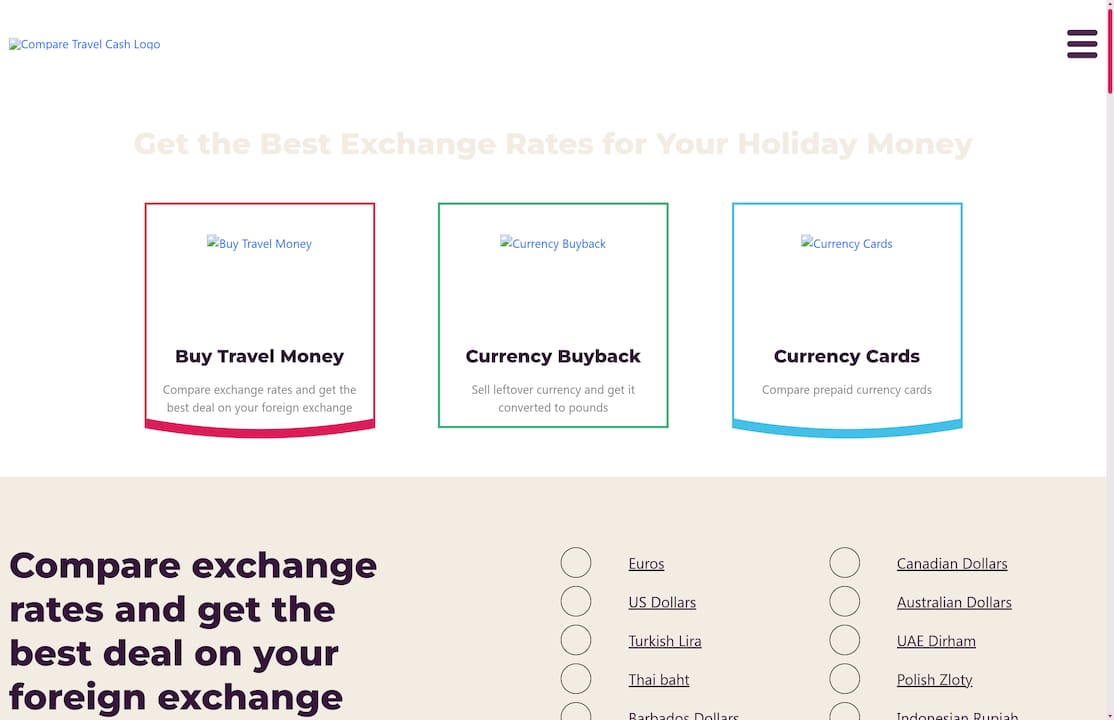
You can compare exchange rates for travel cash and find the best deal before you buy. If you prefer the convenience of a card abroad, our tool lets you compare currency cards side by side. Coming home with leftover currency? Check currency buyback rates to make sure you get a fair price for what you bring back. One platform, all your options, no guesswork.
Frequently asked questions
What is the ‘mid-market’ rate and why does it matter?
The mid-market rate is the average of global buy and sell prices used by banks as the baseline for currency trading. It matters because the best exchange rate is defined as the one closest to it, making it the fairest benchmark for comparing what providers offer you.
How can I check if a provider’s exchange rate is a good deal?
Look up the current mid-market rate on Google or XE.com, then compare it to the provider’s offered rate. Factor in all fees to calculate the true cost, and use comparison sites for real-time quotes to check multiple providers at once.
Is it ever safe to use airport or hotel exchange services?
Only in genuine emergencies. Airport and hotel kiosks typically apply markups of 5 to 15% above mid-market, meaning you could lose £50 to £150 on a £1,000 exchange compared to booking online before you travel.
What’s the best way to exchange a large amount (over £10,000)?
Specialist currency brokers are far more cost-effective for large sums. They typically charge 0.1 to 0.6% compared to banks at 3 to 4%, which can represent a saving of thousands of pounds on significant transfers.
Recommended
- Travel money exchange: How UK travellers get the best rates
- Compare currency exchange options: a guide for UK travellers
- How exchange rates affect your travel budget: UK guide
- Foreign exchange explained: get the best rates for your holiday
- Trusted home exchange: swap safely for affordable travel | Swap Space Blog