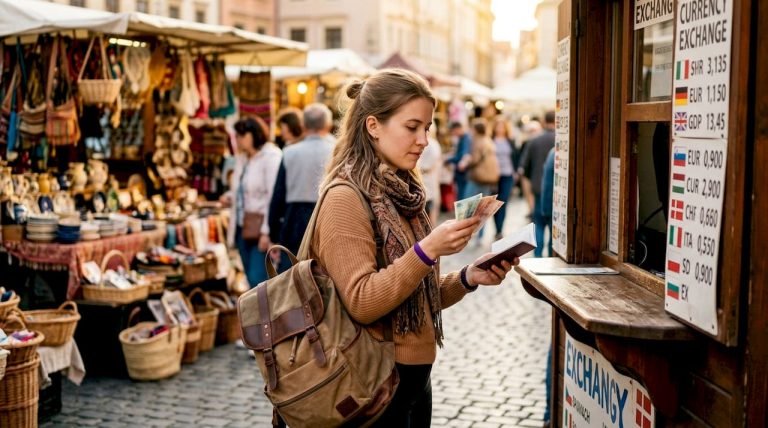
Most travellers spend hours hunting for the best exchange rate and almost no time thinking about security. That’s a costly oversight. The role of security in currency exchange goes well beyond a locked door at a bureau de change. It covers everything from armed robbery at physical counters to card fraud on public Wi-Fi and counterfeit notes slipped across a desk. Understanding these risks, and knowing how to guard against them, is as important as finding a competitive rate before you fly.
Physical security risks at exchange points
When most people think about protecting currency transactions, they picture online threats. Physical risks are just as real and arguably more immediate when you’re abroad.
Armed robbery at exchange counters does happen. In one reported case, two masked men robbed a currency exchange dealer of nearly ₹25.90 lakh in broad daylight. That kind of incident is a reminder that the moment you’re standing at a counter with a visible wad of foreign currency, you become a target. The risk isn’t limited to the exchange desk itself. Thieves often watch travellers leave and follow them.
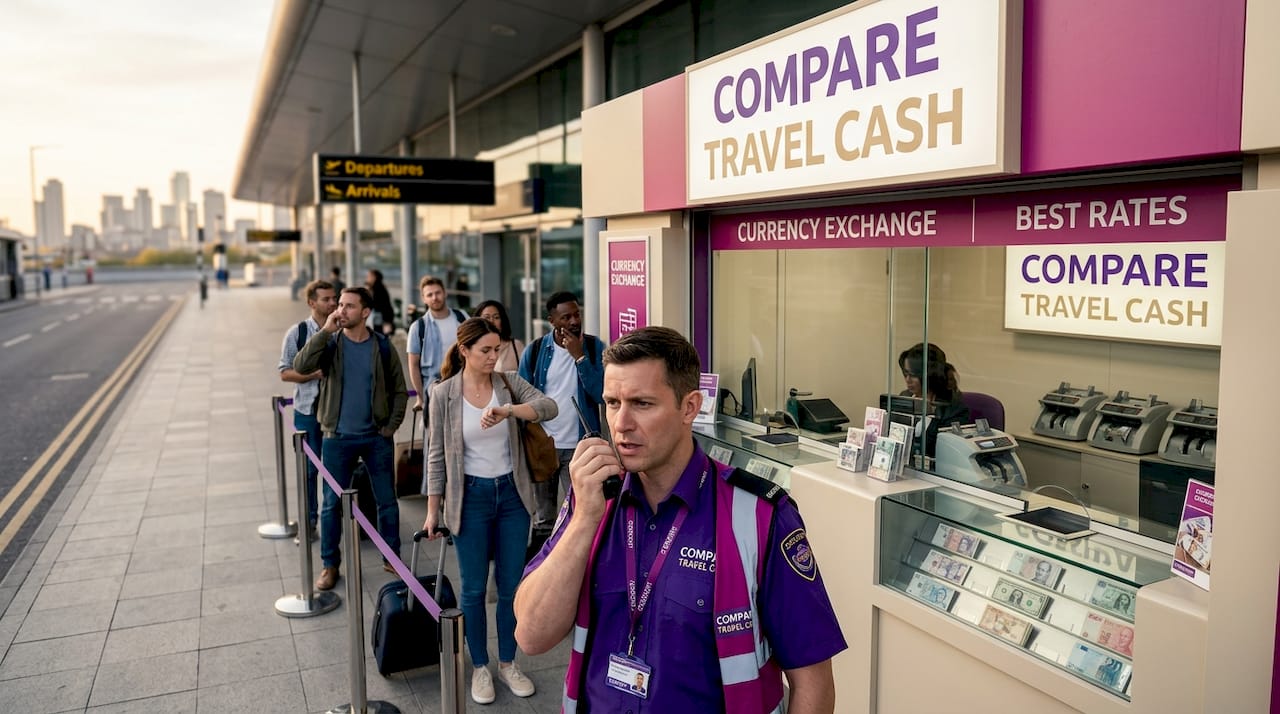
Counterfeit notes are another underappreciated hazard. Counterfeit currency risks remain very real in tourist-heavy areas, as a case involving 96 fake 100-yuan banknotes in Jeju City demonstrated. A tourist unknowingly attempted to exchange forged notes worth around $1,600. If a fraudulent note reaches your hands, the loss is yours.
Here’s what raises your physical risk at exchange counters:
- Using unlicensed or street-based exchange operators, particularly in markets or tourist zones
- Conducting large exchanges in open, unsecured public spaces
- Counting notes visibly in crowded areas after an exchange
- Accepting notes without checking for basic security features
- Exchanging money at irregular hours when proper supervision is reduced
Pro Tip: Exchange only what you need for the first day or two on arrival. Carrying large amounts of local currency immediately after landing makes you conspicuous. Use a secure money exchange guide to plan ahead.
Always use regulated, supervised exchange providers. Reputable bureaux de change and bank-affiliated counters operate in monitored environments, which deters opportunistic theft and reduces the chance of counterfeit notes entering the transaction.
Digital security measures for travellers
Physical threats are visible. Digital threats are not, which makes them harder to defend against instinctively.
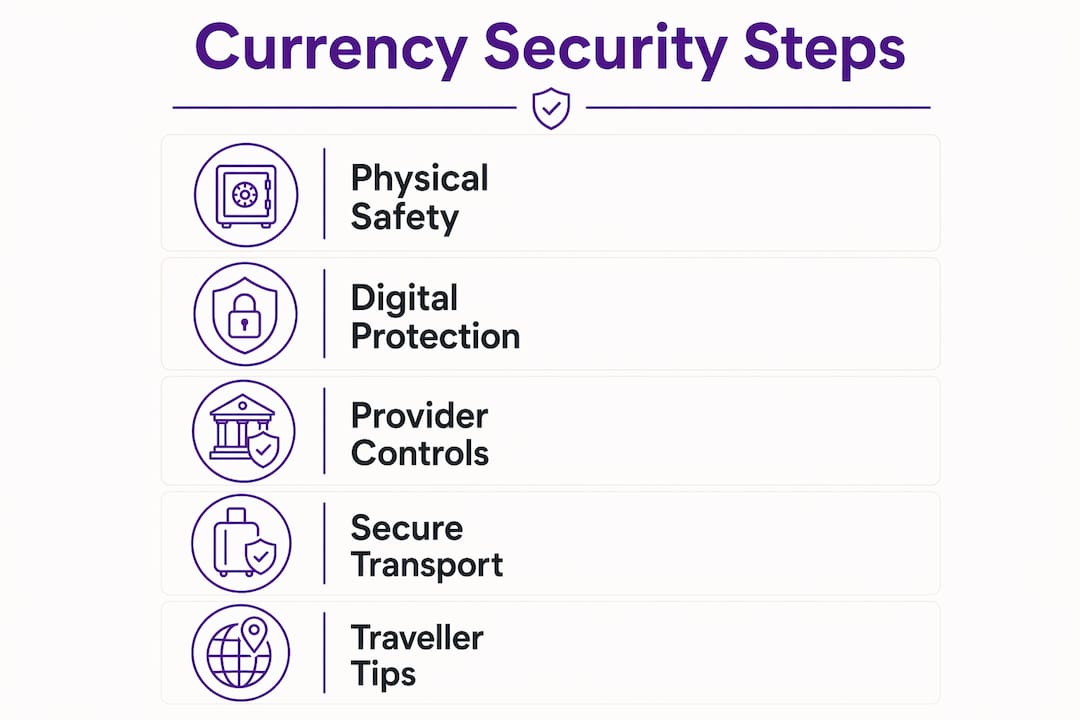
CNBC recommends enabling multi-factor authentication (MFA), setting up real-time transaction alerts, using a VPN on public networks, and choosing credit cards over debit cards as core travel money security practices. These aren’t optional extras. They’re the baseline for protecting your accounts while abroad.
Here’s why each one matters in practice. MFA adds a second verification step to every login, so a stolen password alone isn’t enough to access your account. Real-time transaction alerts narrow the fraud window dramatically, letting you spot an unauthorised charge within seconds rather than discovering it on a statement weeks later. A VPN encrypts the connection between your device and the internet, which is critical when using the hotel or airport Wi-Fi that thousands of strangers also use.
The choice between credit and debit cards isn’t minor either. In the UK, credit cards provide Section 75 protection on purchases over £100, and most providers offer strong fraud liability limits. Debit cards draw directly from your account, meaning stolen funds come out of your own balance immediately and recovery can take days.
- Enable MFA on your banking and travel money apps before you depart
- Set up real-time transaction alerts via SMS or push notifications
- Use a VPN whenever you access financial accounts on shared or public Wi-Fi
- Notify your bank of your travel dates and destinations in advance
- Know how to instantly freeze your card through your provider’s app
Pro Tip: Set up a dedicated travel account or prepaid currency card with a daily spending cap. If that card is compromised, your main savings remain untouched.
Knowing how to buy currency safely online before your trip also removes a significant digital risk. Ordering from regulated providers on a secure connection, rather than searching for deals on the fly from a hotel lobby, reduces your exposure considerably.
How exchange providers protect your data
The security controls that reputable exchange providers operate in the background aren’t visible to you as a customer, but they’re worth understanding. Knowing what a trustworthy provider actually does gives you a clearer basis for choosing one.
Providers protect customer identity through direct document verification, controlled internal access, and supervised counter environments. That means the person serving you at the counter is not the only safeguard. Systems are structured so that different staff members have access only to the data they specifically need to complete a transaction. This is known as role-based access control, and it significantly limits the opportunity for internal fraud.
| Security practice | What it means for you |
|---|---|
| Identity verification at the counter | Confirms you are who you say you are, reducing impersonation fraud |
| Role-based internal access | Staff see only the data needed for their role, limiting internal leaks |
| Supervised physical environment | Monitored counters deter opportunistic theft and misconduct |
| Cash handling protocols | Structured procedures reduce errors and prevent cash interception |
| Regulatory compliance checks | Licensed providers must meet anti-money-laundering and fraud standards |
Role-based access to transaction records is a control that many travellers never think about, yet it’s one of the most effective internal fraud prevention measures in regulated exchanges. Combining that with physical supervision of counter staff means that both your identity data and your cash are handled with structured oversight, not just goodwill.
Regulatory compliance is the final layer here. Licensed exchange providers in the UK must register with the Financial Conduct Authority and comply with anti-money-laundering regulations. That creates procedural accountability that unregulated providers simply don’t have.
How cash moves securely before it reaches you
The security chain for currency exchange doesn’t start at the counter. It starts much earlier, when physical cash is transported from vaults and central banks to exchange locations.
Cash transport security relies on multiple integrated layers. These include reinforced secure containers, carefully planned vehicle logistics, and active anti-tamper technologies that protect cash even if a transport vehicle is intercepted. One such technology is ink protection, sometimes called SQUID Ink Protection, which permanently stains banknotes if a container is tampered with. Stolen cash becomes unusable after the ink system activates, removing the financial incentive for theft entirely.
Why does this matter to you as a traveller? Because the notes you receive at a legitimate exchange provider have been through a verified chain of custody. When you use unlicensed operators or accept cash from informal sources, that chain breaks down. The physical integrity of banknotes, and the assurance that they haven’t been substituted or tampered with, depends on this behind-the-scenes infrastructure.
The key protections in the transport chain include:
- Reinforced containers with tamper-detection mechanisms
- GPS-tracked vehicles with covert monitoring
- Active ink protection systems on cash packages
- Strict chain-of-custody records for every denomination transferred
- Regular auditing against declared stock levels
Physical cash security is therefore about more than the exchange moment. The entire transport and storage chain contributes to the integrity of the currency you ultimately receive.
Practical steps to protect your money abroad
Knowing the theory is useful. Knowing what to actually do before and during your trip is what makes the difference.
Start before you travel. Research your exchange provider and confirm they are regulated. Comparetravelcash allows you to compare rates from verified UK providers, so you’re not guessing at credibility. Check tips for exchanging money abroad to familiarise yourself with common traps and how to avoid them.
A security-by-containment strategy limits your losses by ensuring that any single compromised account or stolen wallet does not expose your entire travel budget. Split your funds across a primary card, a backup card, and a small amount of local cash. Cap daily withdrawal limits on your travel account.
Here’s a practical checklist to follow:
- Verify that your exchange provider is FCA-regulated before booking
- Order travel money in advance from a trusted online provider on a secure connection
- Enable MFA and real-time alerts on all banking apps
- Notify your bank of your itinerary so legitimate transactions aren’t blocked
- Set a daily withdrawal cap on any travel or prepaid card you carry
- Carry only the cash you need for that day. Store the rest securely at your accommodation
- Check notes for security features when receiving currency at any counter
- Avoid exchanging money in unsupervised, informal settings or from street traders
Pro Tip: If your travel involves multiple currencies, a prepaid multi-currency card lets you load specific amounts per currency. Your exposure is capped by design, not by discipline.
My take on where travellers go wrong
I’ve seen the same pattern repeat itself. Travellers agonise over finding a rate that’s 0.5% better, then stand at a busy airport counter counting out a significant sum of cash in full view of everyone around them. The financial gain from the better rate is real. The security risk of that moment is equally real, and far less thought about.
What I’ve found is that most people treat security as a single checkpoint. They think “I’m using a reputable provider, I’m fine.” But the importance of security in exchanges is that it operates across multiple points simultaneously. Your behaviour at the counter, your digital habits before you travel, the provider you choose, and even the transport chain behind the scenes all contribute.
The travellers who handle this well aren’t necessarily more security-conscious by nature. They’ve simply learned that the protections aren’t automatic. Combining verified providers with digital safeguards and sensible physical habits closes the gaps that theft and fraud exploit.
The uncomfortable truth is that most incidents are preventable with basic preparation. Not expensive preparation. Not technical preparation. Just the awareness that currency exchange, at every stage, carries risk that rewards a small amount of planning.
— Jason
Compare providers before you travel
Choosing the right exchange provider is one of the most practical steps you can take to protect your travel money. Comparetravelcash makes that comparison straightforward, showing rates and provider details from regulated UK suppliers side by side.
Whether you want to check the rates at Hays Travel or browse the full range of travel money providers, you can do so from home, on a secure connection, before your trip begins. The platform also compares prepaid currency cards, so you can find an option that builds security into your spending by design. Comparing providers in advance doesn’t just save money. It means you arrive with a verified, regulated supplier already chosen, rather than making that decision under pressure at the airport.
FAQ
What is the role of security in currency exchange?
Security in currency exchange protects travellers from physical theft, counterfeit currency, fraud, and data theft across every stage of a transaction. It covers provider practices, traveller behaviour, digital safeguards, and the physical transport chain behind the cash.
How do I know if a currency exchange provider is secure?
Check that the provider is registered with the Financial Conduct Authority (FCA) in the UK. Regulated providers must follow anti-money-laundering rules, verify customer identity, and maintain supervised transaction environments.
What are the biggest security risks when exchanging currency abroad?
The main risks include robbery at or near exchange counters, receiving counterfeit notes, card fraud on unsecured networks, and data theft through unregulated providers. Using FCA-regulated suppliers and enabling real-time transaction alerts reduces exposure to all of these.
Are prepaid travel cards safer than carrying cash?
Yes, in most cases. Prepaid cards let you cap your exposure to a fixed amount, and most can be frozen instantly if lost or stolen. They also remove the risk of carrying large amounts of visible cash in tourist areas.
Is it safe to buy travel money online?
Buying from an FCA-regulated provider via a secure connection is safe and often more convenient than exchanging at an airport. Avoid using public Wi-Fi when completing the transaction, and always confirm the provider’s registration before paying.