Rate alerts in travel money are automated notifications that trigger when a currency pair reaches your chosen exchange rate target, so you can convert or buy foreign currency at a favourable moment rather than checking rates manually every day. The role of rate alerts in travel money has grown considerably as providers like Wise and XE have built these tools directly into their apps, making currency exchange tracking accessible to any UK traveller with a smartphone. For anyone buying euros, US dollars, or Thai baht before a holiday, these alerts represent a genuine shift in how you approach the foreign exchange market. Instead of guessing when to buy, you set a target and let the market come to you.
How do rate alerts work for UK travellers?
A rate alert is set by choosing a currency pair, such as GBP to EUR, and entering the exchange rate you want to achieve. When the market reaches that level, the service sends you a notification. XE’s rate alerts are designed precisely for this purpose, delivering push notifications or email alerts once your target rate is met, so you can then initiate a transfer or purchase manually.

Wise takes the concept a step further with its Auto Conversions feature. Rather than simply notifying you, Wise’s Auto Conversions automatically convert your money when the rate hits or exceeds your target. This removes the need to act quickly after receiving a notification, which matters when rates move fast and you are at work or asleep.
The most common currency pairs UK travellers track include:
- GBP/EUR for European holidays
- GBP/USD for the United States and the Caribbean
- GBP/TRY for Turkey
- GBP/THB for Thailand
- GBP/AED for Dubai
Notification methods vary by provider. XE uses email and push notifications. Wise sends in-app alerts and can act automatically. Some services also offer SMS alerts, though these are less common. The key point is that rate alerts remove guesswork from currency buying decisions, replacing daily manual checks with a single, purposeful setup.
Pro Tip: Set your target rate slightly above the current mid-market rate rather than aiming for an unrealistic peak. A modest improvement on today’s rate is far more likely to trigger within your booking window than a record high.
What savings do rate alerts offer over traditional options?
The financial case for using rate alerts becomes clear when you compare typical travel money options side by side. Airport bureaux de change in the UK charge approximately 5 to 15% above the mid-market rate. That means on a £500 currency purchase, you could lose between £25 and £75 before you have even boarded your flight.
| Travel money method | Typical margin above mid-market | Rate alert compatible? |
|---|---|---|
| Airport bureau de change | 5–15% | No |
| High-street bureau de change | 3–8% | No |
| Pre-ordered online cash | 1–2% | Partially |
| Specialist travel debit card | 0–1% | Yes (via app alerts) |
| Online transfer (e.g. Wise) | 0.4–1% | Yes (Auto Conversions) |
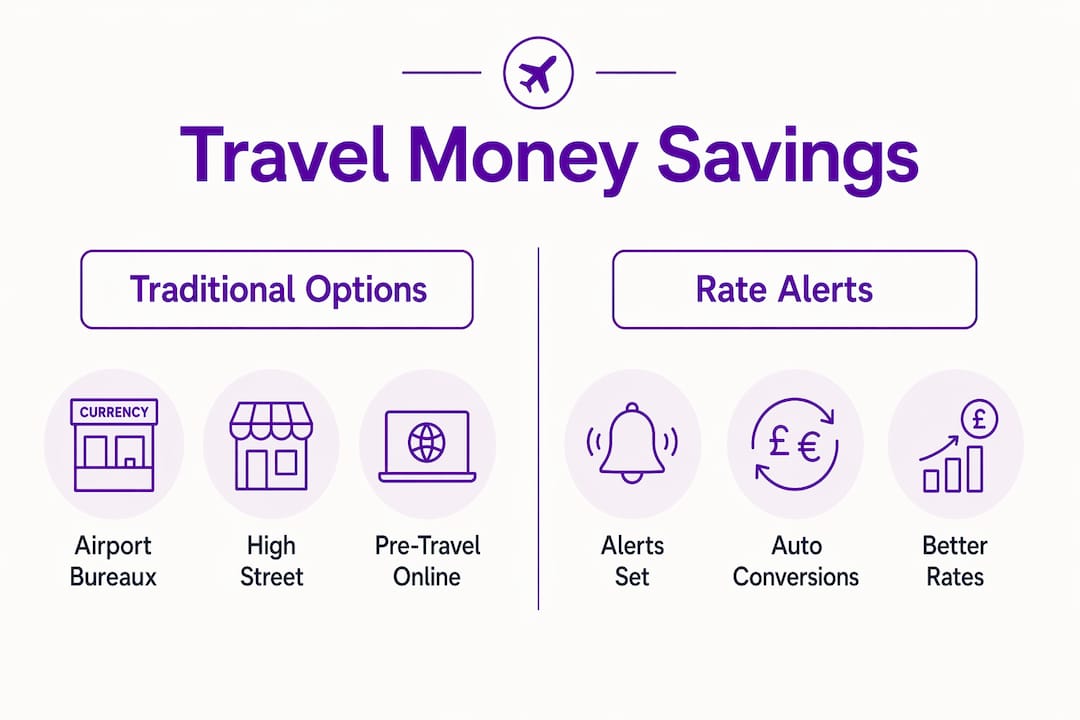
Pre-travel online currency ordering already delivers better rates. Online orders typically charge 1 to 2% above mid-market compared with the airport’s 5 to 15%, which is a meaningful saving. When you combine online ordering with a rate alert, you also gain timing control, buying when the market is in your favour rather than when your departure date forces your hand.
Rate alerts also protect you from captive pricing. The closer you get to your travel date, the fewer options you have and the more leverage providers hold over you. Avoiding last-minute airport exchanges by securing currency in advance at a rate you chose is one of the most straightforward ways to protect your travel budget. Understanding why competitive exchange rates matter for UK travellers makes the case even clearer.
Pro Tip: If you are travelling to a eurozone country, set your GBP/EUR alert at least six to eight weeks before departure. This gives the market enough time to move in your favour without cutting it too close.
Are all rate alerts the same? Key differences between providers
Not all travel money rate notifications are built equally, and the differences between providers can affect both your savings and your convenience. The table below summarises the key features of the two most prominent alert services available to UK travellers.
| Feature | Wise | XE |
|---|---|---|
| Alert type | In-app notification | Email and push notification |
| Auto conversion | Yes (Auto Conversions) | No, manual action required |
| Mid-market rate used | Yes | Yes |
| Linked to debit/transfer | Yes, direct transfer | Yes, via XE transfer service |
| Mobile app | iOS and Android | iOS and Android |
| Alert customisation | Rate and amount | Rate only |
| Free to use | Yes | Yes |
The most significant distinction is execution speed. Wise supports Auto Conversions while XE requires manual transfer initiation after the alert fires. If you receive an XE alert at 3am and the rate moves back before you wake up, you miss the window entirely. Wise’s automated approach closes that gap.
Both services use the mid-market rate as their reference point, which is the fairest benchmark available. The mid-market rate is the midpoint between the buy and sell prices on global currency markets. It is the rate you see on Google or Reuters, and it is the rate that specialist providers like Wise use as their baseline before adding a small, transparent fee. High-street bureaux and airport kiosks do not disclose their markup in the same way, which makes comparison harder and the cost easier to overlook.
For travellers who want to understand how international money transfers work alongside rate alerts, the mechanics of currency conversion and transfer fees are worth understanding before you commit to a provider.
Best practices for using rate alerts on your next trip
Getting the most from currency exchange rate tracking requires more than simply switching on an alert and waiting. These five practices will help you use alerts more effectively.
-
Research recent rate history before setting your target. Look at the GBP/EUR or GBP/USD rate over the past three months. Setting a target rate that the market has not reached in six months is unlikely to trigger before your holiday. Use XE’s historical charts or Google Finance to find a realistic but favourable level.
-
Set alerts across multiple providers simultaneously. Wise and XE both offer free alerts. Running both means you get a second opinion on rate movements and a backup if one service has a technical issue. You are not committed to converting through either until you choose to act.
-
Activate alerts at least four to six weeks before travel. Currency markets move daily, but meaningful shifts in GBP pairs often take weeks to develop. Starting early gives your target rate a realistic chance of being reached. Tracking exchange rates early is consistently cited as one of the most effective ways to secure better travel money deals.
-
Account for fees and transfer times when acting on an alert. When a notification arrives, do not just look at the exchange rate. Check the transfer fee, the amount you will receive after conversion, and how long the transfer or delivery takes. A slightly lower rate with no fee can beat a higher rate with a £5 charge on smaller amounts.
-
Combine alerts with a travel money comparison tool. Rate alerts tell you when the market is favourable. A comparison tool tells you which provider offers the best deal at that moment. Using both together, as Comparetravelcash recommends when getting the best rates, gives you both timing and provider advantage simultaneously.
Pro Tip: If you are using Wise’s Auto Conversions, make sure you have funded your Wise account in advance. The automatic conversion only works if the balance is already there when the rate triggers.
Why I think rate alerts are underused by most UK travellers
Most UK travellers still buy their currency at the airport or on the high street, often within days of departure. I understand the appeal. It feels simple and familiar. But the cost of that convenience is real, and it is largely avoidable.
What strikes me most about rate alerts is not the technology itself but the behavioural shift they represent. Automating currency monitoring turns a passive traveller into someone who is actively, if effortlessly, participating in the foreign exchange market. You are no longer at the mercy of whatever rate happens to be on the board when you arrive at the airport. You have already made your decision at a time and rate that suited you.
The one caveat I would add is that an alert without a fast execution pathway is only half the solution. If you receive a notification and cannot act on it for several hours, the rate may have already moved. This is why Wise’s Auto Conversions feature represents a genuine step forward compared to alert-only services. The true effectiveness of rate alerts comes from coupling them with immediate execution, not just awareness.
My advice: set up alerts now, even if you are not travelling for months. The habit of monitoring rates early is one of the simplest and most underrated ways to protect your travel budget. Pair that with a comparison tool and you are in a far stronger position than the majority of travellers who walk up to an airport kiosk and accept whatever rate they are given.
— Jason
Find the best travel money rates with Comparetravelcash
Rate alerts tell you when the market is right. Comparetravelcash tells you which provider to use when it is.
Comparetravelcash aggregates live travel money rates from providers across the UK, so you can see at a glance who is offering the most competitive deal at any given moment. Whether you are buying euros for a European city break or US dollars for a transatlantic trip, comparing rates before you buy is just as important as timing your purchase well. Check the latest rates from Hays Travel or browse the full travel money comparison tool to see current rates from multiple providers side by side. Combining a well-timed rate alert with the right provider is the most effective approach available to UK travellers today.
FAQ
What is the role of rate alerts in travel money?
Rate alerts notify you when a currency pair reaches your chosen exchange rate, allowing you to buy foreign currency at a favourable moment rather than accepting whatever rate is available at the time of purchase. They replace daily manual monitoring with a single automated trigger.
How do I set up a rate alert for travel money?
You can set up rate alerts through providers like Wise or XE by selecting a currency pair, entering your target rate, and choosing your preferred notification method such as email or push notification. Both services are free to use and available on iOS and Android.
Are Wise rate alerts better than XE rate alerts?
Wise offers Auto Conversions, which automatically converts your money when the target rate is reached, while XE requires you to act manually after receiving the alert. For travellers who cannot respond immediately to notifications, Wise’s automated approach offers a practical advantage.
Can rate alerts help me avoid airport bureau de change fees?
Yes. By securing your currency in advance at a target rate through an online provider, you avoid the 5 to 15% markup that airport bureaux de change typically charge above the mid-market rate. The saving on a £500 purchase can be between £25 and £75.
Should I use rate alerts alongside a travel money comparison tool?
Using both together gives you the best outcome. Rate alerts optimise your timing by flagging when the market is favourable, while a comparison tool like Comparetravelcash identifies which provider offers the best rate at that moment, so you benefit from both timing and provider selection.