Travel money insurance is defined as the section of a travel insurance policy that covers financial losses from stolen, lost, or damaged cash and monetary instruments while you are abroad. Most UK travellers assume their policy covers everything in their wallet. The reality is far more restrictive. This guide to insuring travel money UK sets out exactly what your policy covers, where the gaps are, and how to protect your funds before and during your trip.
What does UK travel insurance actually cover for travel money?
Travel insurance policies in the UK treat “money” and “cash” as two separate categories, and the distinction matters enormously when you make a claim. Policy definitions differ: “money” typically includes traveller’s cheques, prepaid cards, and vouchers, while “cash” refers strictly to banknotes and coins. Cash coverage is almost always lower and subject to tighter conditions.
The numbers tell a clear story. Just over a third (35%) of UK travel insurance policies cover cash losses of £200–£299, and 24% cover £300–£399. Very few policies go higher. That means if you carry £600 in euros and it is stolen, you may recover less than half. The sub-limit is not a technicality. It is a hard ceiling on your payout.

On top of sub-limits, standard excess charges range from £50 to £150 on cash claims. If your policy has a £100 excess and a £250 sub-limit, a £300 cash theft nets you just £150. That is the real-world arithmetic most travellers do not calculate before they travel.
Key exclusions to know before you travel:
- Emergency cash advances are covered by only around 2% of policies, making them an unreliable safety net.
- The alcohol clause voids your claim entirely if the insurer determines you were under the influence when the loss occurred. This clause applies even if you were not legally intoxicated for driving purposes.
- Losses from unattended luggage or cash left in an unsecured location are routinely excluded.
- Gradual loss (money that disappears over time rather than in a single incident) is almost never covered.
Pro Tip: Read the “money” section of your policy document, not just the summary. The summary often lists the headline figure; the full wording contains the sub-limits and exclusions that determine your actual payout.
How to protect your travel money and reduce risk abroad
Physical cash is a high-risk asset. Travel experts advise treating it as such and building habits that both reduce loss and protect your right to claim if something goes wrong.
Follow these steps to keep your funds secure:
- Use the hotel safe every time. Many insurers require that valuables, including cash, are secured in a hotel safe if one is provided. Leaving cash in your room and then claiming theft is grounds for rejection. This is not a grey area.
- Split your cash across multiple locations. Carry only what you need for the day. Leave the rest locked away. If you are pickpocketed, you lose one day’s spending money, not your entire holiday budget.
- Back up your cards. Carry at least two payment cards from different networks, such as Visa and Mastercard, stored separately. If one is stolen or blocked, you have an immediate fallback.
- Use a digital banking app with a card freeze feature. Apps from providers like Monzo, Starling Bank, and Revolut let you freeze a card within seconds of noticing it is missing. This limits your exposure before a thief can use it.
- Keep all receipts and transaction records. If you need to prove how much cash you withdrew and when, ATM receipts and bank statements are your evidence. Insurers can and do ask for these.
- Report theft to the police immediately. A formal police report from the country where the theft occurred is a mandatory requirement for almost every cash claim. Without it, your insurer will not pay out.
Pro Tip: Take a photo of your cash before you travel, alongside your passport, as a timestamped record of the amount you carried. It is not foolproof, but it adds weight to a claim.
How are claims for lost or stolen travel money handled?
The claims process for lost or stolen cash is more demanding than most travellers expect. Knowing what insurers require in advance is the difference between a successful claim and a rejected one.
The core requirements for a cash claim are:
- A police report filed at the scene. Failure to provide this almost always results in rejection. File the report as soon as possible after the incident, even if local police seem unhelpful or the process is slow.
- Written evidence of the amount lost. Bank statements, ATM receipts, or currency exchange receipts from a provider like Hays Travel or The Currency Club all serve as supporting documentation.
- Proof that reasonable precautions were taken. This means demonstrating you used a safe if one was available, did not leave cash unattended, and were not under the influence of alcohol.
Common reasons insurers reject cash claims:
- No police report, or a report filed too late after the incident.
- Cash was not stored in the hotel safe when one was provided.
- The alcohol clause applies because the incident occurred during a night out.
- The amount claimed exceeds the policy sub-limit, and the traveller did not realise the shortfall.
- The loss was gradual or unexplained rather than a single, documented incident.
One important distinction: Section 75 of the Consumer Credit Act protects purchases made on a UK credit card between £100 and £30,000, but it does not cover theft of physical cash. Many travellers overestimate credit card protections for cash loss. Section 75 is a consumer rights tool for goods and services, not a substitute for travel insurance on cash.
What are your options for insuring and protecting travel funds?
The table below compares the main options available to UK travellers for protecting travel money, covering both insurance products and financial tools.
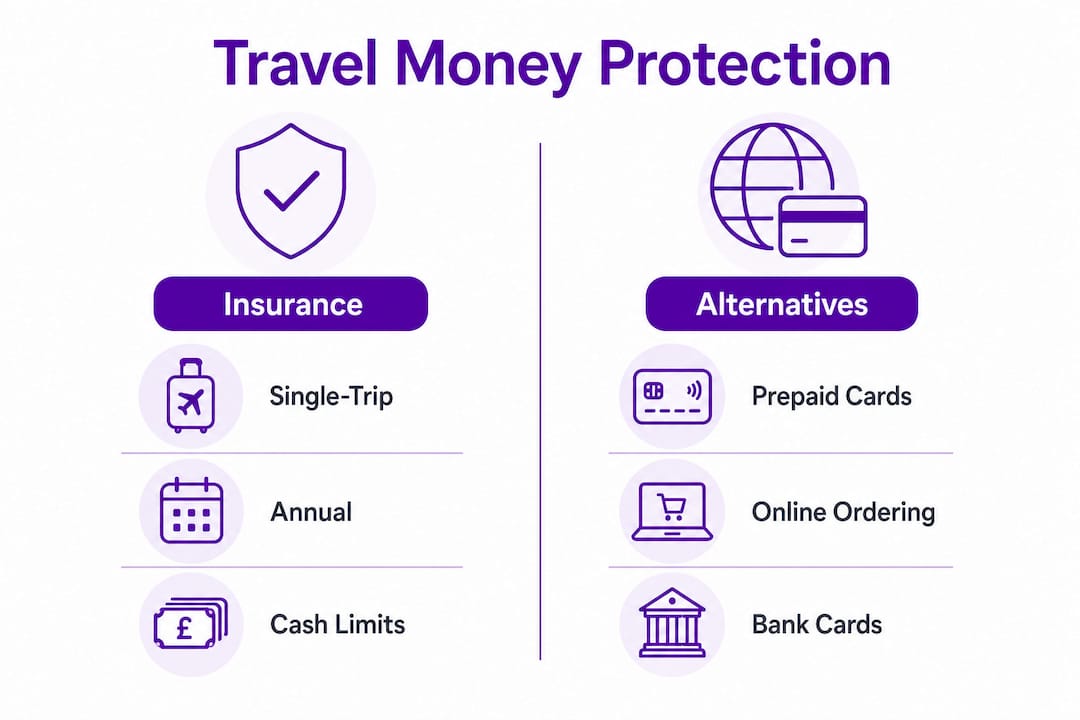
| Protection Method | What It Covers | Key Limitation |
|---|---|---|
| Single-trip travel insurance | Cash up to sub-limit (typically £200–£500) | Excess applies; alcohol clause may void claim |
| Annual multi-trip policy | Same cash sub-limits per trip | Sub-limits reset per trip, not per year |
| Prepaid currency card | Card balance if reported stolen | Does not cover physical cash separately carried |
| Credit card (Section 75) | Goods and services purchased on card | Does not cover cash theft or loss |
| Multi-currency app (Monzo, Revolut) | Instant card freeze; dispute process | No insurance element; relies on bank dispute |
| Traveller’s cheques | Replaceable if lost or stolen | Rarely accepted; limited practical use in 2026 |
Prepaid currency cards are the most practical complement to travel insurance for cash protection. You can compare prepaid multi-currency cards to find one that suits your destination and spending habits. Cards from providers like Caxton, Wise, and Revolut offer instant freeze features and real-time spending notifications.
Ordering travel money online before you travel consistently delivers better exchange rates than airport bureaux de change. Better rates mean you carry less cash to achieve the same spending power, which directly reduces your exposure if something goes wrong. You can also explore a guide to home delivery travel money to understand how pre-ordering works and why it is safer than buying at the airport.
When reviewing policies, read the full policy wording rather than the comparison site summary. Annual policies are cost-effective for frequent travellers, but the cash sub-limit applies per trip, not per year. If you travel four times a year, you have four separate cash claims available, each capped at the same sub-limit.
Why most travellers get this wrong (and what i have learned)
The most common mistake I see is travellers assuming their travel insurance works like home contents insurance. It does not. Home insurance replaces the full value of stolen items up to your sum insured. Travel insurance for cash is a sub-limited, excess-heavy product that pays out a fraction of what you lost, and only if you followed every procedural requirement.
The second mistake is carrying too much physical cash. I understand the instinct. Cards get declined abroad, some markets are cash-only, and there is comfort in having notes in your hand. But the insurance industry has not kept pace with the reality of modern travel. Sub-limits of £200–£500 were set when cash was the primary payment method. Today, with multi-currency apps and prepaid cards widely available, there is no good reason to carry more cash than your policy sub-limit covers.
My honest view is that a digital-first approach to travel money is now the most sensible strategy for most UK travellers. Use a prepaid card as your primary spending tool. Carry a modest amount of local currency for markets, taxis, and tips. Keep that cash amount within your policy’s sub-limit so that if the worst happens, you are fully covered. Diversify your payment methods so no single loss wipes out your holiday budget.
The insurance industry will not change its sub-limits to suit your habits. You need to change your habits to suit the coverage available.
— Jason
Plan your travel money with Comparetravelcash
Protecting your travel money starts before you leave home. Comparetravelcash makes it straightforward to compare live exchange rates from trusted UK providers, so you get more currency for your pound and carry less risk from the moment you convert.
Whether you want to compare travel money rates across multiple providers, find the best prepaid card for your trip, or check Hays Travel’s latest rates before you order, Comparetravelcash puts all the information in one place. You can also use the currency buyback comparison tool to recover value from any leftover foreign notes when you return. Smarter preparation means less cash at risk and a stronger position if you ever need to make a claim.
FAQ
What is the typical cash cover limit on UK travel insurance?
Most UK travel insurance policies cover cash losses between £200 and £500, with 35% of policies capping cover at £200–£299. A mandatory excess of £50–£150 reduces the actual payout further.
Do i need a police report to claim for stolen cash abroad?
A formal police report filed at the scene is a mandatory requirement for virtually all cash theft claims. Insurers will reject claims without one, regardless of the circumstances.
Does section 75 cover stolen travel cash?
Section 75 of the Consumer Credit Act does not cover theft of physical cash. It applies only to goods and services purchased directly on a UK credit card between £100 and £30,000.
Can i claim if my cash was stolen while i was drinking?
The alcohol clause in many travel insurance policies voids your claim if the insurer determines you were under the influence at the time of the incident. This applies even if you were not legally intoxicated by driving standards.
Are prepaid currency cards safer than carrying cash abroad?
Prepaid currency cards offer instant freeze features and dispute processes that physical cash does not. They do not replace travel insurance, but they significantly reduce the amount of cash you need to carry and therefore your exposure to loss.