Currency comparison websites are tools that display live exchange rates, provider fees, and currency conversion data, allowing UK travellers to identify the best deal before exchanging money. Knowing how to read currency comparison websites correctly is the difference between getting a fair rate and quietly losing £30 or more on a standard holiday currency order. These sites pull data from multiple providers, but the numbers only work in your favour when you understand what each figure actually means. Comparetravelcash aggregates rates from providers across the UK, giving travellers a single, reliable place to compare real costs rather than headline figures.
How to read currency comparison websites: key features explained
Currency comparison websites display several distinct data elements. Each one tells you something different, and misreading any of them leads to a worse deal.

Exchange rates: base, quote, and mid-market
Every rate on a comparison site shows a currency pair. The base currency is the one you hold (usually GBP for UK travellers), and the quote currency is what you receive. A rate of 1.17 for GBP/EUR means £1 buys €1.17. Mid-market rates represent the midpoint between global buy and sell prices, acting as a neutral benchmark. No provider sells you currency at the mid-market rate. It is the reference point you use to judge how much margin a provider is adding.
Banks typically add margins of 1–3% above the mid-market rate, and cash exchange rates are generally worse still due to handling costs. That gap is the provider’s profit. A rate that looks competitive on the surface may still carry a significant spread once you calculate the difference from mid-market.
Fees, charges, and hidden markups
Providers often advertise attractive exchange rates but offset them with service fees, delivery charges, or markups buried in the rate spread. A provider can display a competitive headline rate but add hidden fees that reduce the actual amount you receive. Always look for a “total you receive” or “final amount” figure rather than stopping at the headline rate.
Common charges to check include:
- Service fees: A flat fee per transaction, sometimes waived for online orders above a minimum amount.
- Delivery charges: Applies when currency is posted to your home address.
- Card payment fees: Some providers add a surcharge for debit or credit card payments.
- Rate spread: The difference between the mid-market rate and the provider’s offered rate. This is often the largest hidden cost.
Update timestamps and data freshness
Every rate table should display a “last updated” timestamp. Stale data in fast-moving markets can cause incorrect decisions, particularly if you compare a current bank rate against a table updated several hours ago. Check the timestamp before acting on any figure. If a rate has not been refreshed within the last hour during a volatile trading session, treat it with caution.
Pro Tip: On Comparetravelcash, rates are updated regularly throughout the day. Refresh the page before making a final decision to confirm you are working with current data.
| Data element | What it shows | What to check |
|---|---|---|
| Exchange rate | How much foreign currency £1 buys | Compare to mid-market rate |
| Service fee | Fixed charge per transaction | Look for fee-free online orders |
| Rate spread | Provider margin above mid-market | Smaller spread = better deal |
| Last updated | When the rate was last refreshed | Avoid rates older than 1 hour |
| Final amount | Total foreign currency after all fees | This is the only number that matters |
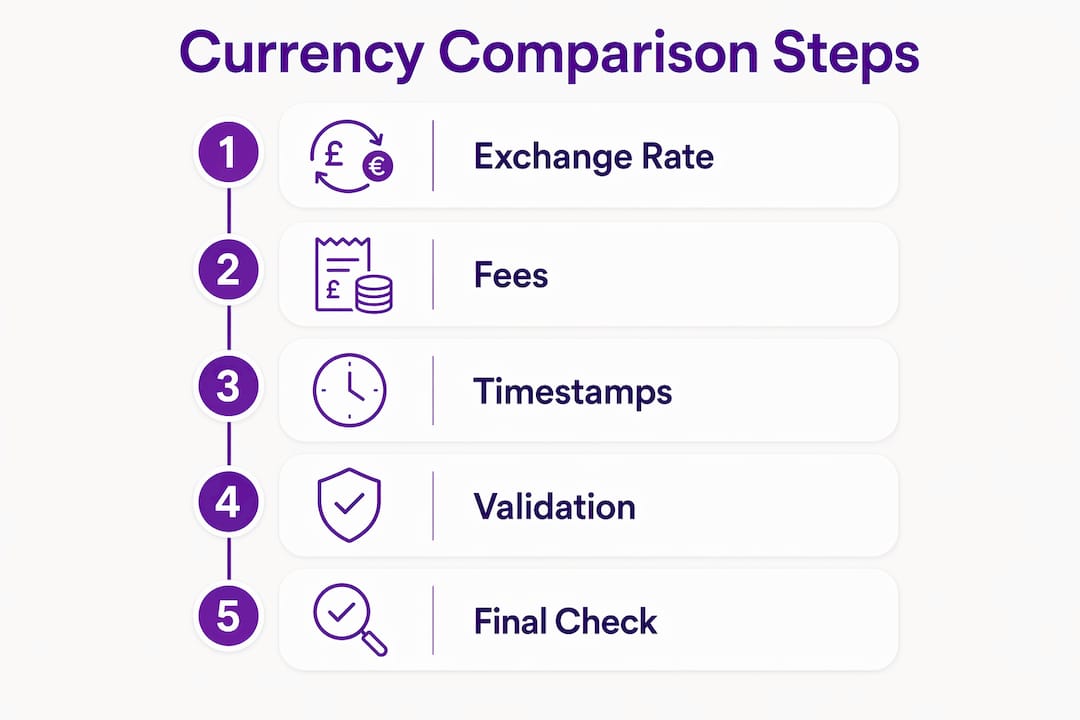
How do you interpret exchange rates and avoid common mistakes?
The most common cause of errors when calculating exchange amounts is misreading the direction of the currency pair. If a site displays 1 USD = 0.92 EUR, the inverse is 1 EUR = 1.09 USD. Confusing the two leads to completely wrong calculations. Always confirm which currency is the base before you start comparing.
Direct quotes vs inverse quotes
A direct quote shows how much foreign currency one unit of your home currency buys. An inverse quote shows how much of your home currency one unit of the foreign currency costs. Both are valid, but mixing them up is a costly error. If you are a UK traveller buying Euros, you want the GBP/EUR direct quote. A rate showing EUR/GBP is the inverse and will give you a different number entirely.
Cross-rate validation
Cross-rate calculations are a useful check against poor pricing. If your specific quote deviates significantly from the implied cross-rate derived through a common base currency like USD, it signals excessive provider margins or poor liquidity. For example, if GBP/TRY looks unusually low compared to what you would expect from GBP/USD and USD/TRY combined, the provider is adding a heavy markup on that pair. This is a particularly useful check for less common currency pairs such as Thai Baht or Turkish Lira.
Cross-rate analysis also helps you spot arbitrage opportunities and hidden costs in indirect conversions. You do not need to be a forex trader to use this. A quick mental check against a known rate is enough to flag a suspicious quote.
Pro Tip: Always verify the direction of the currency pair before calculating. Write down which currency is the base and which is the quote. One minute of checking saves a significant miscalculation.
Common mistakes to avoid when reading comparison data:
- Comparing headline rates without accounting for fees
- Accepting a rate without checking the last updated timestamp
- Confusing the direct quote with the inverse quote
- Treating the mid-market rate as an achievable rate rather than a benchmark
- Ignoring the final amount received in favour of the percentage rate
Step-by-step guide to using currency comparison websites
A clear process makes comparison sites far more useful. Follow these steps before every currency purchase.
-
Check the mid-market rate first. Look up the current GBP/EUR or GBP/USD mid-market rate on a neutral source. This is your baseline. Any provider rate you see should be measured against this figure.
-
Scan the rate board for notable movements. A shift of 0.5% or more in a currency compared to the previous day signals a timing opportunity. If GBP has strengthened against EUR by 0.5% overnight, buying Euros today gives you more for your money than yesterday.
-
Use the currency converter for your exact amount. Enter the precise amount you plan to exchange, not a round number. A rate that looks good on £100 may carry a flat fee that makes it poor value on £500. The converter shows the real final figure.
-
Include all fees in your comparison. Add service fees, delivery charges, and any card payment surcharges to the cost. The only figure worth comparing across providers is the total amount of foreign currency you receive after every charge.
-
Use both a rate board and a converter together. Rate boards show currency trends across multiple pairs, giving you the macro picture. Converters give you the exact transaction amount. Using both together gives you the full picture for a confident decision.
-
Check the timestamp on every rate table. Confirm the data is current before committing. If the rate was last updated more than an hour ago during a busy trading day, refresh the page or check back shortly.
-
Book online where possible. Most providers offer better rates for online orders than in-store or at the airport. Comparetravelcash links directly to online travel money rates so you can order at the rate you see, not a worse walk-in rate.
Common pitfalls when reading currency comparisons
Providers often advertise attractive exchange rates but offset these with fees or unfavourable markups hidden in the rate spread. This is the single most expensive mistake UK travellers make. The headline rate is a marketing figure. The final amount is the truth.
Stale data is a silent trap. A rate table last updated three hours ago during a volatile session may show a rate that no longer exists. Always verify the timestamp before acting. Outdated rates can mislead travellers and cause real financial loss in fast-moving markets.
Other frequent pitfalls include:
- Ignoring currency direction. Reading EUR/GBP instead of GBP/EUR gives you the inverse rate. The numbers look similar but the calculation is completely wrong.
- Trusting airport or hotel rates. These are consistently the worst available. Airport bureaux de change operate on wide spreads with no competitive pressure.
- Overlooking the buyback rate. If you return with leftover currency, the rate at which a provider buys it back matters. Comparetravelcash includes a currency buyback comparison so you can factor this into your decision upfront.
- Assuming all comparison sites show the same data. Some sites display indicative rates rather than live, bookable rates. Confirm whether the rate shown is the rate you can actually lock in.
Pro Tip: When in doubt, use the tips for spotting bad rates from Comparetravelcash’s blog to cross-check any quote that looks too good or too poor compared to the mid-market benchmark.
What I have learned from years of comparing travel money rates
The biggest mistake I see UK travellers make is treating the exchange rate as the only variable. Fees are where providers quietly recover their margin, and most travellers never notice. I have seen two providers show identical headline rates where one delivers £40 more in Euros on a £1,000 order, purely because of a difference in service fees.
The habit that makes the biggest difference is using a rate board and a converter together, not one or the other. The rate board tells you whether today is a good day to buy. The converter tells you exactly what you will receive. Neither tool alone gives you the full picture. Checking currency rate forecasting guides can also help you understand the broader context behind rate movements, which is useful when deciding whether to buy now or wait a few days.
Timing matters more than most travellers realise. A 0.5% shift in GBP/EUR on a £1,000 order is £5. That sounds small, but it compounds across a family holiday budget. I check rates a few weeks before travelling, not just the day before. If GBP is strengthening, waiting a few days can be worth it. If it is weakening, buying early locks in a better rate.
The one thing I would tell every UK traveller is this: always compare the final amount received, not the headline rate. That single habit will save you money on every trip.
— Jason
Comparetravelcash: find the best travel money rates in one place
Comparing exchange rates across multiple providers used to mean visiting several websites and doing the maths yourself. Comparetravelcash does that work for you, pulling together live rates from providers across the UK so you can see the best deals in one place.
Whether you are buying Euros for a European city break, US Dollars for a transatlantic trip, or Thai Baht for a long-haul holiday, compare travel money rates on Comparetravelcash before you buy. The platform covers cash rates, prepaid currency cards, and buyback deals, giving you a complete picture of your options. Rates are updated throughout the day, so the figure you see reflects what providers are actually offering right now.
FAQ
What is a mid-market exchange rate?
The mid-market rate is the midpoint between the global buy and sell prices for a currency pair. No provider offers this rate to retail customers; it is the benchmark used to measure how much margin a provider is adding.
Why do two providers show different rates for the same currency?
Each provider sets its own spread above the mid-market rate and applies different fee structures. Banks typically add margins of 1–3% above mid-market, while specialist travel money providers often offer tighter spreads.
How do I know if a rate on a comparison site is current?
Check the “last updated” timestamp on the rate table. Stale data can cause costly errors in fast-moving markets, so always refresh the page before making a decision.
What is the difference between a direct quote and an inverse quote?
A direct quote shows how much foreign currency one unit of GBP buys. An inverse quote shows how much GBP one unit of the foreign currency costs. Confusing the two is the most common calculation error when reading currency comparison data.
Should I compare rates at the airport or online?
Online rates are consistently better than airport rates. Airport bureaux de change operate on wide spreads with no competitive pressure. Use Comparetravelcash to book travel money online before you travel for the best available rate.