Many travellers assume digital currency is the preserve of tech enthusiasts and speculative investors. That assumption is increasingly out of date. Understanding what is digital currency for travel means recognising a practical set of tools that now cover everything from fee-free payments in China to stable budgeting across multiple countries. This guide explains the main types of digital currency relevant to travellers, how to use them for real payments and daily expenses, and where they fit alongside traditional cash and currency cards. No prior technical knowledge is assumed.
Table of Contents
- What digital currency means for travellers
- How to use digital currency when travelling
- Benefits and challenges of digital currency for travel
- Digital currency vs traditional travel payments
- My honest take on digital currency for travel
- Get the best rates on your travel money
- FAQ
What digital currency means for travellers
The term “digital currency” covers several distinct things, and the differences matter enormously when you are abroad.
Central bank digital currencies (CBDCs) are issued by governments and carry full legal tender status. China’s e-CNY is the most advanced example tourists are likely to encounter. Issued by the PBOC, it functions as a digital form of cash rather than a bank deposit or investment. You load it into a wallet app, tap to pay at shops and restaurants, and the merchant receives the equivalent of paper yuan. No exchange rate speculation. No third-party payment processor taking a cut.
Cryptocurrencies such as Bitcoin and Ethereum operate on decentralised networks without government backing. Their value fluctuates, sometimes sharply, which creates real budgeting risk for travellers. You might budget £500 in Bitcoin on Monday and find it worth £430 by Thursday.

Stablecoins such as USDT and USDC sit in the middle. They are cryptocurrencies in structure but are pegged to a fiat currency, usually the US dollar, which keeps their value predictable. For travel budgeting purposes, stablecoins behave more like digital cash than speculative assets.
The table below summarises the key distinctions:
| Type | Backing | Volatility | Legal tender | Best travel use |
|---|---|---|---|---|
| CBDC (e.g. e-CNY) | Government | None | Yes (in issuing country) | Daily payments at destination |
| Cryptocurrency (e.g. Bitcoin) | None | High | No | Booking platforms, crypto cards |
| Stablecoin (e.g. USDT) | Fiat peg | Very low | No | Budgeting, cross-border transfers |
Key characteristics to keep in mind:
- CBDCs carry no exchange rate risk within their home country
- Cryptocurrencies offer wide platform acceptance but unpredictable value
- Stablecoins offer the stability of cash with the speed of crypto transfers
- Anonymity varies: CBDCs typically require identity verification, whereas some crypto wallets do not
How to use digital currency when travelling
Understanding the theory is useful. Knowing the practical steps is what actually helps you at a hotel check-in desk or taxi rank.
1. Crypto debit cards
The most accessible entry point for most British travellers is a crypto-funded debit card. BitPay’s debit card, for example, converts cryptocurrency from your wallet at the point of sale and processes the transaction through Mastercard’s network. The merchant never handles crypto directly. You simply tap or swipe as normal. This means you can use Bitcoin or stablecoins at any merchant that accepts Mastercard, which covers the vast majority of hotels, airlines, and shops in developed travel destinations.
2. Travel booking platforms
A growing number of booking platforms now accept stablecoins and cryptocurrencies directly for flights, hotels, and tours. You pay in digital currency at checkout and receive a standard booking confirmation. The platform handles the conversion on the back end.
3. Voucher and prepaid credit systems
In regions where direct crypto payments are rare, prepaid crypto vouchers offer a practical workaround. You fund a voucher with your crypto holdings and redeem it for accommodation credits, transport passes, or retail purchases. This approach broadens acceptance considerably without requiring merchants to handle crypto themselves.
4. CBDC wallets at destination
If you are travelling to China, setting up an e-CNY tourist wallet before or shortly after arrival gives you access to fee-free NFC payments at millions of merchants. The offline payment capability is particularly valuable in areas with poor mobile connectivity.
Pro Tip: Load a modest amount onto your crypto debit card or stablecoin wallet before departure rather than converting a large sum at once. This limits your exposure to any sudden price movements during the trip, even when using stablecoins.
Benefits and challenges of digital currency for travel
The benefits are real, but so are the limitations. A clear-eyed view of both helps you use digital currency sensibly rather than treating it as a silver bullet.
The genuine advantages:
- Lower transaction fees. CBDCs like e-CNY charge no fees on transactions, which compares favourably with credit card foreign transaction fees typically ranging from 1.5% to 3%.
- Predictable budgeting. Stablecoins pegged to fiat allow you to set a daily spending limit in dollar terms and know it will hold its value throughout your trip.
- Offline payments. The e-CNY wallet supports NFC tap-to-pay offline, meaning you are not dependent on a stable internet connection to complete a transaction.
- Speed for transfers. Sending stablecoins across borders settles in seconds rather than the two to five business days typical of international bank transfers.
The real challenges:
- Merchant acceptance is patchy. Outside dedicated crypto travel platforms and CBDC regions, finding merchants who accept digital currency directly requires research in advance.
- Regulatory compliance adds friction. Stablecoin transfers above €1,000 trigger Travel Rule requirements, meaning your payment platform must collect and transmit identity information about both the sender and recipient. For most holiday spending this threshold is fine, but it is worth knowing.
- Fraud protection is limited. Unlike credit card payments, most crypto transactions are irreversible. If you pay a fraudulent merchant in stablecoin, recovery is extremely unlikely.
Pro Tip: Keep your identity documents consistent across all your digital currency accounts and exchange platforms. If a payment triggers a compliance verification check, having mismatched names or addresses will cause delays at the worst possible moment.
Digital currency vs traditional travel payments
Digital currency does not replace your existing payment toolkit. It adds to it. Understanding where it fits helps you make smarter choices at each stage of your trip.
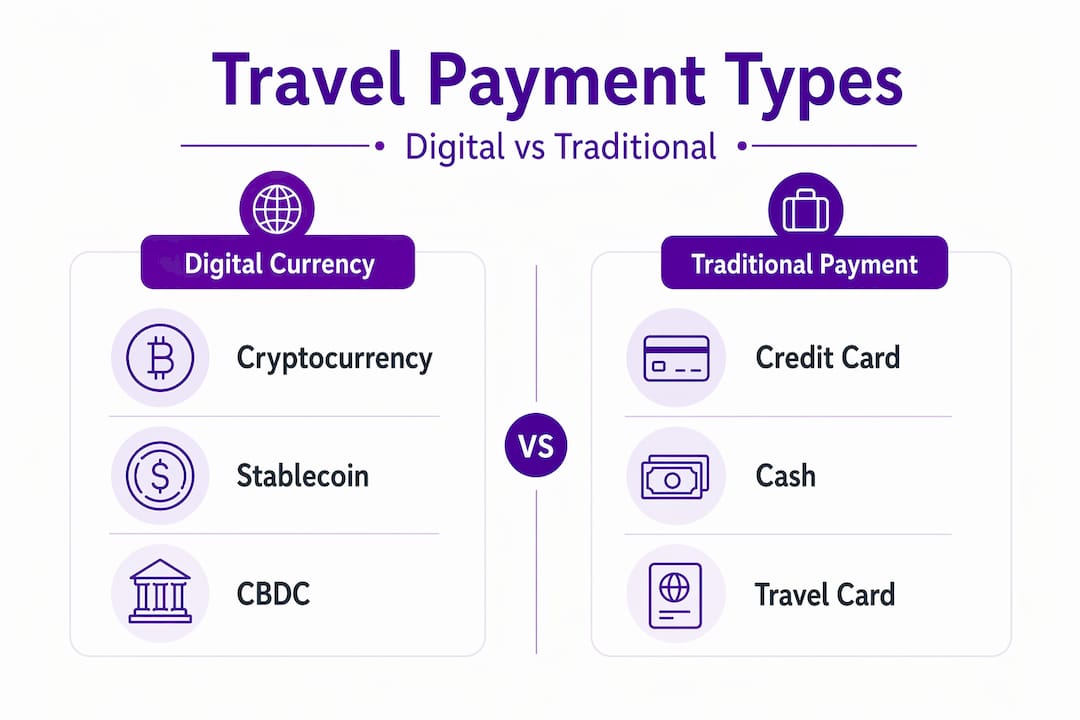
The honest comparison looks like this:
| Payment method | Foreign transaction fees | Fraud protection | Merchant acceptance | Offline use |
|---|---|---|---|---|
| Credit card | 1.5–3% | Strong (chargeback rights) | Very wide | No |
| Prepaid currency card | Low to none | Moderate | Wide | No |
| Cash (local currency) | Exchange rate markup | None | Universal | Yes |
| Stablecoin via crypto card | Low to none | Minimal | Mastercard/Visa network | No |
| CBDC (e.g. e-CNY) | None | Moderate | Destination-specific | Yes |
For most British travellers, the practical approach is to combine methods. Use a prepaid multi-currency card for day-to-day card payments, carry a modest amount of local cash for markets and small vendors, and consider a stablecoin wallet or crypto card for bookings on platforms that offer a discount for crypto payment.
When you are planning your budget, comparing exchange options for your traditional currency is still the highest-value task. Digital currency is growing, but it complements rather than replaces the need to get a competitive rate on your pounds.
A few situations where digital currency genuinely adds value:
- Booking flights or hotels on crypto-native platforms where stablecoin payment attracts a price reduction
- Travelling to China, where e-CNY removes the friction of loading Alipay as a foreign visitor
- Sending money to yourself across borders mid-trip without paying wire transfer fees
- Maintaining a portion of your travel budget in stablecoins to hedge against a weakening pound
For everything else, understanding how to get the best rate on your travel money still saves you more in practice than switching entirely to crypto.
My honest take on digital currency for travel
I have watched the conversation around digital currency for travellers shift considerably over the past few years. Early adopters were largely tech-enthusiasts chasing a novelty. Now I am seeing ordinary holidaymakers ask genuinely practical questions about stablecoins and CBDCs before a big trip.
My view is that digital currency will become a standard part of travel payments, but not as a replacement for anything. The travellers who benefit most are those who treat it as one layer in a broader payment strategy rather than a complete solution.
The pitfall I see most often is overcommitting. Someone converts a large portion of their travel budget into Bitcoin because they read it is accepted on a booking site, then watches the value drop 15% before their trip begins. Stablecoins largely solve this, but most people do not realise the distinction until after the experience.
What most travellers overlook is the compliance side. Regulations around digital currency payments are tightening, not loosening. Identity verification requirements for larger transactions will become more common, not less. Getting your accounts verified and your documentation consistent before you travel avoids unpleasant surprises at the checkout.
My practical advice: start with a small experiment. Load £100 or £200 onto a stablecoin wallet or crypto debit card before your next trip and use it for one or two bookings. See how it fits. You are not replacing your travel card or your euros. You are learning how the tools work on a scale where a mistake is a minor inconvenience rather than a crisis.
— Jason
Get the best rates on your travel money
Whether you are keeping digital currency as a small part of your trip budget or relying mainly on traditional payment methods, the foundation of smart travel spending is getting a competitive rate on your pounds. Comparetravelcash makes that straightforward. You can compare travel money rates from multiple UK providers in one place, avoiding the inflated rates at airports and high street exchanges. For card-based spending abroad, checking the latest deals on prepaid currency cards gives you low-fee access to foreign currencies without the volatility of crypto. Use digital currency where it adds genuine value, and let Comparetravelcash handle the rest.
FAQ
What is digital currency for travel?
Digital currency for travel refers to CBDCs, cryptocurrencies, and stablecoins used to pay for travel expenses or manage international spending. These range from China’s e-CNY, which functions as digital cash at local merchants, to stablecoins that allow predictable cross-border budgeting.
Is digital currency safe for travel?
Stablecoins and CBDCs carry low volatility risk, but crypto transactions are generally irreversible, meaning fraud protection is weaker than with credit cards. Keeping amounts modest and using regulated platforms reduces your exposure significantly.
Which digital currencies are best for travellers?
Stablecoins such as USDT and USDC are the most practical for budgeting because their value is pegged to fiat currency. CBDCs like e-CNY are excellent within their issuing country. Bitcoin and Ethereum are better suited to bookings on crypto-native platforms than for daily spending.
Do I need to declare digital currency when travelling?
Carrying digital currency in a wallet app does not typically require customs declaration the way physical cash does, but regulations vary by country. Transfers above certain thresholds trigger identity verification requirements, so checking the rules for your specific destination before travel is sensible.
Can I use crypto abroad without internet access?
The e-CNY wallet supports offline NFC payments, which is a unique advantage over most mobile payment systems. Most other digital currency wallets and crypto debit cards require an internet connection to process transactions.