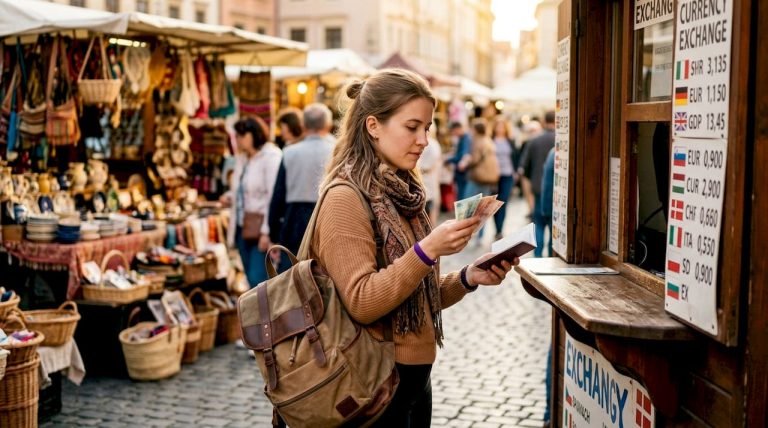
Travel currency scams are fraudulent practices that manipulate exchange rates, fees, or physical currency to extract money from tourists, and the examples of travel currency scams most likely to affect you range from dynamic currency conversion (DCC) at card terminals to counterfeit note swaps on busy streets. These scams are classified in the financial fraud industry as “currency conversion fraud” or “foreign exchange deception,” and they cost travellers significant sums every year. The problem persists because most losses go unnoticed, embedded in exchange rates rather than flagged as theft. Knowing what to look for before you travel is the most reliable defence you have.
1. Dynamic currency conversion: the most widespread travel money scam
Dynamic currency conversion is a charge mechanism where a foreign card terminal or ATM offers to process your payment in your home currency rather than the local one. It sounds helpful. It is not. DCC adds hidden markups of between 3% and 13%, meaning a €200 restaurant bill could cost you £20 to £30 more than necessary. The merchant or ATM operator pockets the difference.
The scam works because the offer appears at the point of payment, often framed as a convenience. Staff may press you to accept, claiming it makes your receipt “easier to understand.” In reality, choosing local currency triggers your bank’s network rate, which is almost always more favourable than the merchant’s inflated conversion. Understanding the DCC fee structure before you travel helps you recognise the prompt immediately.
- Always select “pay in local currency” at every card terminal abroad
- If a machine defaults to your home currency, cancel and retry
- Confirm with the cashier that local currency has been selected before approving
Pro Tip: If a terminal shows you a conversion rate, compare it against the mid-market rate on Google or XE before accepting. A gap of more than 2% is a red flag.
2. Fake and tourist-trap currency exchange booths
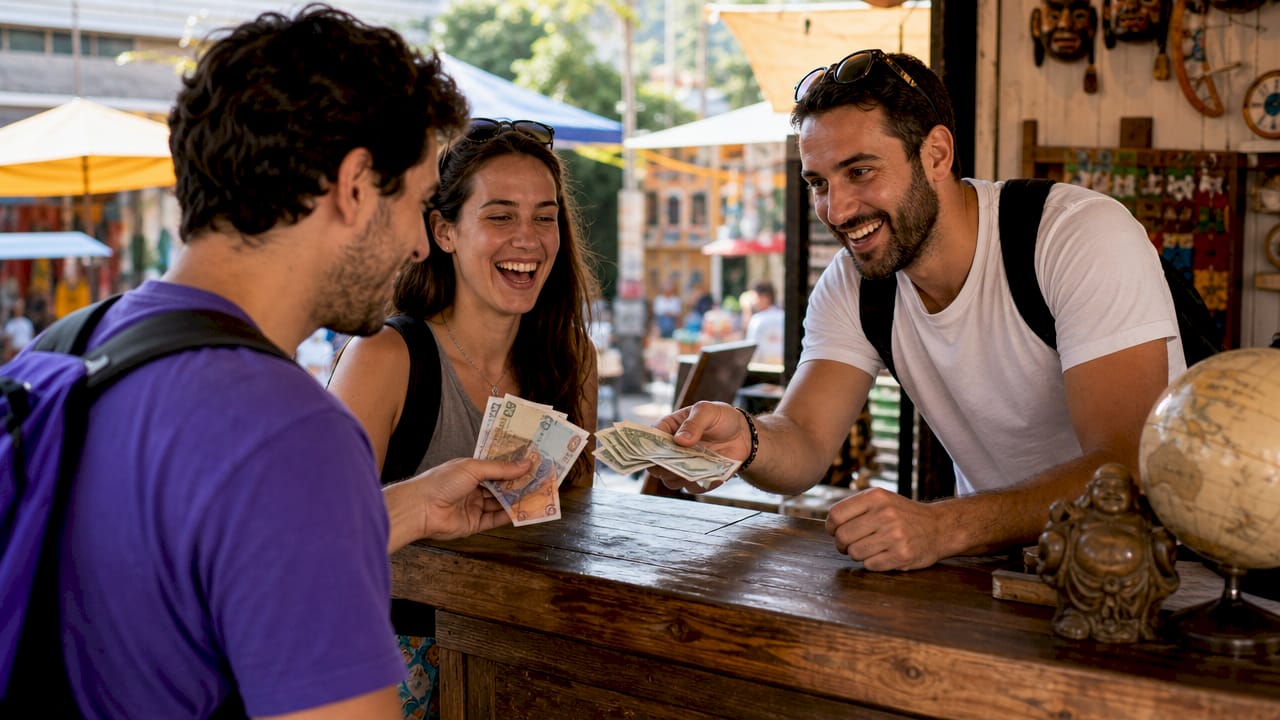
Currency exchange booths in airports, train stations, and tourist districts frequently advertise “zero commission” or “best rates in town.” These claims are misleading. Airport kiosks impose markups of 8% to 12% as standard, and some unregulated booths hide charges as high as 30% within the exchange rate itself rather than as a visible fee. The advertised rate and the rate you actually receive are two different numbers.
The mechanism is straightforward. The booth displays an attractive headline rate on a large board. When you hand over your cash, the operative applies a significantly worse rate, citing a “service charge,” a “handling fee,” or simply a different rate for smaller amounts. By the time you notice, you have already completed the transaction.
| Location | Typical markup range | Risk level |
|---|---|---|
| Airport kiosks | 8–12% | High |
| Tourist-area street booths | 10–30% | Very high |
| High-street bank branches | 2–4% | Low |
| Bank ATMs abroad | 1–3% (network rate) | Low |
| Prepaid travel cards | 0–2% | Very low |
Many travellers assume that a professional-looking storefront or a branded sign guarantees a fair rate. It does not. The safest approach is to use a bank branch ATM or to order currency in advance from a regulated UK provider before you depart. Always verify the live mid-market rate on a source like the European Central Bank or XE before exchanging any cash, so you know immediately whether the offered rate is reasonable.
3. Street-level money swap scams
Street-level currency fraud relies on distraction, sleight of hand, and counterfeit notes. The most common version involves a stranger offering to exchange cash informally, often at a rate that appears better than any booth nearby. Once you hand over your money, a coordinated accomplice creates a distraction. When you look back, your notes have been partially or fully swapped for counterfeits or low-denomination bills from a different country.
Documented losses from street scams reached $900 in a single incident in Pattaya, Thailand in early 2026, where three men worked together to trick Indian tourists through coordinated distraction. This is not an isolated case. Bangkok, Istanbul, Barcelona, and Rome all feature regularly in traveller fraud reports involving informal money changers.
Recognising the warning signs protects you before the transaction begins:
- Any unsolicited offer to exchange currency on the street is a scam signal
- Perpetrators often work in groups of two or three, with one engaging you and others positioned nearby
- Pressure to complete the exchange quickly is a deliberate tactic to prevent you from counting the notes
- Layered distraction techniques are a hallmark of organised street fraud, not opportunistic theft
Pro Tip: Count every note before you move away from any exchange, official or otherwise. Fold them individually and check denominations. A scammer relies on your reluctance to appear rude or suspicious.
4. ATM scams and card skimming
ATMs present two distinct threats to travellers. The first is the DCC prompt described above, which appears on screen and costs you money through a poor conversion rate. The second is physical card skimming, where a device fitted over the card slot reads your card data while a hidden camera or overlay captures your PIN. Both result in financial loss, though skimming also exposes your account to ongoing fraud after you return home.
Skimming devices are most common at standalone ATMs in tourist areas, petrol stations, and convenience stores. Bank branch ATMs, particularly those inside a building, carry significantly lower risk because they are monitored and serviced more frequently. Before inserting your card, inspect the card slot for any loose or unusual attachments, and cover the keypad with your hand when entering your PIN.
- Use ATMs attached to bank branches rather than standalone machines
- Avoid ATMs that have been modified, have loose parts, or show signs of tampering
- Select “local currency” if prompted, and decline any conversion offer
- Use a prepaid travel card with an instant freeze feature so you can lock the card immediately if something feels wrong
Separating holiday money from your main accounts via a dedicated travel card limits the damage if your card details are compromised. Your primary savings remain untouched even if the travel card is skimmed or stolen.
5. Practical measures to protect yourself from currency scams
Awareness of specific scams is only half the solution. The other half is building habits that reduce your exposure before and during your trip.
1. Order currency before you travel. Rates from UK-based providers are almost always better than anything available at an airport or tourist-area booth. Comparetravelcash lets you compare live exchange rates from multiple providers in one place, so you can lock in a competitive rate before you board.
2. Use a no-foreign-transaction-fee card. Cards from providers such as Starling Bank, Monzo, or Chase UK charge no fee for overseas spending and apply the Mastercard or Visa network rate, which tracks closely to the mid-market rate.
3. Split your money. Experienced travellers divide cash across a decoy wallet, a hidden money belt, and a card kept separately from the wallet. If one is stolen or compromised, the rest remains safe. This practice is sometimes called “money-splitting” and it directly limits the impact of both theft and scams.
4. Carry minimal cash. Take only what you need for the day. Leaving the bulk of your currency in a hotel safe or locked luggage reduces the amount at risk at any given moment.
5. Verify rates before every exchange. Check the mid-market rate on XE or Google before approaching any booth or ATM. Knowing the fair rate means you can spot a bad exchange rate immediately rather than discovering the loss later.
6. Reject pressure tactics. Legitimate exchange services do not rush you, offer unsolicited deals, or claim their rate is only available “right now.” Any urgency is a manipulation technique.
About 73% of tourist thefts are opportunistic, meaning they depend on an easy target presenting itself. Simple concealment methods such as a neck wallet or a hidden money belt remove you from that category entirely.
| Protection method | What it guards against | Effort required |
|---|---|---|
| Prepaid travel card with freeze | Skimming, ATM fraud | Low |
| Money belt or neck wallet | Pickpocketing, street theft | Low |
| Pre-ordered currency | Airport and tourist-area markups | Low |
| Declining DCC at terminals | Dynamic currency conversion | Very low |
| Verifying mid-market rate | Fake booths, inflated rates | Low |
The scams that cost travellers the most are the ones they never notice
After years of covering travel finance, the pattern I find most striking is not the dramatic street scam or the skimmed ATM card. It is the quiet, invisible loss that happens at a card terminal or a branded exchange booth, where the traveller walks away believing everything was fine.
Currency-related scams are underreported precisely because the fees look like legitimate exchange costs. A traveller who loses £40 to DCC on a two-week holiday does not file a fraud report. They chalk it up to “the cost of travelling abroad.” Multiply that across millions of trips and the aggregate loss is enormous.
The habits that protect you are not complicated. Decline DCC every single time. Order your currency from a regulated UK provider before you fly. Use a travel card with a freeze function. Count your change. These are not dramatic measures. They are small, consistent choices that close the gaps scammers rely on.
What I would tell any traveller planning a trip right now is this: the exchange rate you see is rarely the rate you get, unless you have verified it yourself. That one habit, checking the mid-market rate before any transaction, eliminates the majority of currency conversion pitfalls in a single step.
— Jason
Compare rates and travel with confidence
Avoiding currency scams starts before you leave the UK. Comparetravelcash gives you a clear, up-to-date comparison of travel money rates from regulated providers across the country, so you know exactly what a fair rate looks like before you encounter a tourist-area booth or an airport kiosk.
Whether you want to compare travel money rates for Euros, US Dollars, or Thai Baht, or find the best prepaid currency card for your trip, Comparetravelcash puts verified, competitive options in one place. Booking in advance through a regulated provider is the single most effective way to avoid the markups and manipulation tactics covered in this article. Check today’s rates and travel knowing you got a fair deal.
FAQ
What is a travel money scam?
A travel money scam is any fraudulent practice that manipulates currency exchange rates, fees, or physical notes to extract money from travellers. Common forms include dynamic currency conversion, fake exchange booths, and street-level note swaps.
How do I spot a bad exchange rate abroad?
Check the mid-market rate on XE or Google before any transaction. If the rate offered by a booth or ATM differs by more than 3% to 5%, the difference represents a hidden markup or commission charge.
Is it safer to use a card or cash abroad?
A no-foreign-transaction-fee card used in local currency is generally safer and cheaper than exchanging cash at tourist-area booths. Prepaid travel cards with instant freeze features add an extra layer of protection against skimming and theft.
Why does dynamic currency conversion cost more?
DCC allows the merchant or ATM operator to apply their own conversion rate rather than your bank’s network rate. That merchant rate typically carries a markup of 3% to 13%, which goes directly to the operator rather than to you.
Are airport currency exchange booths safe to use?
Airport booths are regulated but not competitively priced. Markups of 8% to 12% are standard at airport kiosks, making them one of the most expensive ways to obtain foreign currency. Ordering in advance from a UK provider consistently delivers better value.