Most UK travellers still assume the airport bureau de change or their high street bank is the safest, most reliable place to swap pounds for foreign currency. That assumption is costing them real money every single trip. Hidden markups, inflated board rates, and sneaky fees quietly erode holiday budgets before the first drink is even ordered. The currency exchange landscape has shifted dramatically in recent years, with digital platforms and specialist providers now offering rates that traditional outlets simply cannot match. This article cuts through the noise, explains how different providers operate, and gives you the knowledge to make genuinely informed decisions before you travel.
Table of Contents
- What currency exchange providers do and why it matters
- Comparing traditional and modern currency exchange options
- Fees, markups, and hidden costs: what UK travellers must watch out for
- How fintech disrupts traditional exchange providers for UK travel
- The uncomfortable truth about currency exchange providers most travellers miss
- Compare and optimise your currency exchange options
- Frequently asked questions
Key Takeaways
| Point | Details |
|---|---|
| Know your provider | Different exchange providers offer varying rates and fees—research before you buy. |
| Avoid hidden costs | Dynamic currency conversion and ATM fees can significantly reduce value if not managed. |
| Fintech advantages | Digital platforms usually offer better rates, but travellers should check fee structures and conditions. |
| Compare rates online | Using online comparison tools helps ensure you get the best available exchange rate. |
What currency exchange providers do and why it matters
Now that you know the common assumptions, let’s clarify how exchange providers actually operate behind the scenes.
At their core, all currency exchange providers do the same basic thing: they buy foreign currency from wholesale markets and sell it to you at a slightly higher price. The difference between what they pay and what you pay is called the spread or markup. This spread is how providers make their profit, and it varies enormously depending on who you use.
Providers source their liquidity from interbank markets or panels, apply a markup for profit and operational risk, and typically offer better “web rates” for click-and-collect orders compared to walk-in “board rates” displayed in store. Digital providers take this further by using real-time Visa or Mastercard rates combined with a low, transparent fee structure. This matters because the gap between a walk-in rate and an online rate can be as much as 1 to 2 percentage points on a popular currency like the euro.
The main categories of provider available to UK travellers are:
- High street banks (Barclays, HSBC, Lloyds): widely accessible but typically the most expensive option
- Airport kiosks and bureaux de change: ultra-convenient but notorious for the worst rates in the market
- Specialist travel money firms (Post Office, Travelex): usually better than banks but still below digital alternatives
- Digital apps and prepaid cards (Wise, Revolut, Starling): closest to mid-market rates with the most transparent fee structures
- Online click-and-collect services: order at web rates and collect at a local branch or have currency delivered
Understanding how Currency Club rates work is a useful starting point when thinking about specialist providers, since they operate on a model quite different to the traditional bank.
To illustrate the difference in practical terms, consider a traveller exchanging £1,000 into euros. A high street bank with a 4% spread delivers roughly €1,120 at a mid-market rate of 1.17. A specialist online provider with a 1% spread delivers around €1,158. That is a difference of €38, or approximately £32, before you’ve even arrived at your destination. Multiply that across a family holiday or multiple trips, and the cumulative impact is substantial.
| Provider type | Typical spread | £1,000 converted (EUR) | Approx. loss vs mid-market |
|---|---|---|---|
| Airport kiosk | 8 to 12% | €1,043 to €1,075 | €45 to €77 |
| High street bank | 3 to 5% | €1,109 to €1,132 | €28 to €61 |
| Specialist online | 0.5 to 2% | €1,146 to €1,164 | €6 to €24 |
| Digital app | 0 to 1% | €1,158 to €1,170 | £0 to £12 |
The table makes the financial reality very clear. Convenience comes at a measurable cost, and that cost is entirely avoidable with a small amount of forward planning.
Comparing traditional and modern currency exchange options
Understanding provider mechanics is helpful, but comparing their offerings reveals where true savings or losses occur.
Traditional banks and airport kiosks have built their models around accessibility and trust. You know where they are, you recognise the name, and they feel safe. But that sense of security carries a price. Traditional providers prioritise convenience and typically absorb higher operational costs, which they pass on through spreads that regularly exceed 3%. Airport kiosks frequently go even further, applying markups of 8 to 12% on the mid-market rate.
Fintech and specialist providers approach the problem differently. Firms such as Wise, Revolut, and CurrencyTransfer compete on transparency and low markups, offering rates close to what you’d see on Google or XE.com. They may have limits on fee-free ATM withdrawals or charge inactivity fees on dormant prepaid cards, but when used actively, they consistently outperform traditional alternatives.
When choosing between options, consider the following:
- Banks: Best when you already bank with them and need a small amount of currency quickly; rarely competitive on rate
- Airport kiosks: Only justifiable for emergency top-ups when you’ve already arrived at a destination
- Specialist travel money firms: Reasonable for larger amounts ordered in advance online, where web rates apply
- Prepaid travel cards: Excellent for day-to-day spending abroad, particularly where ATM access is limited
- Cash vs card: Cash remains essential for markets, taxis, and rural areas in many countries; cards offer security and chargeback protection for larger purchases
When comparing exchange options for your next trip, think about the currency, the destination, and how you plan to spend. A digital card might be ideal for a city break in Europe but less practical for a remote trip to Southeast Asia.
Pro Tip: If you use a digital provider such as Revolut or Wise, load the card in your home currency and let the app convert at the point of purchase. This captures the live exchange rate rather than locking in a rate days in advance, which can work in your favour when rates are moving favourably.
The psychological pull of familiar names is strong. Many travellers walk past far better deals because the alternative feels unfamiliar. The reality is that regulated fintech providers are subject to FCA oversight in the UK, making them just as secure as the brands you recognise on the high street.
Fees, markups, and hidden costs: what UK travellers must watch out for
After comparing providers, it’s crucial to look at the specific costs and fees that impact your final spend.
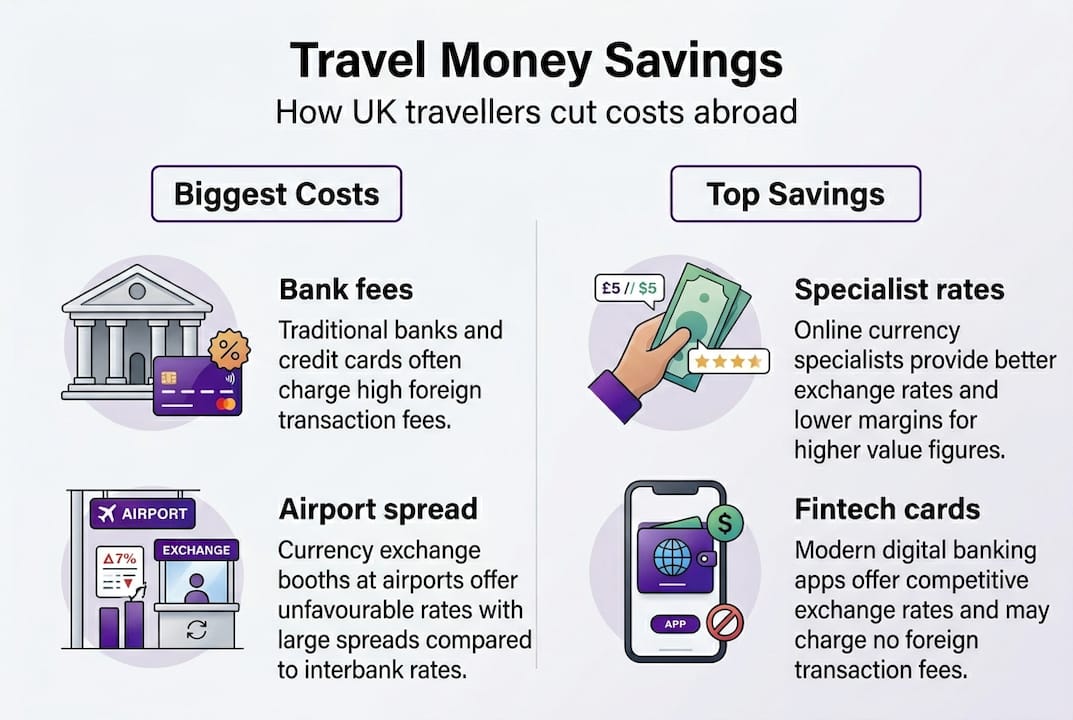
Not all charges are obvious. In fact, the most damaging costs in currency exchange are often the ones you don’t notice until you check your bank statement back home. The spread is the most significant, but a range of additional fees can stack up quickly.
Here are the main charges to be aware of:
- The spread or markup: The core difference between the mid-market rate and the rate you receive. This is built into every transaction and is rarely advertised clearly.
- Service or handling fees: A flat fee charged per transaction, common with banks and some specialist providers.
- ATM withdrawal fees: Even on cards marketed as “fee-free,” the ATM operator may charge €2 to €5 per withdrawal.
- Weekend markups: Certain providers including Revolut and Wise apply a 1% surcharge at weekends because interbank markets are closed and they carry additional currency risk.
- Dynamic currency conversion (DCC): A charge applied when you pay in GBP abroad rather than local currency, adding 3 to 7% to your transaction.
“Dynamic currency conversion is one of the most costly mistakes a traveller can make. When a card machine abroad asks whether you’d like to pay in pounds or local currency, always choose local currency. Paying in GBP transfers the conversion to the merchant’s bank, which applies a deeply unfavourable rate.”
The table below shows how these costs can accumulate on a single two-week holiday:
| Fee type | Frequency | Estimated cost |
|---|---|---|
| Spread on £1,000 (bank rate) | One-off | £35 to £50 |
| ATM operator fee | Per withdrawal (x6) | £15 to £30 |
| Weekend markup (Revolut) | Per weekend transaction | £5 to £10 |
| DCC charge | Per DCC transaction (x3) | £15 to £45 |
| Total potential extra spend | £70 to £135 |
Some currencies add a further complication. Closed currencies such as the Tunisian Dinar cannot be purchased outside the country of origin and must be exchanged in-country using local banks or authorised exchange offices. Attempting to source them in the UK is simply not possible, so planning ahead for such destinations is essential.
The travel money FAQs page covers specific currency questions in more detail, including which currencies require special handling and where to find reliable in-country exchange facilities.
Pro Tip: Always decline DCC at card machines abroad. When the terminal shows you a price in pounds, that is a DCC offer. Press “no” or “pay in local currency” every time. It takes one second and consistently saves money.
How fintech disrupts traditional exchange providers for UK travel
Now, let’s see how digital solutions are redefining the travel money market and what savvy travellers should do.
The rise of fintech in travel money has been significant. A decade ago, your realistic options were a bank, the Post Office, or an airport kiosk. Today, digital-first providers offer rates within fractions of a percent of the mid-market rate, with real-time app controls, instant transaction notifications, and the ability to freeze your card from your phone in seconds.
Fintech providers now outperform traditional banks on rate by a significant margin. Where banks typically apply spreads of 3% or more, digital alternatives frequently come in under 1%, and for many currency pairs during weekday market hours, the rate offered is effectively the mid-market rate with only a small fixed service fee.
Key advantages of fintech providers for UK travellers:
- Near mid-market rates on weekday transactions across most major currencies
- App-based controls allowing you to lock spending categories, set limits, or freeze the card remotely
- Instant notifications for every transaction, making it easy to spot unauthorised spending quickly
- Multi-currency wallets that let you hold euros, dollars, and other currencies simultaneously
- Competitive ATM allowances, typically £200 to £400 fee-free per month before charges apply
Despite these advantages, the nuances matter. Exchanging money before you travel remains sensible for destinations where card acceptance is unreliable or for currencies that are harder to access once abroad. And understanding the full picture of getting the best rates means knowing when to use a digital card and when to carry physical cash.
Key statistic: Research suggests that UK travellers who switch from bank-sourced currency to specialist or fintech providers can save an average of 2 to 4% per transaction. On a £2,000 holiday budget, that represents £40 to £80 returned directly to your pocket.
The shift toward digital-first travel spending is accelerating. More merchants in popular European and Asian destinations now accept contactless payment, reducing the need for large cash reserves. However, a small cash float for tips, local transport, and smaller vendors remains practical advice for virtually any international trip.
Pro Tip: Load your digital travel card mid-week, ideally Tuesday to Thursday, when interbank market liquidity is highest and rates tend to be most competitive. Avoid converting large amounts on Friday afternoon or over the weekend to sidestep weekend markups.
The uncomfortable truth about currency exchange providers most travellers miss
Here is an opinion most advice columns won’t state plainly: the biggest problem in travel money is not any single provider. It is the way travellers make decisions. Most people spend hours comparing flight prices and hotel deals, then exchange currency at the airport or their bank out of habit. The result is that they overpay by more than they saved on the fare.
The cumulative impact of small markups is genuinely underestimated. A 3% spread sounds trivial until you realise it applies to every purchase you make abroad. Buy a meal, pay in local currency via a poor-rate card, withdraw cash from an ATM that charges a fee, and add a weekend markup. These costs layer silently on top of each other throughout a two-week trip.
There is also a false security around digital providers. Fintech is excellent, but blind trust without understanding the fine print leads to the same problem. Weekend fees, ATM limits, and currency restrictions catch users who assume the rate will always be competitive.
The smarter approach is a hybrid strategy. Use a digital provider as your primary spending tool for card payments, carry a modest amount of physical cash sourced from a specialist online provider before departure, and always check a comparison platform before committing to any single exchange. Exploring alternatives to money4travel is a practical example of exactly this kind of informed comparison behaviour.
True financial agency in travel money means treating your exchange as seriously as any other travel cost. The tools exist. The savings are real. The only thing standing in the way is old habit.
Compare and optimise your currency exchange options
Ready to apply these insights? Using a comparison platform is the most direct way to put this knowledge into practice.
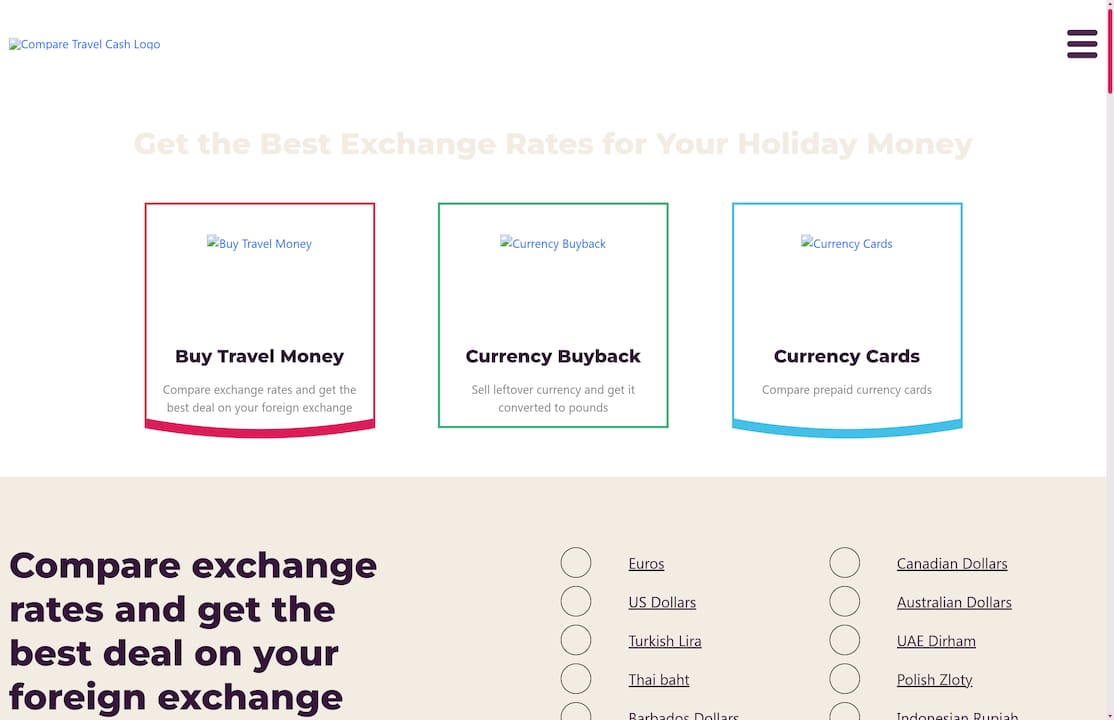
CompareTravelCash.co.uk aggregates live rates from multiple UK providers, making it simple to spot the best deal for your currency and travel dates. Whether you’re looking at Hays Travel rates for a package holiday or checking Marks and Spencer rates as a high street benchmark, the platform gives you a transparent, side-by-side view in seconds. You can also compare currency cards to find the prepaid option that best suits your destination and spending habits. Stop leaving money on the table with convenient but costly choices. A two-minute comparison can make a genuine difference to your travel budget.
Frequently asked questions
Are digital providers always cheaper for currency exchange?
Digital providers often have lower fees and rates much closer to mid-market, but extra charges like weekend markups or ATM limits can still apply, so it pays to read the fine print.
What is dynamic currency conversion and should I avoid it?
Dynamic currency conversion lets you pay in GBP abroad, but adds 3 to 7% to your bill. Always choose to pay in local currency when prompted at a card machine abroad.
Can I exchange all currencies outside their home country?
No. Certain currencies such as the Tunisian Dinar are closed currencies and can only be legally exchanged within their country of origin, so you must plan accordingly before departure.
Do ATM fees apply even with fee-free travel cards?
Yes. Even on cards with no provider withdrawal fees, ATM operator charges of €2 to €5 per transaction typically apply, levied directly by the machine owner rather than your card provider.