Most UK travellers wouldn’t dream of booking a flight without comparing prices, yet thousands exchange currency without a second thought about the rate they’re getting. That oversight can be costly. Exchange rates vary considerably between providers, and even a small difference adds up quickly when you’re converting hundreds of pounds. This guide explains what travel currency rates are, why they matter, and exactly how you can check them before your trip to make sure more of your money ends up in your pocket rather than a provider’s.
Table of Contents
- What are travel currency rates and why do they vary?
- How travel currency rates impact your holiday spending
- Comparing travel currency rates: where and how to check
- Common mistakes travellers make when exchanging currency
- Our take: why checking rates is the single most important step for travel money
- Secure the best travel currency rates with our comparison tools
- Frequently asked questions
Key Takeaways
| Point | Details |
|---|---|
| Rate awareness saves money | Checking currency exchange rates before your trip ensures you get more for your pounds and avoid hidden fees. |
| Online comparison is key | Using live comparison tools helps you instantly spot the best rates among banks, bureaux, and online providers. |
| Avoid last-minute exchanges | Leaving currency exchange until the airport usually means worse rates and higher charges. |
| Check regularly for the best deal | Rates change frequently, so monitoring in the days before you travel can maximise your savings. |
What are travel currency rates and why do they vary?
To understand why you should check rates, it’s important to grasp what travel currency rates actually are and what influences them.
A travel currency rate is simply the price at which one currency is exchanged for another. When you swap British pounds for euros or US dollars, the rate determines how much foreign currency you receive. The starting point is the mid-market rate, sometimes called the interbank rate, which is the midpoint between the buying and selling prices on global currency markets. No retail customer gets that exact rate. Every provider adds a markup to cover costs and generate profit.
Why do those markups differ so widely? Several forces are at play:
- Market forces: Currency values shift constantly based on economic data, political events, and investor sentiment.
- Provider type: Banks, high-street bureaux de change, online platforms, and airport kiosks all operate with different cost structures and profit margins.
- Timing: Rates can move meaningfully between morning and afternoon, let alone day to day.
- Volume: Some providers offer better rates for larger orders, reducing the proportional markup.
- Additional fees: Commission charges and delivery costs are sometimes added on top of the headline rate.
Common places UK travellers exchange currency include:
- High-street banks
- Post Office branches
- High-street bureaux de change
- Online currency exchange providers
- Airport kiosks
- Prepaid travel cards
Rates at high-street bureaux can vary significantly from online providers, meaning two travellers exchanging the same amount on the same day could end up with noticeably different sums of foreign cash.
Understanding foreign exchange basics is not about becoming a currency trader. It’s about recognising that the rate you accept directly controls how much spending money you have. A rate difference of just 2% on a £1,000 exchange is £20 gone before you’ve even boarded the plane. Across a family holiday, those losses compound fast.
Exploring your currency exchange options in advance gives you the leverage to choose better, rather than simply accepting whatever is offered at the nearest counter.
How travel currency rates impact your holiday spending
Once you know what affects currency rates, the next step is to see how much difference checking them really makes to your travel funds.
Let’s put real numbers on it. Say you’re converting £1,000 before a trip to Spain. The rate you secure will determine exactly how many euros land in your hand.

| Provider type | Rate (GBP to EUR) | Euros received for £1,000 |
|---|---|---|
| Online comparison platform | 1.17 | €1,170 |
| High-street bureau | 1.14 | €1,140 |
| Airport kiosk | 1.09 | €1,090 |
| Bank branch | 1.12 | €1,120 |
The gap between the online rate and the airport rate here is €80. That’s a full day of meals or a couple of excursions simply evaporating because of where the exchange happened. A better pre-trip rate comparison can leave you with considerably more spending money, without any extra effort beyond a few minutes of research.
Beyond the headline rate, watch out for these additional costs that quietly reduce what you receive:
- Commission fees: A percentage charge applied to the total exchange amount, sometimes labelled as a “service fee.”
- Fixed handling charges: A flat fee per transaction, which hits harder on smaller exchanges.
- Delivery charges: If ordering online, postal delivery may carry an extra cost unless you meet a minimum order threshold.
- Card payment surcharges: Some providers charge extra if you pay by credit card rather than debit card.
Pro Tip: Always ask for the total amount you will receive after every fee is applied, not just the headline rate. A rate that looks attractive can become far less appealing once charges are factored in.
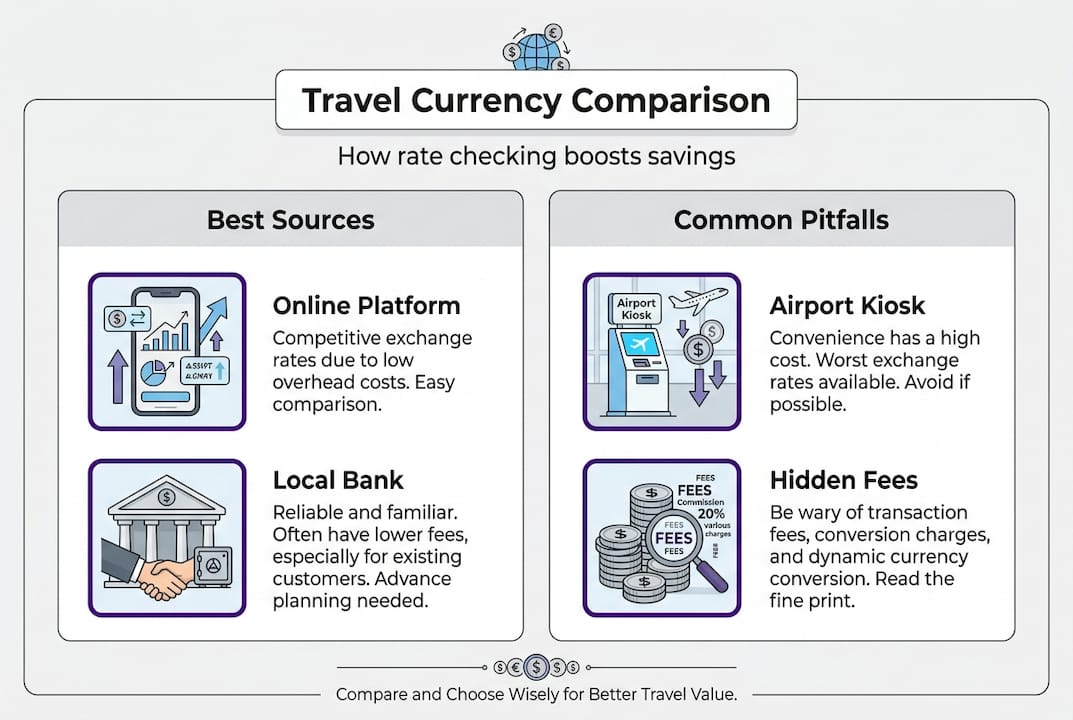
Tracking how exchange rates affect your travel budget is a straightforward habit to build. Knowing roughly what rate to expect also helps you spot a bad deal instantly, turning you from a passive buyer into an informed one. Searching for best value travel currency before committing means you negotiate from knowledge rather than guesswork.
Comparing travel currency rates: where and how to check
Understanding the impact, you’ll want to know where to find the best rates and how to compare them with minimal hassle.
The table below gives a quick snapshot of where different provider types typically sit on rate quality:
| Source | Rate competitiveness | Convenience | Extra fees common? |
|---|---|---|---|
| Online comparison platform | High | High | Rarely |
| High-street bureau | Medium | Medium | Sometimes |
| Bank branch | Low to medium | Medium | Often |
| Airport kiosk | Low | Very high | Almost always |
| Prepaid travel card | High | High | Occasionally |
Online comparison tools frequently show better rates than buying at the airport, sometimes by a margin wide enough to cover a night’s accommodation.
Here’s a simple process for checking and comparing rates effectively:
- Start early. Begin monitoring rates at least two to three weeks before departure so you can spot a favourable movement.
- Use a comparison platform. Sites that aggregate rates from multiple providers show you the market at a glance, saving individual visits to each provider’s website.
- Check the total payout. Use an online calculator to enter your exchange amount and see the exact sum you’d receive after all fees.
- Shortlist two or three providers. Pick the best rate with no or low fees, then verify that provider’s reviews and trustworthiness.
- Book online. Many online providers lock in the rate at the point of booking, protecting you from further fluctuations before collection or delivery.
- Avoid the airport. If you’ve done your homework, you won’t need to exchange there. Airport kiosks operate on high-footfall convenience, not competitive rates.
Understanding why compare exchange rates matters is one thing. Acting on it is where the savings actually happen. As departure nears, check rates every few days. Rates can shift quickly, and some providers allow you to set up alerts when a target rate is reached. Reading up on travel money saving tips alongside rate comparison rounds out a solid pre-trip financial plan.
Common mistakes travellers make when exchanging currency
Even if you know where to compare, it’s easy to slip into avoidable mistakes. Here’s what to watch for next time.
Many UK travellers lose money not through ignorance but through habit. Familiar patterns feel comfortable, even when they’re expensive. These are the most frequent pitfalls:
- Exchanging at the airport out of convenience. This is probably the costliest mistake of all. Rates at airport kiosks can be 10% or more below what you’d find online.
- Ignoring the fee breakdown. A rate of 1.15 with a £5 commission might beat a rate of 1.16 with a £10 fixed fee on a smaller exchange. The maths matters.
- Leaving it to the last minute. Scrambling to exchange on the day of travel typically means accepting whatever rate is available rather than the best one.
- Only exchanging at one provider without checking others. Loyalty to a single provider, without comparison, nearly always costs you.
- Assuming your bank gives the best rate. Banks are often among the least competitive options for travel money.
Failing to check rates often leads to paying higher fees or receiving less cash than you should. That’s money you could have spent enjoying your holiday.
Pro Tip: Sign up for rate alerts through a comparison platform so you’re notified when your target rate becomes available. This removes the need to check manually every day and means you can act quickly when a good rate appears.
Building rate-checking into your travel routine takes only a few minutes. Think of it alongside booking travel insurance or checking your passport expiry date. Reviewing best value travel currency options and understanding rates before buying are small steps that consistently deliver real financial benefits.
Our take: why checking rates is the single most important step for travel money
Beyond all the practical steps, here’s our direct experience about what really matters when it comes to currency and travel money.
We’ve seen the data across thousands of exchanges, and the pattern is consistent. Travellers who check rates regularly before their trip save more over time, not just on a single holiday but across years of travelling. The habit compounds. Once you’ve seen first-hand how much more spending money lands in your pocket by spending five minutes comparing, you don’t stop doing it.
The real insight is this: rate-checking is low effort and high reward, not unlike a pre-flight checklist. Most people wouldn’t skip checking in for their flight. Skipping a rate check carries a similar kind of avoidable risk.
Most holiday regrets about money happen after the trip, not before. Nobody thinks too hard about the airport kiosk rate until they’re back home totting up what things cost. Checking rates proactively means you make the decision with clear information, not hindsight. Understanding how rates affect your travel budget before you go is genuinely one of the most powerful things you can do as a traveller. Make it your ritual.
Secure the best travel currency rates with our comparison tools
Having learned the importance of rate-checking, here’s how you can put this into action quickly and easily.
CompareTravelCash.co.uk brings together live rates from multiple providers in one place, so you can see exactly where the best deal sits right now without visiting a dozen separate websites.
You can compare live travel money rates in seconds, whether you need euros, dollars, or any other major currency. If you’d prefer added flexibility and security on your trip, explore best prepaid travel cards as a smart alternative to carrying cash. Both tools are free to use and built to help you get more for your money before your next trip.
Frequently asked questions
Is it better to exchange travel money in advance or at the airport?
You’ll nearly always get a better rate by exchanging in advance. Airport exchange rates are usually worse compared to pre-booked rates, and extra fees are common at kiosks.
How often do travel currency rates change?
Currency rates are influenced by real-time market movements, meaning they can shift daily or even hourly, so it pays to check regularly before you travel.
What fees should I look out for when exchanging currency?
Watch out for commission charges, poor base rates, and delivery fees. Additional fees can make a significant difference to the final amount you receive, so always check the total payout.
Do prepaid travel cards offer better rates than cash exchange?
Prepaid cards tend to offer better exchange rates and greater security compared to buying foreign cash at banks or airport kiosks, making them a competitive alternative.