Every year, millions of UK travellers hand over far more money than necessary when buying foreign currency. The culprit is almost always the same: exchanging cash at the airport or on the high street without checking whether a better deal exists online. Airport rates can be up to 13% higher than rates available through online providers, costing unsuspecting travellers as much as £274 extra on a single €1,000 exchange at Gatwick. This guide explains exactly how online booking works, why it almost always wins on price, and how to apply these lessons before your next trip.
Table of Contents
- Why currency exchange costs vary so much
- How online booking for currency exchange works
- Comparing online booking to other exchange options
- Maximising your savings: tips for booking currency online
- The real reason most travellers overpay for holiday money
- Smarter ways to compare and book your travel money
- Frequently asked questions
Key Takeaways
| Point | Details |
|---|---|
| Book currency in advance | Securing your foreign cash online before you travel guarantees the best rates and saves you unnecessary expense. |
| Online beats airport rates | Ordering online can save you up to hundreds of pounds compared to exchanging money at airports. |
| Click-and-collect is flexible | You can order online and collect at various convenient locations, including high street branches or airports. |
| Always compare providers | Checking several online currency providers helps you secure the very best deal for your needs. |
| Avoid last-minute exchanges | Leaving currency exchange to the airport or last-minute usually means paying much more than you need to. |
Why currency exchange costs vary so much
Now that we have established how excessive these costs can be, let us dig into why prices differ so dramatically depending on where and how you exchange your money.
The first thing to understand is the mid-market rate. This is the real exchange rate, the midpoint between the buying and selling prices on global currency markets. It is the rate you see on Google or XE.com. No retail provider offers you exactly this rate, but the closer they get to it, the better value you receive.
When a currency provider sells you foreign cash, they apply a mark-up on top of the mid-market rate. This mark-up is their profit margin. Some providers label it a commission; others bake it invisibly into the quoted rate so it never looks like a separate charge. The result is your retail rate, which is always less favourable than the mid-market rate. Understanding exchange rates explained in these terms makes it far easier to spot who is genuinely competitive and who is quietly pocketing your holiday budget.
The size of that mark-up varies enormously between provider types:
- Airport bureaux de change operate in high-footfall, captive-audience locations. Rent is expensive, overheads are high, and most customers have no realistic alternative once they are past security. The mark-up reflects all of this.
- High-street branches face lower overheads than airports but still carry staffing and property costs. Their rates are better than airports but rarely as sharp as online.
- Online-only providers have the lowest overhead structures of all. They pass a significant share of those savings on to customers through tighter mark-ups.
Here is a straightforward illustration of what these differences look like in practice when you exchange £1,000 worth of Euros:
| Provider type | Approx. EUR received | Approx. cost vs mid-market |
|---|---|---|
| Airport walk-up | €1,085 | Up to 13% above mid-market |
| High-street branch | €1,130 | Typically 3% to 6% above |
| Online specialist | €1,155 | Around 0.3% to 1.5% above |
These are illustrative figures, but they reflect real patterns reported consistently across consumer investigations. Understanding the travel money process from start to finish helps you see exactly where these costs accumulate.
“The airport is not just inconvenient for your wallet — it is structurally designed to charge you more. You are a captive customer, and the rates reflect that reality.”
The key lesson: the mark-up is not random. It closely tracks the overhead costs and competitive pressure each provider faces. Online providers face the most competition and the lowest costs, which is precisely why their rates are consistently sharper.
How online booking for currency exchange works
With these differences in cost clear, it is time to look at how online booking actually works and why it consistently beats traditional walk-up options.
Online FX ordering works by letting you choose an amount and currency on a website or app, then either collect your cash from a branch or have it delivered to your home, all while locking in a pre-agreed rate. The process is straightforward and typically takes fewer than ten minutes to complete.
Here is a step-by-step walkthrough of what to expect:
- Visit the provider’s website or comparison platform. Enter the currency you need and the amount you want to exchange. The site will display the rate and the exact foreign currency amount you will receive.
- Compare and select your provider. If you are using a comparison tool, you can view rates from multiple suppliers side-by-side before committing to any one of them.
- Choose collection or delivery. Click-and-collect lets you pick up your cash from a branch or airport bureau at a pre-agreed time. Home delivery typically takes one to three working days and is ideal if you are not in a rush.
- Lock in the online rate. Once you confirm your order, the quoted rate is secured. The rate will not change between your order and collection, even if the market moves.
- Pay and collect. Most providers allow payment by debit card at the point of ordering. You then collect at the agreed location or wait for delivery.
Click-and-collect versus delivery: which is better?
Click-and-collect suits travellers who want their cash quickly and prefer the certainty of collecting it in person. Many providers offer airport collection points, meaning you can pre-order online and pick up near your departure gate without ever paying walk-up rates. Home delivery is more convenient for those who travel frequently and prefer everything arranged well ahead of the departure date. The main risk with delivery is a short buffer window; if your trip is less than two working days away, delivery may not arrive in time.
Why do online providers consistently offer better rates? Two reasons. First, lower operating costs mean they can afford to price more competitively. Second, pre-ordering gives providers advance notice of demand, allowing them to source currency more efficiently rather than holding costly excess stock. Both factors compress the mark-up compared to walk-up locations.
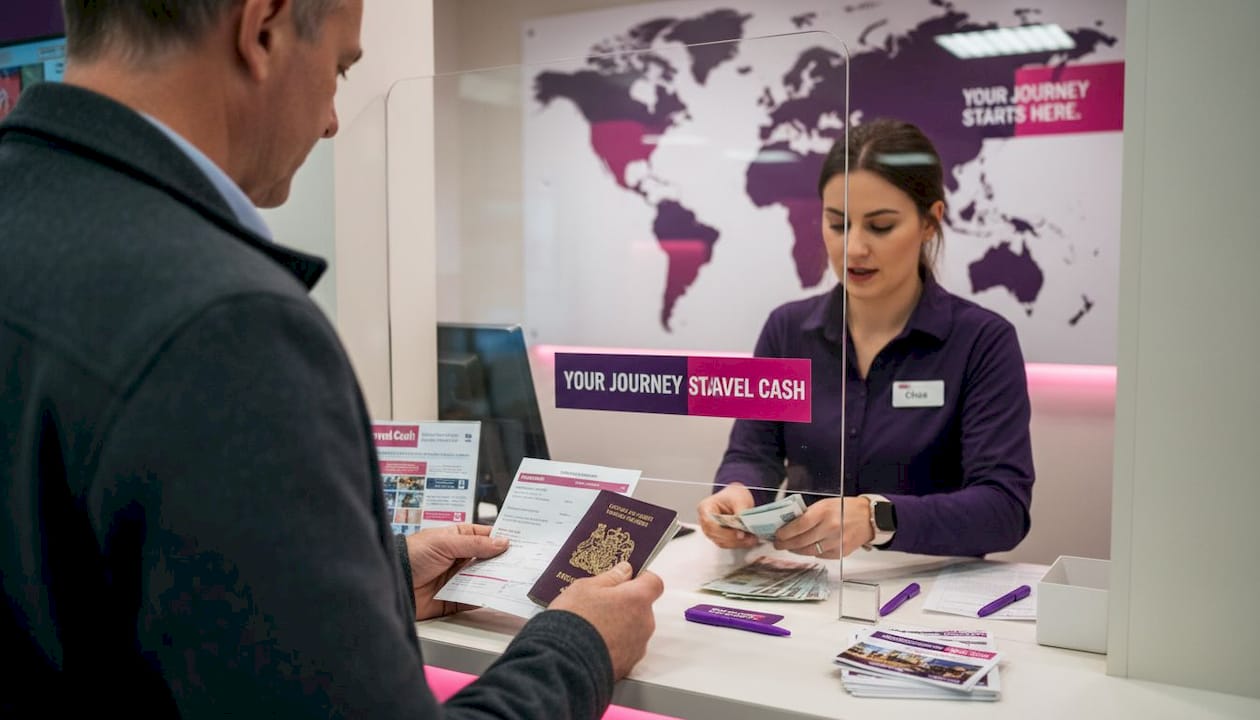
Pro Tip: Always book your currency online even if you plan to pick it up at the airport. Most major UK airports have collection points for pre-orders, and the rate difference between a walk-up and a pre-order at the same location can be substantial. Booking currency online takes just minutes and can save you tens of pounds.
For a thorough overview of what to check before you commit to any provider, the guide on how to secure travel money online covers the safety and credibility checks worth making.
Comparing online booking to other exchange options
Having covered the process, the next logical step is comparing how online booking measures up to other ways of getting your travel cash.
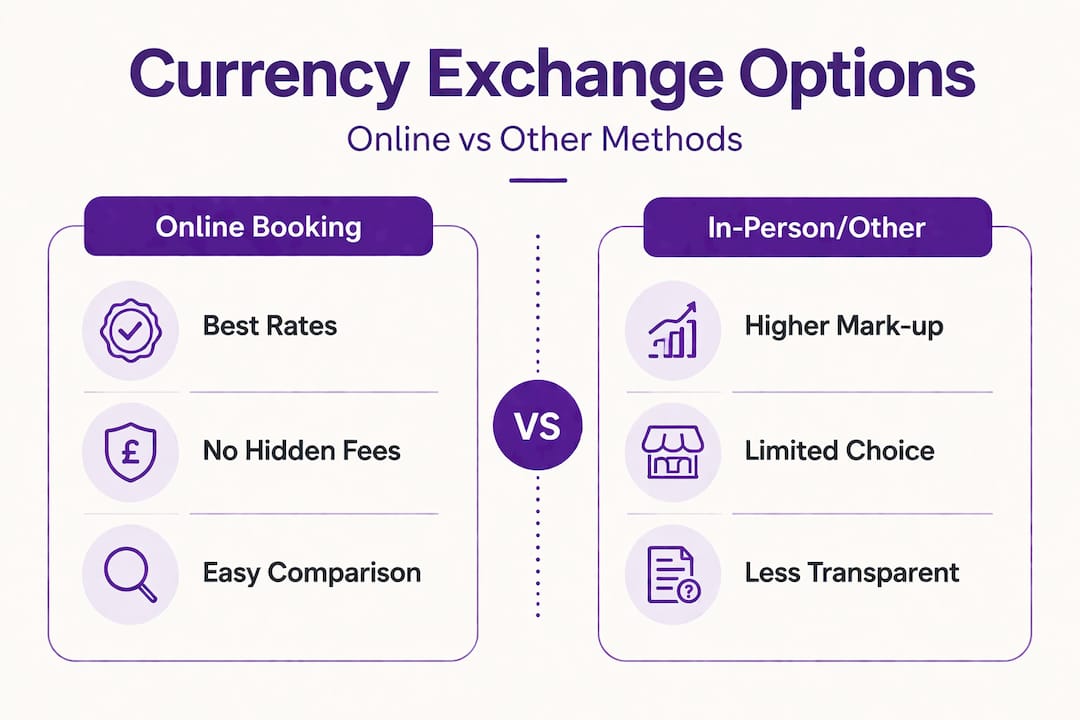
Most travellers consider four main options: ordering online, visiting a high-street branch, buying at the airport, or withdrawing cash from an ATM abroad. Each has its merits, but the differences in cost and convenience are stark.
| Method | Rate quality | Typical mark-up | Convenience | Rate transparency |
|---|---|---|---|---|
| Online booking | Excellent | 0.3% to 1.5% | High (home delivery or click-and-collect) | Full, upfront |
| High-street branch | Good | 3% to 6% | Moderate | Usually clear |
| Airport walk-up | Poor | 5% to 15% | High (if already at airport) | Often unclear |
| ATM abroad | Variable | 2% to 5% plus fees | High | Often unclear |
Online specialists consistently sit closest to mid-market rates, typically within 0.3% to 1.5%, while airport kiosks can charge between 5% and 15% above the same benchmark. That gap is where your money disappears.
Beyond the headline rate, several other factors deserve attention:
- Rate guarantee. Most reputable online providers lock in the rate at the point of order. You know precisely what you will receive before you hand over any money.
- Safety. Ordering online means you are not carrying large amounts of cash on public transport. Home delivery is insured, and click-and-collect limits your exposure time.
- Time required. A high-street visit can take an hour once travel is factored in. Online booking takes minutes.
- Stock availability. Less common currencies may be out of stock at walk-up locations. Pre-ordering online guarantees your amount is reserved.
Understanding why you should compare exchange rates before every trip is arguably the single most valuable habit a regular traveller can develop. If you have ever felt short-changed at an airport bureau, the practical guide on how to avoid airport bureau de change rates is worth reading before your next departure.
When you compare currency exchange options side by side using real figures, the case for online booking becomes impossible to ignore.
Maximising your savings: tips for booking currency online
Knowing the benefits is great, but to really capitalise on them, here is how you can squeeze every possible saving from booking travel money online.
- Book at least 24 to 48 hours before you travel. Leaving it to the last minute narrows your options and risks stock shortages for less common currencies. Ordering in advance to collect at the airport consistently produces better rates than buying at the kiosk walk-up on the day of departure.
- Always compare several providers before committing. Rates shift throughout the day, and different providers offer different deals at any given moment. A comparison platform lets you view multiple quotes simultaneously rather than visiting several websites individually.
- Use click-and-collect even for airport pickup. If you are travelling through a major UK airport, pre-ordering for collection eliminates the walk-up premium entirely. The collection point is usually located just minutes from your gate.
- Check delivery and collection terms carefully. Confirm opening hours for your chosen collection branch, minimum order amounts, and any delivery cut-off times. Missing a collection window because of unclear terms is an avoidable frustration.
- Look for providers with verified reviews and clear rate guarantees. A provider who displays their rates transparently and has strong independent reviews is far less likely to apply hidden charges or bait-and-switch pricing.
Pro Tip: Rate alerts are available on some platforms, notifying you when a currency hits a target rate. This is particularly useful if you are planning a trip several weeks in advance and want to buy when the rate is favourable rather than simply when you remember to order.
For a broader look at achieving the sharpest possible deal, the full breakdown of best rate tips is worth bookmarking before any overseas trip.
The real reason most travellers overpay for holiday money
These practical steps help, but let us step back and look at why so few UK travellers take advantage of these simple savings, and what really separates the money-savvy from the rest.
The honest answer is not ignorance. Most people know, in a vague sense, that airport rates are worse. The problem is psychological readiness. When packing bags, booking taxis, and managing the general anxiety of departure day, sorting out currency feels like a minor logistical detail. It gets pushed back until the last moment, and the airport kiosk becomes the path of least resistance.
Frequent travellers behave differently. They treat currency exchange with the same deliberateness they apply to booking flights or hotels. They compare rates days before departure, lock in an online price, and arrange collection or delivery well in advance. They have learned, often through costly experience, that the so-called “convenience” of an airport bureau is really a convenience tax paid on their behalf of the provider, not themselves.
There is also a misplaced trust factor. Many travellers assume that because a bureau de change operates in a regulated, branded airport environment, the rates must be broadly fair. They are not. The location commands a premium, and that premium comes directly out of your spending money.
“The savviest travellers prepare their spending money before packing their bags, not after.”
The mindset shift is not complicated. It simply requires treating holiday money as a priority task on your pre-trip checklist, not an afterthought. Those who build this habit into their travel routine consistently spend less on exchange costs and more on the experiences that actually matter. If you want a head start, the guide for the experienced traveller covers the full strategy in practical detail.
Smarter ways to compare and book your travel money
If you want to put these lessons into action and stop overpaying for your holiday money, here is how you can get started today.
CompareTravelCash.co.uk makes it straightforward to find and book competitive rates without trawling through multiple provider websites. You can view live rates from leading UK currency suppliers in one place, then order online for click-and-collect or home delivery to lock in your chosen rate immediately.
If you want a specific starting point, see Hays Travel rates for a reputable high-street provider with competitive online pricing. For travellers who prefer maximum flexibility, multi-currency card deals are worth exploring as an alternative to carrying cash. Ready to see the full picture? Compare more providers across all major currencies and find the deal that works best for your trip.
Frequently asked questions
How far in advance should I book currency online to get the best rate?
Book your travel money at least 24 to 48 hours before you travel to guarantee the best rates and full stock availability. Ordering in advance consistently produces better rates than buying at an airport kiosk on the day of departure.
Do I pay extra fees for booking travel money online?
Online booking fees are usually lower, with most providers offering reduced or no commission compared to airport walk-up rates. Online specialists typically sit within 0.3% to 1.5% of the mid-market rate, versus 5% to 15% at airport kiosks.
Can I still pick up pre-ordered currency at the airport?
Yes, most providers let you order online and collect at the airport, so you avoid paying inflated walk-up rates entirely. Ordering your cash online to lock in the rate and collect at a branch, even at the airport on the same day, is a well-established and widely available option.
Why are airport exchange rates so much worse?
Airport currency kiosks charge higher mark-ups to cover the premium cost of their locations, leading to rates up to 13% higher than those available through online providers.