If you have ever walked past a currency exchange booth and spotted a “0% commission” sign, you may have assumed the deal was cost-free. It rarely is. Understanding what is commission on currency exchange is one of the most practical things you can do before a trip abroad, because the real costs are often buried where most travellers never think to look. This article breaks down exactly what commission means in the context of currency exchange, how hidden markups work, what other fees you might face, and how to keep more of your money when you travel.
Table of Contents
- What commission on currency exchange actually means
- The hidden markup most travellers miss
- Other fees you need to know about
- How to reduce what you pay in commission
- Understanding your total exchange cost
- My honest take on commission confusion
- Find the best travel money rates with Comparetravelcash
- FAQ
What commission on currency exchange actually means
At its most basic level, commission in currency exchange is the fee a provider charges for converting your money from one currency to another. It is the cost of using their service. But the way that fee gets applied varies considerably from one provider to the next, and that variation is where most travellers get caught out.
Commission typically appears in one of two forms. The first is a percentage fee, where the provider charges a set percentage of the total amount you are exchanging. If you exchange £500 and the commission rate is 2%, you pay £10. The second is a flat fee, sometimes called a service charge, which applies regardless of how much you exchange. A flat fee of £7 on a £100 exchange hits you far harder than the same fee on a £500 exchange.
Some providers combine both structures, charging a small percentage alongside a fixed minimum fee. This is especially common at high-street bureaux de change and bank branches.
Here is where it gets more complicated. A large portion of what providers actually earn does not appear as a labelled commission at all. Instead, it is built directly into the exchange rate they offer you. This is called a rate markup, and it functions as a hidden commission. You exchange at a rate that is worse than the real rate, and the difference goes to the provider.
- Percentage commissions are transparent but vary widely between providers
- Flat fees are straightforward but disproportionately costly on small exchanges
- Rate markups are the most common form of hidden cost, often larger than visible fees
- Currency exchange fees consist of several interrelated components that combine to affect the total you receive
Pro Tip: Before exchanging any currency, search for the mid-market rate on a free tool or finance site. That is the real rate. Whatever rate the provider quotes you tells you immediately how much markup they are adding.
The hidden markup most travellers miss
The mid-market rate, sometimes called the interbank rate, is the true exchange rate between two currencies at any given moment. It is what banks use when trading with each other. Consumers almost never receive this rate. Providers add a margin above it, and that margin is effectively a hidden commission that never appears on any receipt.
This markup typically ranges from 2% to 6%, depending on the provider and the currency pair. On a £1,000 exchange, a 3% markup costs you £30. That is more than most fixed service charges, and most travellers have no idea they paid it.
Here is a comparison to make the difference clear:
| Provider type | Visible commission | Typical rate markup | Estimated cost on £500 |
|---|---|---|---|
| Airport bureau de change | £0 (0% commission advertised) | 5% to 8% | £25 to £40 |
| High-street bank | £5 flat fee | 3% to 5% | £20 to £30 |
| Online travel money provider | £0 to £2 | 1% to 2.5% | £5 to £14.50 |
| Specialist travel card | £0 | 0% to 0.5% | £0 to £2.50 |
The airport bureau de change advertises zero commission but charges the most overall. This is precisely why 0% commission advertising is often misleading. Providers simply shift their profit margin into the exchange rate rather than showing it as a separate fee.
“Focusing only on whether there is a visible commission charge is like judging a restaurant purely by its cover charge. The real cost is in what you order.”
Banks justify these markups partly as a buffer against currency market volatility. Exchange rates fluctuate constantly, and providers need to protect against rapid shifts in the forex market between the moment they purchase currency and the moment you buy it. That reasoning is legitimate, but it does not mean every markup is justified. Margins at airports, in particular, are far higher than market risk alone would require.
Dynamic currency conversion is another pitfall worth flagging here. When you pay by card abroad and a terminal asks whether you want to pay in sterling or the local currency, always choose the local currency. Choosing sterling triggers dynamic currency conversion, which typically applies a 5% to 15% markup on top of whatever your card charges. It is one of the most avoidable costs in travel money.
Other fees you need to know about
Beyond visible commissions and rate markups, there is a third layer of cost that catches many travellers off guard: foreign transaction fees on debit and credit cards.
When you use a standard UK debit or credit card abroad, your card issuer charges a fee for processing a transaction in a foreign currency. These fees typically range from 1% to 3%, with an average of around 1.57%. That might not sound like much, but across a two-week holiday with dozens of card transactions, it accumulates quickly.
- Foreign transaction fees are charged by your card issuer, not the merchant
- Both Visa and Mastercard may also add their own network conversion fee, usually around 0.5% to 1%
- Some banks pass the network fee through to you; others absorb it
- Specialist travel cards, including many prepaid options, waive foreign transaction fees entirely
Fixed service charges at physical exchange counters are also worth factoring in. Retail currency exchange counters often add fixed charges ranging from around £5 to £15 per transaction. On a small exchange, say £50 for spending money on a short trip, a £10 service charge represents a 20% cost before the rate markup is even considered. This is why larger transactions tend to attract better effective rates: fixed costs are spread over a greater sum, reducing their proportional impact.
The lesson here is straightforward. Any single fee, viewed in isolation, can look harmless. But commission rates for currency exchange, markups, card fees, and service charges stack on top of each other. You are often paying all of them simultaneously, and the total is usually higher than it appears.
How to reduce what you pay in commission
Reducing your currency exchange costs does not require specialist knowledge. It requires attention and a bit of planning before you travel.
-
Get a travel-friendly card. Travel credit and debit cards with no foreign transaction fee are widely recommended by travel money experts as the single most effective way to cut costs abroad. Cards such as these give you close to the mid-market rate with no added charge per transaction.
-
Always pay in local currency. When given the option at a card terminal or ATM abroad, always decline dynamic currency conversion and pay in the local currency. Your card’s rate will almost always be better.
-
Compare rates before you buy cash. The difference between providers on the same day can be surprisingly large. Using a comparison tool before you commit to a purchase takes minutes and can save you a meaningful amount. Tools that let you compare exchange rates online are particularly useful for UK travellers planning ahead.
-
Exchange a larger amount in one go. If you know you will need cash on your trip, exchanging a larger sum at once reduces the proportional impact of any fixed service charges. Two separate £200 exchanges will often cost more overall than a single £400 exchange.
-
Avoid airports and hotel desks. These are reliably the most expensive places to exchange currency. The captive audience means providers have little incentive to offer competitive rates.
Pro Tip: Check the real mid-market rate on the day you plan to exchange. If the rate a provider quotes you is more than 3% worse, keep looking. That gap is entirely avoidable with the right provider.
Understanding your total exchange cost
It helps to have a clear mental model of the different cost components and how they combine.
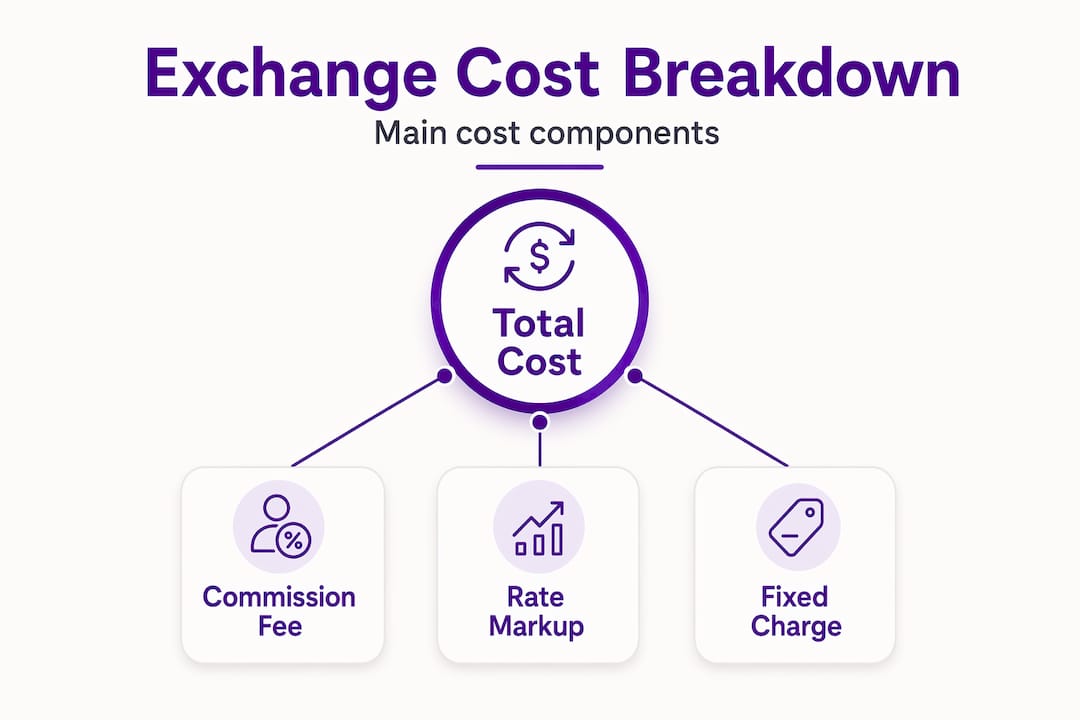
| Cost component | How it appears | Typical range |
|---|---|---|
| Visible commission | Labelled fee or percentage on receipt | 0% to 3% |
| Rate markup | Built into the exchange rate offered | 1% to 8% |
| Foreign transaction fee | Added by card issuer per transaction | 1% to 3% |
| Fixed service charge | Flat fee at physical counters | £5 to £15 |
The total cost of currency exchange is the sum of all these components, not just the one that gets advertised. A provider showing 0% commission can still be the most expensive option in the table above because their markup is the highest.
When evaluating any exchange option, ask yourself three things:
- What rate am I being offered, and how does it compare to the mid-market rate today?
- Is there a fixed or percentage fee on top of that?
- Will my card add a foreign transaction fee if I use it here?
Knowing the answers to all three puts you in a genuinely informed position, rather than just reacting to whatever marketing language is on the sign. Learning to spot poor exchange rates before committing is one of the most valuable travel money habits you can build.
My honest take on commission confusion
I have spoken to a lot of travellers who feel embarrassed that they did not realise how much currency exchange was costing them. They should not. The industry has structured its pricing to make the total cost genuinely difficult to see at a glance. That is not an accident.
What I find most frustrating is the durability of the 0% commission myth. I have seen people choose a bureau de change with a confident stride because the sign said “commission-free”, only to receive a rate so far below the mid-market rate that they would have done better almost anywhere else. The sign is technically accurate and practically misleading. Those are two very different things.
My view is that the mid-market rate comparison should be taught as a basic travel skill, in the same category as checking the baggage allowance or setting up roaming on your phone. It takes thirty seconds and it directly affects how much money you have to spend on your trip.
The travellers who come out best are not the ones hunting for some obscure trick. They are simply the ones who compare rates before buying, use a no-fee travel card for day-to-day spending, and never let an ATM or card terminal persuade them to pay in sterling. Simple, consistent, and surprisingly effective.
— Jason
Find the best travel money rates with Comparetravelcash
Understanding currency exchange commissions and hidden fees is the first step. The second step is doing something about it before your next trip.
Comparetravelcash makes it straightforward to compare live travel money rates from multiple UK providers in one place, so you can see exactly who is offering the best deal on the day you want to buy. Whether you are looking for competitive euro or dollar rates, checking the latest rates from Hays Travel, or exploring prepaid currency cards that eliminate foreign transaction fees, the tools are free and updated in real time. Stop paying more than you need to.
FAQ
What is commission on currency exchange?
Commission on currency exchange is a fee charged by a provider for converting one currency into another. It can appear as a percentage of the amount exchanged, a flat service charge, or be embedded invisibly within the exchange rate as a markup.
Why does 0% commission not mean no extra cost?
Providers advertising 0% commission typically earn their profit by offering an exchange rate worse than the mid-market rate. This markup can range from 2% to 8%, meaning the total cost to you is often higher than a provider with a visible commission but a better rate.
What are typical commission rates for currency exchange?
Visible commission rates generally range from 0% to 3%, but rate markups of 2% to 6% are common even when no commission is advertised. Fixed service charges at retail counters typically add a further £5 to £15 per transaction.
What is dynamic currency conversion and why should I avoid it?
Dynamic currency conversion occurs when a card terminal abroad offers to charge you in sterling rather than the local currency. It usually applies a 5% to 15% markup, making it one of the most expensive conversion options available. Always pay in local currency.
How can I calculate the real cost of a currency exchange?
Compare the rate offered to the current mid-market rate, then add any visible commission or service charges. The percentage difference between the two rates, plus any fees, gives you the true cost of the transaction.