The exchange rate margin is defined as the markup a currency provider adds above the true mid-market rate when converting your money. It is the most common hidden cost in foreign exchange, and most travellers never see it listed as a separate charge. Banks, travel money bureaux, and airport kiosks all embed this cost directly into the rate they quote you. Understanding it is the difference between getting fair value and quietly losing money on every trip.
What is exchange rate margin and how is it calculated?
The exchange rate margin, also known as the bid-ask spread in professional foreign exchange markets, is the gap between the mid-market rate and the rate a provider offers you. The mid-market rate is the midpoint between global buying and selling prices for a currency pair. No retail customer receives this rate. Providers set their own buy and sell rates on either side of it, and the difference is their margin.
The formula is straightforward. Subtract the provider’s offered rate from the mid-market rate, divide by the mid-market rate, then multiply by 100. The result is the margin as a percentage. A margin above 1% is worth questioning before you commit to an exchange.

Why providers charge a margin
Providers charge a margin to cover operating costs, manage market risk, and account for currency liquidity. The exchange rate margin compensates them for holding currency stock, processing transactions, and absorbing short-term price movements. It is a legitimate business cost. The problem is that it is rarely disclosed clearly.
Typical margins by provider type
| Provider type | Typical margin |
|---|---|
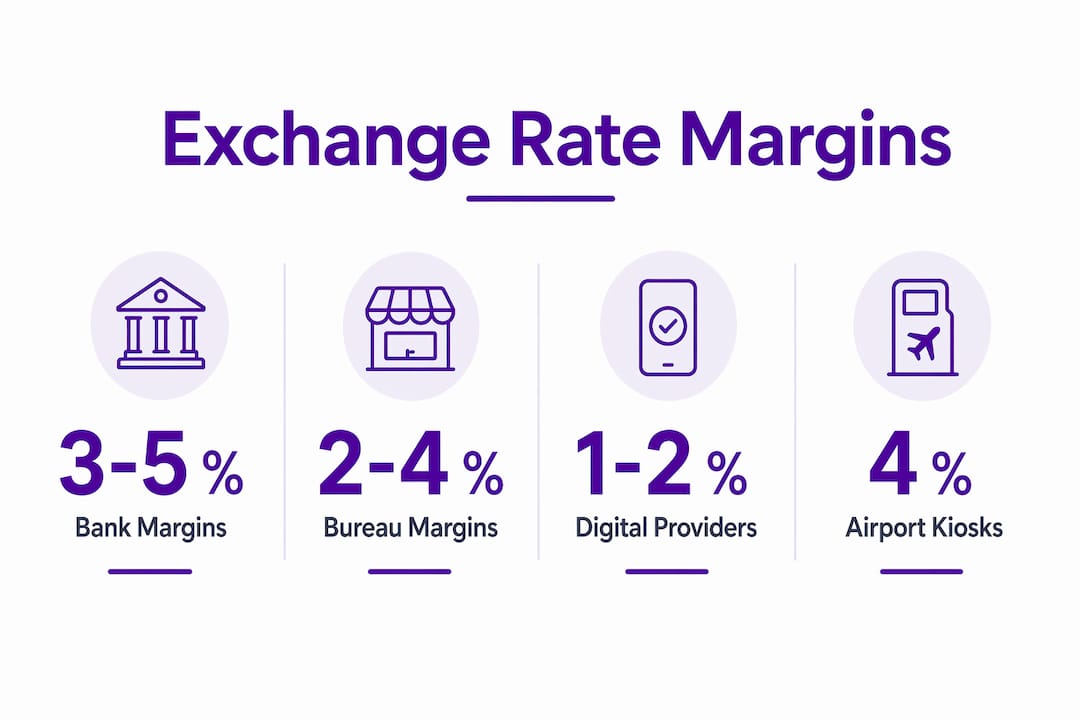
| High-street banks | 3%–5% |
| Post Office and travel bureaux | 2%–4% |
| Airport kiosks | 5%–10%+ |
| Specialist digital providers | 0.5%–1.5% |
Traditional banks apply margins of 1–5% above the mid-market rate, while specialist digital providers can reduce that margin to as low as 0.5%. That gap represents real money. On a £1,000 exchange, a 4% margin costs £40 more than a 0.5% margin.
Pro Tip: Before exchanging currency, look up the current mid-market rate on Google or a rate-checking tool like the Wise rate tracker. Compare it to the rate you are being offered. The difference, expressed as a percentage, is your true cost.
What factors influence the variation in exchange rate margins?
Exchange rate margins are not fixed. Several forces push them wider or narrower depending on the currency, the market, and the size of your transaction.
The key factors are:
- Currency liquidity. Margins are wider for exotic currencies such as the Thai Baht or Turkish Lira compared to major pairs like GBP/EUR or GBP/USD. Less-traded currencies carry higher risk for providers, so they charge more to hold and convert them.
- Market volatility. Providers widen margins during periods of economic uncertainty to protect themselves from rapid price movements. If global markets are unsettled, expect to pay more for your currency conversion.
- Transaction size. Larger transactions often attract narrower margins because the provider’s fixed costs are spread across a bigger sum. Exchanging £5,000 will typically get you a better rate than exchanging £200.
- Provider type. Airport kiosks and hotel desks operate in low-competition environments and charge accordingly. Online specialists compete aggressively and pass savings to the customer.
- Time of exchange. Currency markets move continuously. Rates at the start of a trading week can differ from those on a Friday afternoon when liquidity thins.
Understanding exchange rate terminology helps you read these factors quickly and make better decisions before you travel.
Pro Tip: If you are exchanging a less common currency, buy it before you leave the UK. Margins on exotic currencies are almost always lower at home than at your destination.
How do exchange rate margins affect travellers?
The practical impact on travellers is significant, and it compounds across a trip. A margin of 4% on a £500 exchange costs £20. On three separate exchanges across a two-week holiday, that adds up to £60 in hidden costs. None of it appears as a fee on your receipt.
The “fee-free” claim is the most misleading phrase in travel money. Providers who advertise no commission or no fees almost always recover their costs through a wider margin. The exchange rate itself is the fee. Travellers who focus only on whether a service charges commission routinely miss the larger cost embedded in the rate.
The airport kiosk trap
Airport kiosks are the most expensive place to exchange currency in the UK. They operate in a captive market where travellers are rushed, distracted, and have no alternative nearby. Margins at airports regularly exceed 10%. A traveller exchanging £300 at an airport kiosk could receive the equivalent of £270 worth of foreign currency after the margin is applied. The same exchange at a specialist online provider might yield £297 or more. Comparetravelcash has a detailed breakdown of why airport rates cost more and what to do instead.
What a margin looks like in practice
| Scenario | Mid-market rate (GBP/EUR) | Provider rate | Amount received on £500 | Effective cost |
|---|---|---|---|---|
| High-street bank | 1.18 | 1.13 | €565 | £21 lost to margin |
| Airport kiosk | 1.18 | 1.06 | €530 | £50 lost to margin |
| Digital specialist | 1.18 | 1.17 | €585 | £4 lost to margin |
The margin is embedded in the rate and not shown as a separate line item on receipts. That invisibility is what makes it so costly for travellers who do not know to look for it.
Key behaviours that increase your margin costs:
- Leaving currency exchange until you reach the airport
- Accepting the first rate offered without comparing alternatives
- Assuming “no commission” means no hidden cost
- Exchanging small amounts repeatedly rather than one larger sum
How can you calculate and minimise the impact of exchange rate margins?
Calculating the margin yourself takes less than a minute. Follow these steps before any currency exchange:
- Find the mid-market rate. Search the currency pair on Google (e.g., “GBP to EUR”) or use the Wise rate tracker. Note the rate shown.
- Get the provider’s offered rate. Ask the bureau, bank, or online service for their current rate on the same currency pair.
- Apply the formula. Subtract the provider’s rate from the mid-market rate. Divide the result by the mid-market rate. Multiply by 100. This gives you the margin percentage.
- Compare across providers. Run the same calculation for two or three providers. The difference is often striking.
- Set a threshold. A margin above 1% is worth comparing further. A margin above 3% means you should look elsewhere.
Comparetravelcash makes this process faster by aggregating travel money exchange rates from multiple UK providers in one place, so you can see the effective margin without doing the maths manually.
Strategies to reduce your margin costs
Timing and provider choice are the two biggest levers you control. Buying currency during stable market conditions reduces the risk that a provider has widened their margin to cover volatility. Choosing a specialist digital provider over a high-street bank or airport kiosk consistently delivers a lower margin. Buying in one larger transaction rather than several small ones also helps, since transaction size influences the margin you are offered.
Understanding buy and sell rates is equally useful. The buy rate is what a provider pays you for foreign currency. The sell rate is what they charge you to buy it. The gap between the two is the margin in action.
Pro Tip: Use a comparison site to check rates at least 48 hours before you travel. Rates fluctuate, and locking in a good rate online often beats any walk-in option, including those at the Post Office.
The hidden cost most travellers never question
I have watched travellers hand over hundreds of pounds in unnecessary margin costs without realising it. The most common mistake is not ignorance of exchange rates. It is the assumption that a familiar name means a fair rate. High-street banks and well-known travel bureaux trade on trust, but that trust does not translate into competitive margins.
The confusion between exchange rate margin and forex trading margin makes things worse. These are entirely different concepts. A trading margin is collateral used in leveraged financial trades. An exchange rate margin is simply the markup on a currency conversion. Mixing them up leads travellers to dismiss the topic as too technical, when in reality it is straightforward arithmetic.
What I find most frustrating is the “fee-free” framing. It is technically accurate and practically misleading. A provider can charge zero commission and still take 5% of your money through the rate. Regulators have been slow to address this, which means the responsibility sits with the traveller. The good news is that awareness alone closes most of the gap. Once you know to compare the offered rate against the mid-market rate, you will never accept a poor deal without noticing it.
The market is also improving. Digital providers have forced traditional institutions to sharpen their rates in many currency corridors. Competition works. Using it is the simplest thing any traveller can do.
— Jason
Compare rates and cut your margin costs before you travel
Knowing what an exchange rate margin is only helps if you act on it before you exchange your money.
Comparetravelcash pulls together live travel money rates from providers across the UK, including Hays Travel, The Currency Club, and Marks & Spencer, so you can see which offers the tightest margin on your currency. You can also compare prepaid currency cards, which often carry lower margins than cash exchanges. Checking rates takes two minutes and can save you a meaningful sum on every trip. The comparison is free, and the best rate is usually not where you expect it.
FAQ
What is exchange rate margin in simple terms?
The exchange rate margin is the difference between the mid-market rate and the rate a provider offers you. It is the provider’s hidden profit on your currency conversion.
Is exchange rate margin the same as a transaction fee?
No. A transaction fee is a separate, stated charge. The exchange rate margin is embedded inside the quoted rate and does not appear as a line item on your receipt.
How do I know if a margin is too high?
Use the formula: (mid-market rate minus provider rate) divided by mid-market rate, multiplied by 100. A margin above 1% is worth comparing against other providers before you commit.
Why do airport exchange rates have such high margins?
Airport kiosks face little competition and serve travellers who have run out of time to shop around. This captive market allows them to apply margins that regularly exceed 10%.
Does “no commission” mean no exchange rate margin?
No. “Fee-free” offers typically recover costs through a wider margin on the exchange rate itself. Always compare the offered rate to the mid-market rate, regardless of what fee structure is advertised.