Most UK travellers assume all currency exchange options are roughly the same. They’re not. Airport, hotel, and captive-audience exchange rates are typically 10 to 15% worse than high street rates, which means exchanging £500 at an airport could cost you £50 to £75 more than it should. In-store money exchange, done correctly and in the right location, is one of the most reliable ways to protect your travel budget. This guide explains exactly how to use it to your advantage.
Table of Contents
- What is in-store money exchange?
- Why in-store money exchange often beats airport rates
- How to secure the best in-store money exchange rates
- Top mistakes UK travellers make with in-store currency exchange
- Why the best rates come from careful planning, not luck
- Find your best in-store exchange rate
- Frequently asked questions
Key Takeaways
| Point | Details |
|---|---|
| Airport rates are costly | Airport exchanges often charge 10–15% more than high street shops. |
| Preordering saves money | Ordering currency in advance from in-store providers usually delivers the best rates. |
| Compare providers | Always check multiple high street stores to find the best in-store money exchange rate. |
| Avoid last-minute mistakes | Waiting until the airport leads to poor deals and wasted money. |
| Plan for buy-back | Some in-store providers offer buy-back programmes for unused currency, adding extra value. |
What is in-store money exchange?
In-store money exchange refers to visiting a physical location, such as a high street bureau de change, a bank branch, a travel agent, or a specialist currency shop, to swap British pounds for foreign currency. You walk in, present your cash or card, select the currency you need, and receive foreign notes at the quoted rate. Simple in theory. But the details matter enormously.
It is important to distinguish in-store exchange from two alternatives that travellers often confuse it with. The first is airport or hotel exchange, which operates on a captive-audience model. You have already arrived, you are short on time, and the provider knows it. The second is buying currency online, which lets you lock in a rate from your sofa and either collect from a branch or receive delivery to your home.
Here is what sets high street in-store exchange apart from the alternatives:
- Competitive rates: High street providers compete directly with each other, which tends to keep margins tighter and rates more favourable for you.
- No time pressure: You visit on your own schedule, without a departure gate looming overhead. That means you can shop around without stress.
- Rate transparency: Reputable in-store providers display their rates clearly, allowing you to compare before you commit.
- Pre-order availability: Many high street stores allow you to reserve currency online at a confirmed rate, then collect it in person, often at a better price than a walk-in exchange.
- Staff knowledge: In-store staff can explain charges, minimum order thresholds, and whether fees apply, information that online platforms may bury in the small print.
In-store competitors often provide better value, particularly when travellers take advantage of the preorder option. That single detail, ordering ahead rather than turning up on the day, can make a meaningful difference to what you actually receive.
Why in-store money exchange often beats airport rates
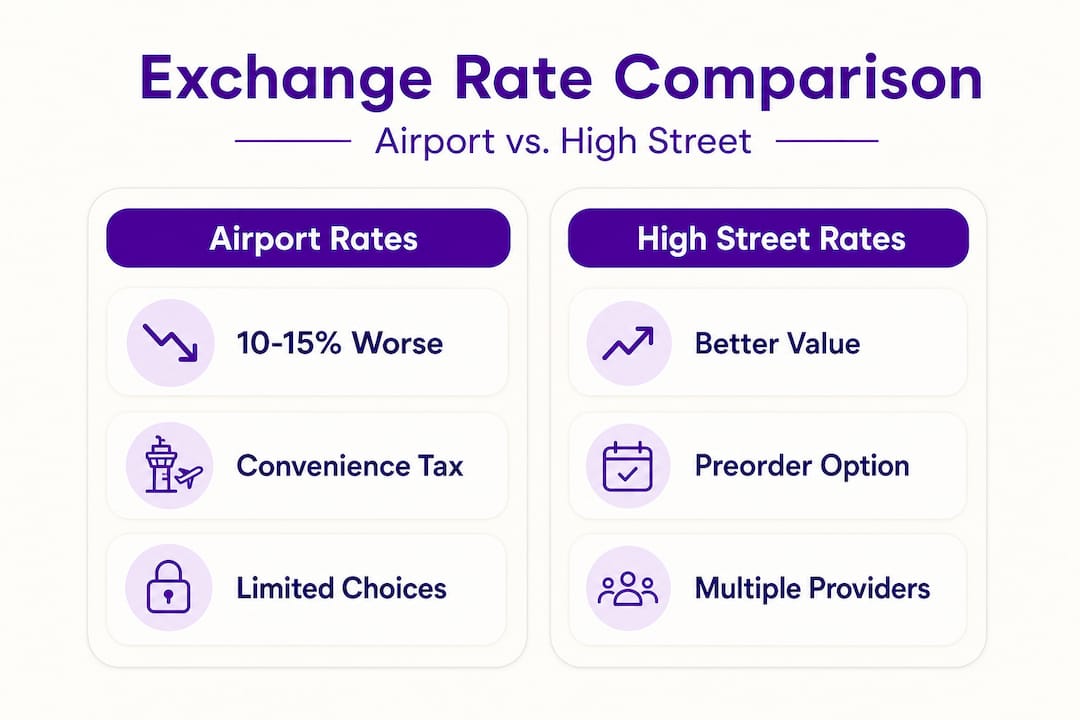
The gap between airport and high street exchange rates is not marginal. It is structural. Airport bureaux de change, along with hotel exchange desks and motorway service station currency outlets, operate in what the industry calls a captive-audience environment. You are already there. You need the currency. And they know you are unlikely to walk away.
Airport exchange bureaux rates are reported as 10 to 15% worse than high street rates. To put that into concrete numbers, consider the following comparison using a hypothetical mid-market rate (the true midpoint between the buying and selling price of a currency, sometimes called the interbank rate):
| Exchange location | Rate (£1 to EUR) | You receive for £500 |
|---|---|---|
| Mid-market rate | 1.18 | €590.00 |
| High street in-store | 1.14 | €570.00 |
| Airport bureau de change | 1.00 | €500.00 |
| Hotel exchange desk | 0.98 | €490.00 |
The difference between the high street rate and the airport rate in this example is €70 on a £500 exchange. That is enough to cover a decent dinner, a day trip, or your first night’s accommodation. Over a two-week family holiday where multiple exchanges might take place, the cumulative cost of airport-rate thinking is genuinely significant.
“The rates at airports and hotels are often the worst available. Smart travellers know to plan ahead and use high street options wherever possible.”
This is what the industry sometimes calls a “convenience tax.” You pay a premium not for a better service but simply for the timing of your decision. The airport exchange pitfalls are well documented, and most experienced travellers learn this lesson once, usually the hard way.
It is also worth noting that many airport bureaux advertise “zero commission” prominently. This phrase is designed to suggest you are getting a good deal. In reality, zero commission simply means the provider builds its profit into the exchange rate itself rather than charging a separate fee. The headline looks attractive; the actual rate is not. Always focus on how many units of foreign currency you receive per pound, not on whether commission is charged.
Exploring your currency exchange options before you travel, rather than at the moment you need cash, is one of the most impactful financial decisions you can make for any trip abroad.
How to secure the best in-store money exchange rates
Knowing that high street rates beat airport rates is a good starting point. But not all high street exchanges are equal either. Here is a practical, step-by-step approach to ensuring you get the most from your in-store exchange.
-
Compare rates from multiple providers before you go. Rates vary between banks, travel agents, and specialist bureaux, sometimes by several percentage points. A quick comparison before you leave the house takes minutes and can save you a meaningful sum.
-
Preorder your currency online for in-store collection. Many providers offer improved rates when you commit in advance. This is because preordering gives them certainty about demand. The result is a better rate passed on to you. Better rates are commonly found by using high street competitors and preordering ahead of collection.
-
Exchange currency well before your travel date. Ideally, sort your travel money at least a week before departure. Rates fluctuate daily based on economic data, political events, and market sentiment. Locking in a good rate early removes the risk of a last-minute dip. Reading up on why you should exchange money before travel gives a clear picture of why timing is so important.
-
Know the mid-market rate before you walk in. Check a financial data site or currency app for the current interbank rate. This gives you an independent benchmark to compare against the rate being offered. If a provider’s rate is more than 3 to 4% below mid-market, consider looking elsewhere.
-
Avoid exchanging small amounts. Some providers apply a higher markup or a flat fee on exchanges below a certain threshold. Exchanging a larger sum in one transaction is generally more cost-effective.
-
Ask about buy-back rates. If you expect to return with unused foreign currency, it is worth knowing in advance what rate the provider offers to buy it back. This is part of the total cost picture and is often overlooked. Your holiday currency checklist should include this step as standard.
-
Consider the full cost of travelling without local cash. While card payments are widely accepted in many destinations, relying entirely on your debit or credit card abroad can attract foreign transaction fees, ATM withdrawal charges, and unfavourable dynamic currency conversion rates. Having local cash from a well-priced in-store exchange covers you for markets, taxis, small shops, and anywhere that does not accept cards. For more on combining payment methods wisely, travel on a budget resources offer useful guidance.
Pro Tip: Never exchange currency at the first provider you see. Even on the high street, rates between two shops a few doors apart can differ by 2 to 3%. Five minutes of comparison can save you considerably on a larger exchange.
Top mistakes UK travellers make with in-store currency exchange
Understanding what to do is only half the picture. Equally important is knowing what to avoid. These are the most common errors UK travellers make when exchanging currency in-store, and how to sidestep each one.
-
Leaving it until the airport. This is by far the most costly mistake. Many travellers end up paying more by exchanging at airports, often without realising quite how much the poor rate is costing them. The urgency of departures makes comparison impossible and providers take full advantage of that.
-
Visiting only one provider. Many people assume the rates at their bank or their nearest travel agent are standard. They are not. Rates are set independently by each provider, and the differences can be substantial. Comparing at least two or three options before committing is a simple habit that consistently saves money.
-
Ignoring the buy-back rate. Most travellers focus exclusively on the buying rate and give no thought to what happens to any leftover currency when they return. If you exchange a large amount and come home with, say, €150 unspent, the buy-back rate determines how much you recover. Some providers offer genuinely competitive buy-back deals; others offer very little. Checking this in advance is part of smart planning.
-
Overlooking alternative travel payment options. A growing number of travellers are combining in-store cash with prepaid currency cards or specialist travel cards for added flexibility. These can offer competitive rates and eliminate some ATM fees abroad. Understanding the full range of travel payment options available today helps you build a smarter overall strategy.
-
Not reading the terms on commission and fees. Some providers advertise attractive headline rates but charge a flat fee or minimum commission per transaction. Always ask directly: what is the total amount of foreign currency I will receive for this amount of pounds? That question cuts through any ambiguity.
-
Assuming your bank offers the best rate. Banks are convenient, but they are rarely the most competitive in-store exchange option. Specialist bureaux de change and comparison platforms almost always provide better value. Check travel money FAQs for clear answers on where the best rates are typically found.
Pro Tip: Before heading out to exchange money in-store, bookmark or screenshot the mid-market rate for your currency. Use it as a reference point in every conversation with a provider. It immediately reveals how far each rate deviates from the fair benchmark.
Avoiding these mistakes is also closely linked to avoiding travel money fees more broadly, including hidden charges on cards and ATM withdrawals that many travellers do not factor into their budget.
Why the best rates come from careful planning, not luck
Here is something worth saying plainly: most travellers who get a bad exchange rate do not get one because they were unlucky. They get one because they made a decision, or failed to make one, at the wrong moment.
There is a widespread belief that exchange rates are largely fixed and that the variation between providers is trivial. Neither is true. Rates shift daily, sometimes dramatically, in response to economic data releases, central bank decisions, and geopolitical events. A rate that looks strong on a Monday can look quite different by Thursday. Providers also set their own margins independently, meaning the same currency bought from two shops on the same street on the same day can vary by a meaningful percentage.
The travellers who consistently get the best outcomes are those who treat currency exchange as a deliberate decision, not an afterthought. They check rates in advance. They preorder. They compare. They know what the mid-market rate is before they walk into any shop. That is not luck. It is preparation.
The uncomfortable reality is that the currency exchange market is designed to reward the informed and penalise the unprepared. Providers operating in high-footfall, time-pressured environments such as airports set their rates knowing that most customers will not compare. They rely on inertia and urgency. Removing those two factors, by planning travel money well in advance and on your own terms, is the single most effective thing you can do to improve the value you receive.
Find your best in-store exchange rate
If this article has made one thing clear, it is that getting a good rate is achievable. You simply need the right tools and enough lead time to use them.
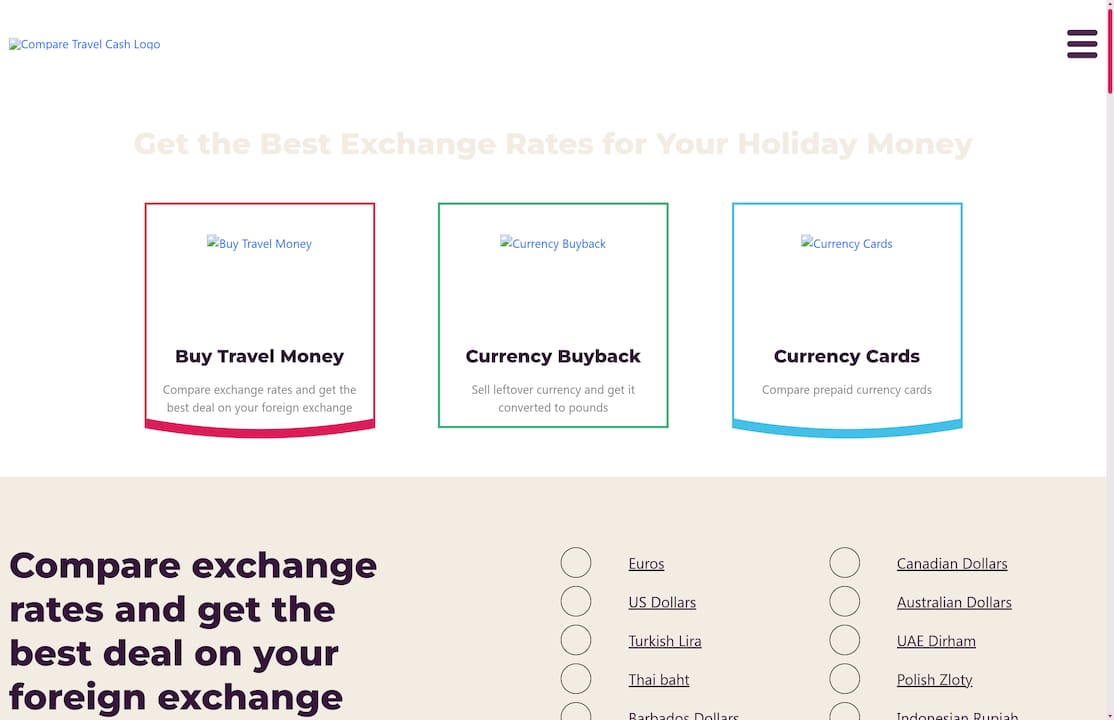
At CompareTravelCash.co.uk, you can compare live in-store exchange rates from multiple UK providers in seconds, covering popular currencies including Euros, US Dollars, Turkish Lira, Thai Baht, and many more. You can also explore buy-back deals to see what you will recover on unused currency, and compare prepaid currency cards for added flexibility abroad. Whether you are planning a city break or a long-haul holiday, the platform makes it straightforward to find competitive rates and book with confidence before you travel.
Frequently asked questions
How is in-store money exchange different from online and airport bureaux?
In-store exchanges offer more competitive rates than airports, and the option to pre-order currency often improves the deal further. Airport rates are often 10 to 15% worse than high street exchanges, making in-store the smarter choice for most travellers.
Is pre-ordering currency at a high street store worth it?
Yes. Preordering is commonly linked to better rates with in-store competitors, as providers reward advance commitment with improved pricing compared to walk-in transactions.
Why are airport exchange rates so much worse?
Airport bureaux use captive-audience pricing because passengers are already committed to travel and have little time to compare. Airport exchange bureaux offer rates that are typically 10 to 15% poorer than high street alternatives.
Are buy-back deals worth considering for unused currency?
Yes, particularly if you expect to return with a notable amount of unspent cash. Some high street stores offer competitive buy-back rates, making them worth factoring into your choice of provider before you even buy.
What is one expert tip for UK travellers exchanging money in-store?
Always compare rates from at least two or three different shops and consider preordering to lock in a better price. Better value is commonly found by using high street competitors and preordering rather than exchanging spontaneously.