Missing the best exchange rate on a typical holiday currency purchase can quietly cost you £100 or more before you’ve even checked in to your hotel. Airport rates are 10-15% worse than those available online or on the high street, and even a small difference in timing can chip away at your spending money in ways that only become obvious when you’re already abroad. The good news is that tracking exchange rates is neither complicated nor time-consuming, and this guide will walk you through exactly what tools to use, how to set up alerts, and how to verify you’ve secured the best possible deal before your trip.
Table of Contents
- What you need before you start tracking exchange rates
- Step-by-step: How to set up exchange rate alerts and trackers
- Troubleshooting and common mistakes to avoid
- Verifying the result: Getting the best deal in the end
- Why most UK travellers miss out on top rates and how you can do better
- Compare and secure the best exchange rates for your next trip
- Frequently asked questions
Key Takeaways
| Point | Details |
|---|---|
| Plan in advance | Tracking rates before your trip gives you real power to save on travel money. |
| Use alerts and top tools | Apps like XE, Wise, and Revolut help you monitor and act at the right time for the best rates. |
| Avoid common mistakes | Steer clear of weekend rates, airport exchanges, and always compare the total cost, not just the headline rate. |
| Verify your deal | Check final rates against mid-market benchmarks to be sure you‘ve got the best value. |
What you need before you start tracking exchange rates
Now that you understand how much you could lose or gain, let’s make sure you’ve got everything ready before you begin monitoring rates.
Before you can track anything effectively, a little preparation goes a long way. The process is far simpler than it sounds, but having the right setup in advance means you won’t be scrambling at the last minute when a good rate appears. This is where most travellers fall short. They think about exchange rates two days before departure, by which point the best rates have already come and gone.
The essentials are straightforward. You need a smartphone or laptop with a reliable internet connection, an idea of which currency pair you want to watch (for example, GBP to EUR or GBP to USD), and a rough sense of how much you plan to exchange. That last point matters more than most people realise. Knowing your budget allows you to calculate the real-world value of even a one or two percent rate improvement. On a £2,000 exchange, a 2% better rate puts £40 back in your pocket.
Dedicated currency tracking services like XE.com and the Wise app allow you to monitor live mid-market rates and set automatic alerts, so you’re notified the moment your target rate is hit. Signing up takes under five minutes and gives you a serious advantage over travellers who rely on guesswork. Our complete travel money guide also covers the wider picture of saving on currency before and during your trip.
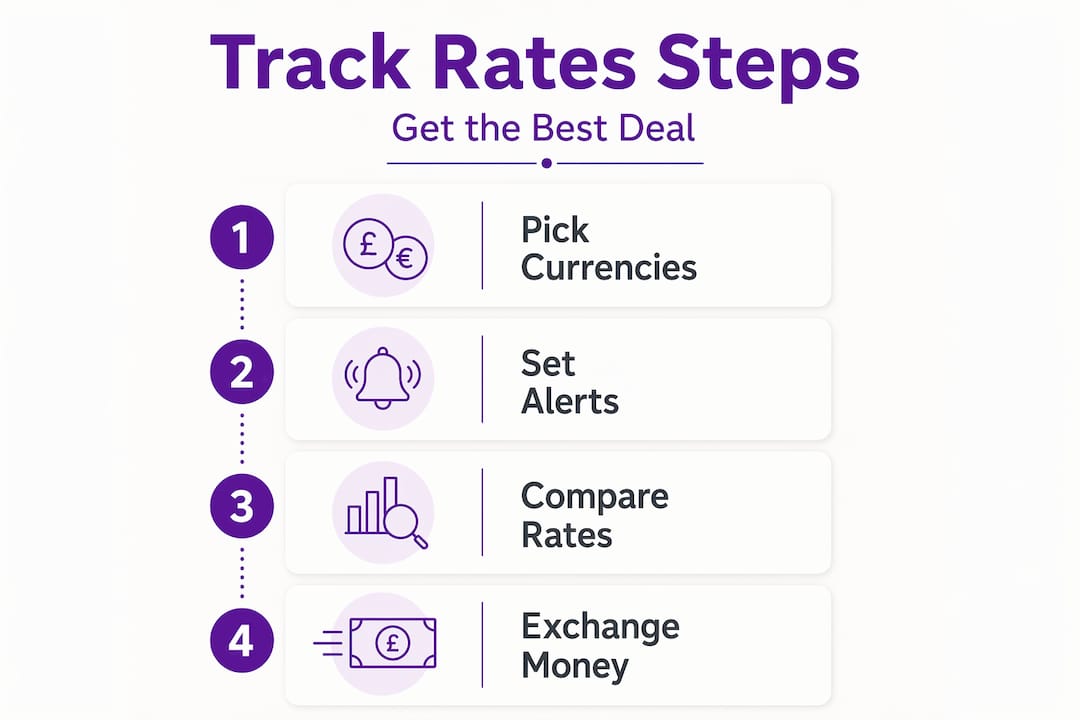
Here is a quick-reference table of what you need before you start:
| Item | Why it matters |
|---|---|
| Smartphone or laptop | Access to live rates and alert apps |
| Email address | Receive rate alert notifications |
| Target currency pair (e.g. GBP/EUR) | Focus your tracking on one or two pairs |
| Exchange budget (in GBP) | Calculate real savings from rate movements |
| Account with XE, Wise, or Revolut | Set personalised alerts and track charts |
| Knowledge of trip dates | Helps define your tracking window |
Key essentials to gather before you begin:
- Know your destination currency and the approximate amount you need
- Download at least one dedicated tracking app (XE, Wise, or Revolut)
- Understand the mid-market rate, which is the midpoint between buying and selling prices and the fairest benchmark for comparison
- Check online exchange advice to familiarise yourself with what realistic rates look like for your pair
Being prepared is the foundation. Everything else builds on it.
Step-by-step: How to set up exchange rate alerts and trackers
With all prerequisites sorted, you’re ready to actually start tracking rates. Here’s how to get set up quickly with the most widely used tools.
Each of the three main platforms works slightly differently, but all of them give you the core functionality you need: live rates, historical context, and alert notifications. Here is how to set up each one.
Setting up XE alerts:
- Visit the XE Currency Converter website or download the XE app.
- Select your currency pair, for example GBP to EUR.
- Choose the rate threshold at which you want to be notified.
- Enter your email address to receive the alert. XE does not always require a full account for basic alerts, making it the fastest option for beginners.
- Confirm the alert and wait for the notification.
Setting up Revolut alerts:
- Open the Revolut app and go to the currency exchange section.
- Select your desired currency pair.
- Set a target rate threshold using the slider or manual input.
- The app will notify you when that rate is reached. Revolut offers live rates with a one-tap convert function, making it highly convenient for those already using the app for travel spending.
Setting up Wise alerts:
- Download the Wise Currency Converter app.
- Add your preferred currency pairs to your favourites list.
- Review historical rate charts, which can cover up to 500 days of data, helping you judge whether current rates are genuinely favourable or just average.
- Set a target alert within the app.
Here is a comparison of the three main tracking tools:
| Feature | XE | Wise | Revolut |
|---|---|---|---|
| Live mid-market rate | Yes | Yes | Yes |
| Rate alert notifications | Yes (email) | Yes (push) | Yes (push) |
| Historical charts | 10 years | Up to 500 days | Limited |
| Account required | Optional | Yes | Yes |
| Direct exchange function | No | Yes | Yes |
| Free to use | Yes | Yes | Basic free |
Understanding the mid-market rate is central to using these tools well. The mid-market rate is the real exchange rate, the one banks and currency providers use when trading with each other. It does not include any markup or commission. When a provider gives you a rate, they add a spread on top of the mid-market rate, which is how they make their margin. The closer your provider’s rate is to the mid-market rate, the better the deal you’re getting.
Pro Tip: Set multiple alerts at different thresholds rather than just one. For example, set one alert at your ideal rate and another at a slightly lower rate as a fallback. This way, you won’t miss the window if rates move fast. Also consider alerts for different times of day since rates can shift noticeably between morning and afternoon sessions.
Learning how to avoid bad exchange rates is just as important as chasing good ones, and it’s worth understanding both sides of the equation before you commit to an exchange. Once you’re comfortable with alerts, you may also want to compare exchange options to see which provider type suits your situation best.
Troubleshooting and common mistakes to avoid
Even with tools in place, traps remain. Here’s how to sidestep the biggest pitfalls in exchange rate tracking.
Having alerts set up doesn’t mean you can switch off entirely. Several common errors can undermine the savings you’ve worked to secure. Being aware of them in advance puts you firmly in control.
Common mistakes UK travellers make when tracking rates:
- Relying on weekend rates. Currency markets are closed at weekends, which means rates are effectively frozen. Providers use the Friday close rate and often apply a wider spread of 0.5-1% to protect against Monday morning volatility. Exchanging at the weekend quietly costs you more than you expect.
- Ignoring the total cost. A rate that looks strong can still be expensive if the provider charges a service fee on top. Always calculate the total cost of the exchange, not just the headline rate.
- Accepting dynamic currency conversion (DCC) abroad. When an ATM or card machine abroad offers to charge you in pounds rather than the local currency, decline. This is DCC, and it almost always uses an unfavourable rate loaded with hidden markup.
- Forgetting about Bank of England and Federal Reserve announcement dates. Volatility spikes around major central bank decisions, which can move rates sharply in either direction within minutes.
Important: The mid-market rate from sources like OANDA or XE is your benchmark, but no retail provider will actually offer you that rate. What matters is how close to mid-market you can get. Anything more than 2-3% away from mid-market deserves scrutiny.
Pro Tip: Even after an alert fires, check the live rate one more time before confirming your exchange. Rates can reverse quickly, especially around news events. A brief double-check takes thirty seconds and ensures you’re acting on current data rather than a rate that has already slipped. For more guidance on keeping costs down, see our travel money tips and review this detailed rate evaluation approach.
Verifying the result: Getting the best deal in the end
Once you’ve acted on an alert, it’s time to confirm you really did secure a top rate.
Acting on an alert is one thing. Knowing with confidence that you got the best available deal is another. This verification step takes just a few minutes and gives you certainty before you hand over your money.
End-to-end checklist for confirming your deal:
- Open XE or Wise and note the current mid-market rate for your currency pair.
- Compare the rate your chosen provider is offering against that benchmark. Anything within 1-2% is strong. Above 3% is worth querying.
- Add any fixed fees to the calculation. A provider offering a marginally better rate but charging a £5 service fee may actually be more expensive overall for smaller amounts.
- Check if a fee-free travel card could serve you better for your spending amount. For many travellers, fee-free cards such as Monzo, Starling, or Chase paired with rate alerts represent the most cost-effective combination available.
- For exchanges of £1,000 or more, consider whether a currency broker could offer a more competitive rate than a standard online provider. The savings can be meaningful.
- Confirm the exchange and keep a record of the agreed rate and total sterling cost.
Pro Tip: For large amounts above £1,000, spending ten minutes researching broker rates or calling directly can save you £50 to £200 compared with standard online providers. For smaller amounts, a fee-free travel card that uses the mid-market rate when you spend is typically the simplest and most competitive option. Either way, avoid exchanging at airports or hotels where markup is consistently the highest.
If you’re not yet familiar with the benefits of ordering currency online, our article on why you should exchange money online lays out the case clearly. For card-based options, browsing currency card deals gives you a direct view of what’s currently available.
Why most UK travellers miss out on top rates and how you can do better
Here is a truth UK travellers rarely hear: the biggest reason people overpay for travel money is not that good rates don’t exist. It’s that they simply don’t look at the right time.
The pattern is remarkably consistent. Travellers know they need foreign currency, but they leave the decision until the week before departure, or worse, the day of travel. At that point, options narrow dramatically. Airports are the only option for many, and competitive exchange rates are nowhere to be found in a departure lounge.
What’s frustrating is that the solution requires almost no effort at all. Setting up two or three rate alerts takes under ten minutes. Checking a live rate comparison before exchanging takes sixty seconds. These are not tasks reserved for financially savvy travellers or currency experts. They’re simple habits that any smartphone user can build into their pre-trip routine.
There is also a persistent myth that you need to time the market perfectly to save meaningfully. You don’t. The goal isn’t to catch the all-time best rate of the year. The goal is simply to avoid the worst rates and to exchange when conditions are at least reasonably favourable. Consistent, modest improvements beat occasional perfection every time.
For those making larger exchanges, say above £2,000, the stakes are higher and the reward for a few extra minutes of research is proportionally larger. A one-percent improvement on a £3,000 exchange is £30 saved, and a two-percent improvement is £60. That’s a decent dinner abroad, not pocket change.
The travellers who consistently get good rates are not doing anything exotic. They’re using free tools, checking rates a few weeks before their trip, and spending their money through a fee-free card rather than an airport bureau. That’s the whole strategy. Simple, repeatable, and genuinely effective.
Compare and secure the best exchange rates for your next trip
Ready to make your research pay off? Putting rate tracking into action is the natural next step, and that’s exactly where CompareTravelCash.co.uk can help.
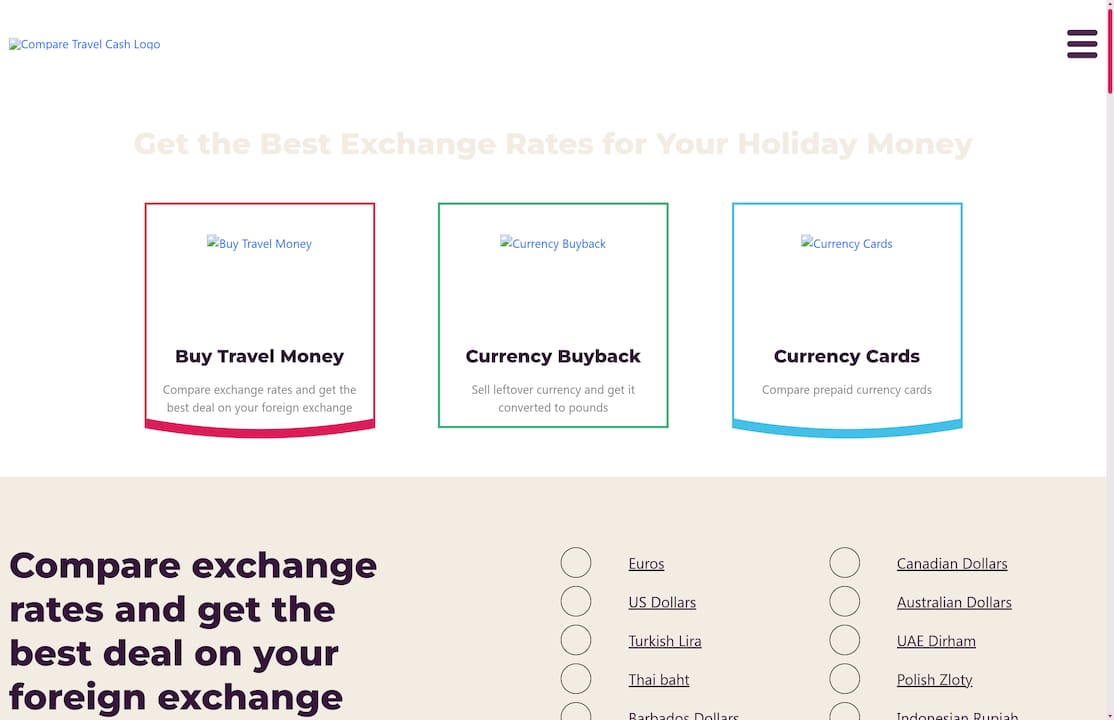
Once your alerts fire and you’ve identified a strong rate, the next step is comparing live offers from multiple providers in one place rather than checking each one individually. CompareTravelCash.co.uk pulls together buy rates from a wide range of UK providers so you can see at a glance who’s offering the most competitive deal right now. You can also compare prepaid currency cards for fee-free spending abroad, or check specific providers such as Hays Travel money rates directly. Head to CompareTravelCash.co.uk to start comparing live rates and make sure your tracking efforts translate into real savings.
Frequently asked questions
How often do exchange rates change?
Exchange rates can fluctuate minute-to-minute during trading hours, with volatility spiking around Bank of England and Federal Reserve announcements or significant economic news. Markets are effectively closed at weekends, so rates remain static until Monday morning.
Is it better to lock in a rate now or wait for a better one?
If rates are already favourable, locking in with a prepaid deal is often the safest approach, particularly for larger amounts. For smaller spends, a fee-free card that applies the live rate at the point of purchase may yield better results if rates continue to improve.
Which app is best for tracking multiple currencies?
The Wise app tracks live rates across multiple currency pairs and provides historical charts covering up to 500 days, making it ideal for travellers watching several destinations. XE is equally reliable and particularly straightforward for setting email-based alerts quickly.
Should I exchange at the airport if I forgot to do it earlier?
Airport rates are typically 10-15% worse than those available from online providers or on the high street, making them a costly last resort. A far better option is to load a fee-free travel card before you travel, which gives you near-mid-market rates at the point of spending.
How do I tell if I’m actually getting the mid-market rate?
Check your quoted rate against XE or Wise’s benchmark to see how far from mid-market your provider sits. True mid-market rates carry no markup or commission, so any retail rate you’re quoted will always be slightly less favourable than the benchmark figure.