Exchange rates are not as predictable as most UK travellers assume. Many people believe rates shift gradually, giving them plenty of time to act, but the reality is that both sweeping global events and subtle behind-the-scenes market mechanics can produce sharp, sudden movements that directly affect how much foreign currency you receive. Whether you are planning a fortnight in Spain, a city break in New York, or an adventure in Southeast Asia, understanding what drives exchange rates is one of the most practical things you can do before you depart. This guide breaks down the key forces at work and shows you how to use that knowledge to protect your travel budget.
Table of Contents
- Supply and demand: the basic driver
- Interest rates, inflation, and economic policy
- Trade balances, debt, and political stability
- Market microstructure: liquidity, volatility, and dealer positioning
- Capital flows and government interventions
- Our perspective: what UK travellers really need to know about exchange rate shifts
- Secure better rates for your next trip
- Frequently asked questions
Key Takeaways
| Point | Details |
|---|---|
| Supply and demand shape rates | Currencies rise or fall based on how many people want to buy or sell them at any given time. |
| Policy and inflation matter | Interest rates and inflation differences can raise or lower currency value, impacting what travellers receive. |
| Unexpected market forces | Hidden factors like market liquidity and dealer activity can shift rates even without big news. |
| Global events and interventions | Shocks, capital flows, and government actions can move exchange rates instantly and dramatically. |
| Preparation beats prediction | UK travellers can best protect spending power by comparing rates, pre-booking, and avoiding last-minute exchanges. |
Supply and demand: the basic driver
At its most fundamental level, currency markets work like any other market. When demand for a currency rises and supply stays flat, its value goes up. When demand falls or supply increases, its value drops. As Wise notes, exchange rates move largely because currency markets are driven by relative demand and supply for each currency.
Think of the pound sterling (GBP) as a product. When investors, businesses, and tourists all want pounds, the price of a pound in terms of euros or dollars rises. When confidence in the UK economy falters, fewer people want pounds and the rate falls. Understanding types of exchange rates can help you recognise which rate you are actually being offered and whether it reflects current market conditions.
Here is a simple real-world illustration. Suppose British demand for summer holidays in Europe surges. More UK travellers need euros, so the demand for euros rises relative to the pound. This increased appetite for euros can push the pound slightly lower against the euro, meaning each pound buys fewer euros. Conversely, a surge in foreign tourists visiting the UK increases demand for pounds, which can strengthen the exchange rate in your favour.
Factors that affect supply and demand include:
- Central bank decisions to print or restrict currency
- Investor appetite for UK assets such as gilts or shares
- Volume of exports and imports between countries
- Seasonal travel demand patterns
- Speculative trading by large financial institutions
Understanding these dynamics explains why competitive exchange rates matter so much for travellers. Even a 1% shift in the rate on a £2,000 holiday budget means you could lose or gain £20 before you have even packed your bag. Across economic indicators and forex markets, these small differences compound quickly.
| Currency pair | Rate when demand is high | Rate when demand falls |
|---|---|---|
| GBP/EUR | 1.18 | 1.12 |
| GBP/USD | 1.30 | 1.22 |
| GBP/TRY | 38.00 | 34.50 |
“Currency values can shift meaningfully in hours, not days. By the time a traveller checks the rate at the airport, the market may have already moved against them.”
With the basics established, let’s look at how economic fundamentals, like interest rates and inflation, interact with supply and demand.
Interest rates, inflation, and economic policy
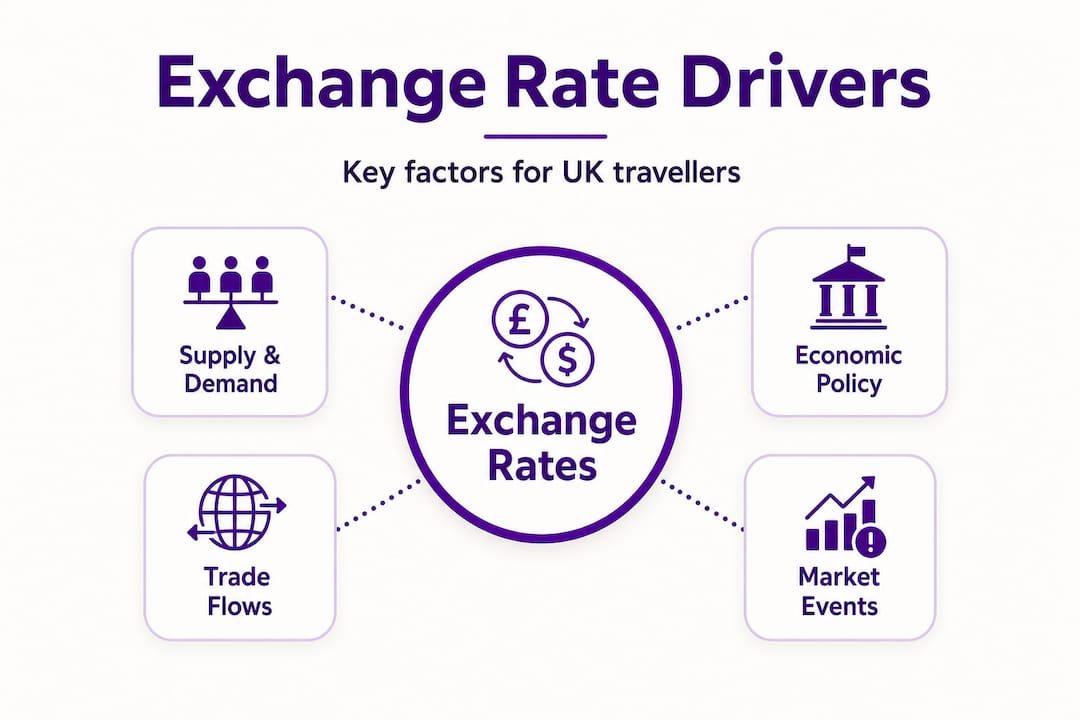
Two of the most powerful macro forces driving exchange rates are interest rates and inflation. According to research, interest rates and inflation affect exchange rates by influencing expected returns on holding one currency versus another. When the Bank of England raises its base rate, holding pounds becomes more attractive to foreign investors seeking better returns. This increased demand strengthens the pound.

Inflation tells a different story. If UK inflation runs significantly higher than in the Eurozone, British goods become more expensive relative to European ones. Foreign buyers purchase fewer UK exports, demand for pounds falls, and the exchange rate weakens. The relationship between CPI and inflation in forex trading is therefore closely watched by analysts and central bankers alike.
Here is a practical example. In 2022, as UK inflation soared above 10%, the pound came under sustained pressure. UK travellers heading to the United States that summer found that the dollar was considerably more expensive than in previous years. Those who booked and converted their currency early saved meaningfully compared to those who waited until the last minute.
How interest rates and inflation affect your travel money:
- The Bank of England raises its base rate, making GBP more attractive to investors.
- Foreign capital flows into the UK, increasing demand for pounds.
- The pound strengthens, giving UK travellers a better rate when buying euros or dollars.
- Conversely, if UK inflation outpaces the European Central Bank’s targets, the euro gains relative strength.
- UK travellers find their holiday budget buys fewer euros per pound.
Staying aware of global events and exchange rates is genuinely useful. Central bank meetings, which happen several times a year, are announced well in advance and are among the clearest signals of where rates might move. Brushing up on exchange rate terminology will also help you make sense of financial news coverage.
Pro Tip: Set a Google Alert for “Bank of England interest rate decision” before any major trip. These meetings are scheduled months in advance, and the announcement dates are publicly available. If a rate change looks likely, consider buying your travel money before the decision rather than after.
Beyond policy and price levels, international trade and capital flows create further pressures on exchange rates.
Trade balances, debt, and political stability
A country’s trade balance is the difference between what it exports and what it imports. A trade surplus, where a country exports more than it imports, tends to support a stronger currency because foreign buyers must purchase that country’s currency to pay for goods and services. A trade deficit creates the opposite pressure. As external balances influence exchange rates through cross-border currency demand, a persistent UK trade deficit can act as a quiet but steady drag on the pound.
Government debt matters too. When a country carries high levels of sovereign debt, investors may worry about the risk of default or the need to print more money to service obligations. Research confirms that public debt and sovereign risk affect exchange rates via investor perceptions of creditworthiness. A credit rating downgrade, such as the one the UK experienced in 2023 from Moody’s, can trigger a quick sell-off in sterling.
Political shocks can be equally destabilising. Political and economic stability are cited as key exchange-rate determinants because they affect risk premiums and capital flows. Brexit is the clearest recent example for UK travellers. The pound fell sharply on the morning of the 2016 referendum result, losing roughly 10% against the dollar in a single day. Those who had not yet bought their travel money faced a significantly worse rate almost overnight.
The lesson for travellers heading to politically volatile destinations is particularly sharp. Countries facing elections, debt crises, or civil unrest can see wild rate swings, sometimes of 5 to 15% within days. For advice on navigating these situations, take a look at tips on how to get the best rates ahead of your trip.
Practical steps for unstable currency environments:
- Research the political calendar of your destination before booking
- Buy a portion of your travel money early to hedge against sudden moves
- Consider a prepaid currency card that locks in a rate at the time of loading
- Monitor employment data and forex signals, as weak jobs data can foreshadow currency drops
Statistic: During the 2016 Brexit vote, GBP/USD fell from around 1.50 to below 1.33 in less than 24 hours, wiping hundreds of pounds off the holiday budgets of those who had not yet exchanged their currency.
Now, let’s dig into the less visible but powerful market forces that drive rates, often catching travellers off guard.
Market microstructure: liquidity, volatility, and dealer positioning
Most travellers understand that big economic events move exchange rates. Fewer appreciate that rates can shift sharply even when no major news is breaking. This is where market microstructure comes in. Research from the IMF confirms that currency premia and exchange-rate dynamics are strongly influenced by frictions and by dealer bank positioning in currency futures.
Liquidity refers to how easily a currency can be bought or sold without moving the market. Major currencies like GBP, EUR, and USD are highly liquid. Exotic currencies, such as the Turkish lira or Thai baht, can be far less liquid. Low liquidity means a relatively small trade can move the market noticeably.
The bid-ask spread is the gap between the price at which you can buy a currency and the price at which you can sell it. In calm, liquid markets, this spread is narrow. During periods of stress or uncertainty, the spread widens, and you lose more to the exchange itself. The IMF’s analysis of FX risk and liquidity confirms that bid-ask spreads and covered-interest-parity deviations intensify during stress periods, transmitting directly into the rates travellers receive.
Understanding how exchange rates affect your travel budget means recognising that these background frictions are always present, not just during crises. They are particularly relevant for travellers exchanging larger sums, where even a small widening of the spread can cost a meaningful amount.
Key market microstructure risks for travellers:
- Rates can move sharply during low-trading hours (overnight or weekends)
- Dealer banks adjust their positions based on anticipated client flows
- Futures markets can amplify short-term currency movements
- Reviewing FX trading rules helps illustrate why sudden moves happen without obvious news
- Market sentiment in forex can shift direction in minutes when large institutional traders act
To bring everything together, understanding how global capital flows and government actions interact sets the scene for how rates change in real time.
Capital flows and government interventions
Capital flows are the large-scale movements of money across borders. When a country cuts interest rates, capital tends to flow out as investors seek better returns elsewhere. This outflow weakens the currency. When a country offers strong growth prospects or policy stability, capital flows in and the currency strengthens. The Bank of England’s research confirms that capital flows and global financial conditions can dominate exchange-rate movements, and the exchange-rate regime affects how these transmit through the economy.
Governments and central banks sometimes intervene directly. The Bank of Japan, for instance, has repeatedly stepped into currency markets to prevent the yen from falling too sharply. The Swiss National Bank once pegged the franc to the euro to prevent excessive strengthening. For UK travellers, the key takeaway is that even a fixed-looking rate can move abruptly if a government abandons or adjusts its currency policy.
For practical tips on finding the best currencies and rates, it pays to understand whether your destination operates a freely floating exchange rate or one managed by its central bank. Managed currencies can appear stable for months before a sudden, officially sanctioned correction.
What UK travellers should do before major trips:
- Check whether your destination has a fixed or floating exchange-rate regime.
- Monitor central bank announcements in the weeks before departure.
- Read about upcoming event trading in forex to understand what market-moving events are scheduled.
- Pre-book your travel money online to lock in a rate before a scheduled policy decision.
- Set rate alerts so you are notified if the market moves in your favour.
Pro Tip: If you are travelling to a country facing an election or a central bank meeting in the week before or during your trip, consider buying at least half your travel money two to three weeks in advance. Even a modest pre-emptive exchange can protect your budget significantly.
Having explored both obvious and hidden drivers, it is vital to look at what all this really means for you as a UK traveller.
Our perspective: what UK travellers really need to know about exchange rate shifts
Most guides focus heavily on the big, visible macro forces: interest rates, inflation, political shocks. These absolutely matter. But what gets less attention is the “market plumbing” layer, the liquidity conditions, dealer positioning, and spread widening that can change your rate on a quiet Tuesday morning without any major news event.
The uncomfortable truth is that even professional economists and forex analysts get their predictions wrong regularly. Currency forecasting is notoriously difficult, and attempting to time the market is a losing game for most travellers. We have seen too many people hold off buying travel money, waiting for the pound to strengthen, only to watch it weaken further.
The smarter approach is not prediction. It is preparation. Pre-booking your currency online through reputable providers, rather than heading to the airport in hope of a decent rate, is consistently the most effective strategy. Using a prepaid currency card to lock in today’s rate protects you from future volatility entirely. Comparing providers through a platform that aggregates live rates means you are not relying on a single provider’s markup.
There is also real value in thinking about stability, not just headline cheapness. A provider offering a rate that is marginally better today but with high fees or unreliable service is not actually cheaper. Securing a consistently good rate through a trusted provider and saving on exchange with online booking will almost always beat last-minute airport gambling. The evidence is clear: informed preparation outperforms attempted market timing, every time.
Secure better rates for your next trip
Understanding what drives exchange rates is only half the battle. Acting on that knowledge is where the real savings come from.
At CompareTravelCash.co.uk, you can compare travel money rates from a wide range of UK providers in seconds, ensuring you never settle for a rate that leaves money on the table. If you want to protect yourself against unexpected rate movements, explore compare currency card deals to find prepaid options that lock in your rate at the time of loading. And if you are returning from a trip with leftover cash, use our tool to find best buyback rates and get the most back from your unspent currency. Smart preparation starts before you travel, and the tools to do it are right here.
Frequently asked questions
Why did the pound suddenly weaken before my holiday?
The pound can weaken quickly due to market shocks, political risks, or sudden changes in market liquidity, even if major news is not widely reported. As the IMF notes, liquidity and bid-ask spreads can intensify during stress periods and transmit directly into exchange rates.
Is it better to buy travel money if UK interest rates go up?
Higher UK interest rates often strengthen the pound, but other factors may still cause rates to move against you. Research confirms that interest rates and inflation affect exchange rates by influencing expected returns, so timing is tricky and rates can shift rapidly even after a rate rise.
What risks make exchange rates unpredictable for travellers?
Political instability, sudden market changes, and low liquidity can all trigger unexpected rate swings. Political and economic stability are recognised exchange-rate determinants because they affect risk premiums and capital flows, making forward planning genuinely difficult.
Can government intervention help control exchange rates?
Yes, governments and central banks can buy or sell their currency to influence rates, but such interventions may only have short-term effects. The Bank of England’s research shows that capital flows and exchange-rate regimes can dominate movements even when authorities attempt to manage them.
Does the type of exchange rate system influence currency value?
Yes, fixed and floating exchange-rate systems transmit shocks differently, affecting the path and volatility of a currency. Bank of England research confirms that exchange-rate moves can be regime-dependent, meaning the same external shock may produce very different outcomes depending on the system in place.