Most UK travellers spend hours hunting the best flight deal, yet hand over hundreds of pounds in unnecessary currency exchange costs without a second thought. The headline exchange rate you see advertised is rarely the rate you actually receive. Providers embed their profit in two places: the spread built into the exchange rate itself and any explicit service fees charged on top. Understanding both is the difference between stretching your travel budget and quietly losing money every time you head abroad.
Table of Contents
- The real cost of currency exchange: Beyond the headline rate
- How exchange rate differences impact your travel budget
- Timing matters: Weekend mark-ups and savvy currency exchange planning
- Benchmarking and comparing: How to spot the most competitive deals
- The uncomfortable truth most travellers miss about currency exchange
- Ready to compare the best currency exchange rates?
- Frequently asked questions
Key Takeaways
| Point | Details |
|---|---|
| Look beyond headline rates | Hidden spreads and fees make a bigger difference to your wallet than the advertised rate. |
| Use the mid-market benchmark | Compare your delivered amount to the mid-market rate to find the true best deal. |
| Watch for weekend markups | Rates often worsen at weekends when markets close, so plan your exchange timing wisely. |
| Track actual outcomes | Recording the currency you receive after each trip helps spot consistent savings or wasted money. |
The real cost of currency exchange: Beyond the headline rate
After highlighting the pitfalls hidden behind the headline rate, it is important to break down exactly where the real costs sneak in.
Every currency exchange provider needs to make money somehow. The two main methods are the rate markup and explicit fees. The rate markup is the invisible one. It means the provider gives you a rate that is worse than the true market rate, quietly pocketing the difference. Explicit fees are more obvious: a flat service charge, a percentage fee, or both charged on top of the transaction.
The reference point you need is the mid-market rate. This is the real exchange rate sitting halfway between the buying and selling prices on global currency markets. No provider will give you the mid-market rate as a customer, but it is the only fair baseline for checking travel currency rates across different providers.
The only true apples-to-apples benchmark is the mid-market rate. Every penny your delivered amount falls short of the mid-market baseline is a cost, whether it shows on the receipt or not.
Getting a handle on foreign exchange explained in everyday terms makes this easier. Think of the mid-market rate as the wholesale price of currency. Providers buy at that price and sell to you at a marked-up price. The wider the gap, the more it costs you.
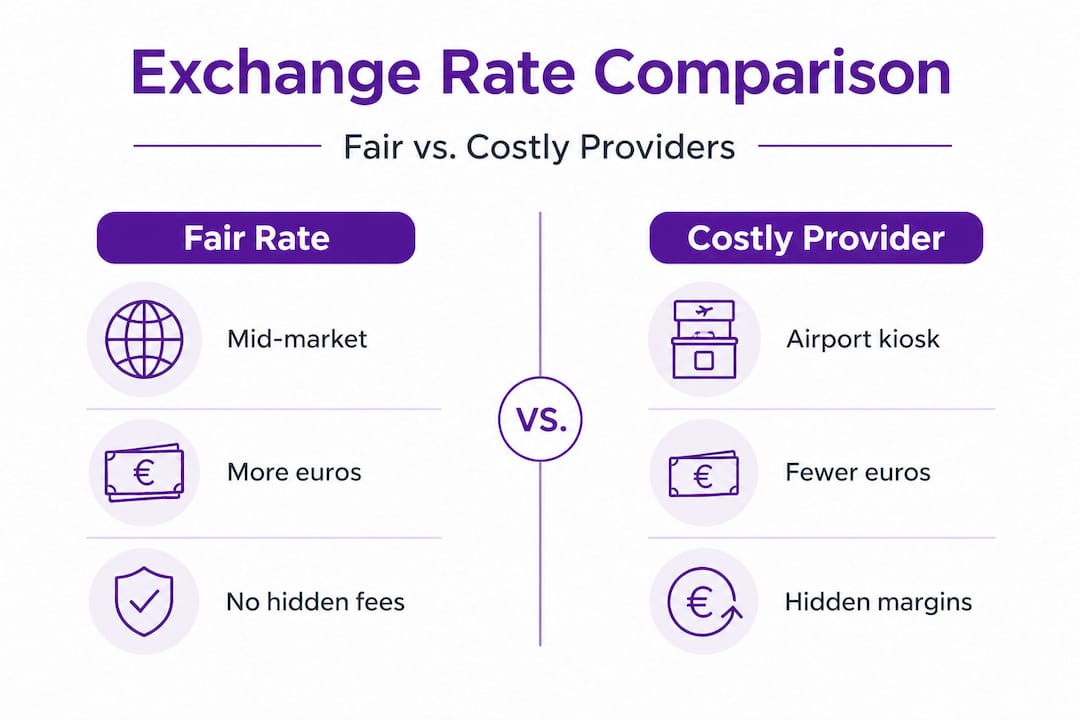
Here is a simple comparison to illustrate how that works in practice when exchanging £500 into euros:
| Provider | Rate offered | Euros received | Explicit fee | Total euros after fees |
|---|---|---|---|---|
| Mid-market rate | 1.1800 | €590.00 | £0 | €590.00 |
| High street bank | 1.1200 | €560.00 | £5.00 | €554.40 |
| Airport kiosk | 1.0500 | €525.00 | £0 | €525.00 |
| Online specialist | 1.1650 | €582.50 | £0 | €582.50 |
The airport kiosk looks fee-free, but the rate alone costs you €65 compared to the mid-market. That is not a small difference. It is the cost of a dinner for two in many popular European destinations.
Comparing exchange rates properly means looking at the total delivered amount, not just whether the provider charges a visible fee. A zero-fee label means nothing if the rate itself has a large markup baked in.
How exchange rate differences impact your travel budget
Understanding how providers structure their charges is only half the picture. Let us see how these differences genuinely add up over your trip.
Small percentage differences in exchange rates can translate into surprisingly large sums when you scale them up. A 1% difference in rate on a £1,000 exchange gives you £10 less to spend. That may sound trivial, but most travellers exchange money more than once, and rates at popular locations are rarely within 1% of the mid-market rate. The effect on your travel budget compounds quickly.

Here is how a £1,000 currency exchange into US dollars plays out across different provider types, based on illustrative rates for comparison:
| Provider type | Rate offered | USD received | Explicit fee | Delivered USD | Gap vs mid-market |
|---|---|---|---|---|---|
| Mid-market (1.2700) | 1.2700 | $1,270.00 | £0 | $1,270.00 | Baseline |
| High street bank | 1.2200 | $1,220.00 | £7.50 | $1,210.58 | $59.42 |
| Airport exchange | 1.1600 | $1,160.00 | £0 | $1,160.00 | $110.00 |
| Online comparison | 1.2580 | $1,258.00 | £0 | $1,258.00 | $12.00 |
The airport exchange leaves you $110 short compared to the mid-market rate. On a family holiday, multiply that across two or three adults and you have lost the equivalent of a full excursion.
The clean comparison method is straightforward: baseline amount = amount × mid-market rate; all-in cost = baseline minus delivered, plus any explicit fees. Write it down. Do the maths before you hand over your cash.
Here is how to apply this practically before any trip:
- Look up the current mid-market rate using a financial site or currency calculator on the day you plan to exchange.
- Calculate your baseline: multiply your pounds by the mid-market rate to find your maximum possible foreign currency amount.
- Get quotes from at least three providers: include one online specialist, one high street option, and note the airport rate for comparison.
- Calculate the gap for each: subtract each provider’s delivered amount from your baseline. Add any explicit fees converted to foreign currency.
- Choose the smallest gap: this is your best-value option on that day.
Pro Tip: Keep a simple note on your phone from your last trip recording the rate you received versus the mid-market rate on the same day. Over two or three trips, patterns emerge. You will quickly see whether your preferred provider is genuinely competitive or whether habit is costing you money.
Tracking travel money and international budget outcomes this way turns currency exchange from guesswork into something measurable.
Timing matters: Weekend mark-ups and savvy currency exchange planning
Rates do not only vary between providers. When you exchange your money can quietly change your outcomes too.
Global currency markets close over the weekend. Banks and exchanges still operate, but they cannot hedge their positions in real time, which means they face greater risk. Many providers respond by widening their spreads or adding a specific weekend markup to cover that uncertainty. Some providers add weekend markups or use wider spreads when currency markets are closed, and locking a rate in advance can improve predictability for budget-constrained travellers.
The estimated average weekend markup across major UK providers sits at around 1% over the weekday rate. That might not sound significant, but on a £2,000 holiday currency purchase it adds up to £20 of avoidable cost for the simple reason that you exchanged on a Saturday rather than a Thursday.
Common timing mistakes travellers make include:
- Leaving currency exchange until the airport: rates at airport kiosks are consistently among the worst available, and there is no time to shop around.
- Exchanging at the destination: rates overseas, particularly at tourist spots, are often heavily marked up against sterling.
- Buying in small, repeated amounts: every micro-transaction may trigger another fee, and you lose the benefit of any bulk-rate advantage.
- Not checking live rates before leaving: a quick check the week before travel can reveal whether rates are particularly favourable or whether it is worth waiting a few days.
- Assuming rates are fixed: rates move daily, sometimes significantly, so a rate that looked fine three weeks ago may have shifted.
Knowing how to spot bad exchange rates before you commit is one of the most practical skills a regular traveller can develop. It takes no more than five minutes to check.
Pro Tip: If you know your travel dates weeks in advance, look into locking your rate through a prepaid currency card or forward-buying from a specialist. Getting the best exchange rates often means acting before your trip, not scrambling at the departure gate.
Planning around known high-cost windows like bank holidays and weekends is a simple change that consistently improves your outcomes.
Benchmarking and comparing: How to spot the most competitive deals
Now that you know when and how exchange costs arise, it is time to get practical about comparing providers like an expert.
The word “benchmarking” sounds technical, but the concept is simple. It just means measuring one thing against a known standard. In currency exchange, your standard is the mid-market rate. Every provider you consider should be measured against it. Benchmarking should track the actual delivered outcome against the mid-market baseline to detect provider drift and hidden charges over time.
The key to making this work is using recognised benchmarks and repeating the exercise consistently, not just once. Providers can be competitive one month and quietly adjust their margins the next. Travellers who benchmark regularly spot these shifts. Those who do not keep paying more without realising it.
Before choosing a provider, ask yourself these questions:
- What is today’s mid-market rate for my currency pair?
- How much foreign currency will I actually receive after all fees?
- Is there a fixed service charge, and does it make small amounts disproportionately expensive?
- Does this provider charge more at weekends or during bank holidays?
- Can I lock in a rate today for a trip that is a few weeks away?
- What do other travellers report about this provider’s actual delivered rates?
- Is there a buyback option if I return with leftover currency, and at what rate?
Using a comparison platform is the most efficient way to answer these questions at once. Rather than visiting five different websites individually, a good exchange options guide explains what the landscape looks like and where the best-value providers tend to sit.
Pro Tip: After each trip, record the mid-market rate on the day you exchanged and what you actually received. After two or three trips, you have your own performance data on your preferred provider. If the gap is consistently growing, it is time to shop around.
Comparison is not a one-off exercise. It is a habit. The travellers who consistently get the best rates are not necessarily lucky. They are simply more methodical about measuring what they receive against a clear benchmark.
The uncomfortable truth most travellers miss about currency exchange
Here is something that rarely gets said plainly: most travellers do not track what they actually receive. They see the advertised rate, feel vaguely satisfied, and move on. By the time they are home, the exact rate they got is a distant memory.
This is where real money is lost, trip after trip. It is not through dramatic rip-offs or obvious scams. It is through accumulated indifference to small differences that compound into significant totals over years of travelling.
The research is consistent on this point. The gap between the mid-market rate and what travellers actually receive is almost always larger than people assume. Yet when surveyed, most travellers rate themselves as reasonably savvy about currency exchange. That disconnect is the real problem.
There is also a misleading comfort in familiarity. Many UK travellers return to the same bank or the same high street provider because it feels safe and familiar. But familiarity is not the same as competitive value. A provider that was good value two years ago may have quietly widened its margins since then.
The mindset shift that actually changes outcomes is treating currency exchange the same way you treat flight prices. You would not book a flight without checking alternatives. You would not accept the first price without knowing what else is available. The same logic applies here, and the travel budget guide evidence bears this out consistently.
What sets budget-savvy travellers apart is not some special financial knowledge. It is the simple discipline of checking the mid-market rate first, comparing what they will actually receive, and noting the outcome afterwards. That three-step habit, applied consistently, is worth more than any single great deal. The challenge is this: on your next trip, note the mid-market rate on the day you exchange, record what you receive, and calculate the gap. Just doing that once changes how you approach it every time afterwards.
Ready to compare the best currency exchange rates?
You now know what to look for and how to measure it. The next step is straightforward.
CompareTravelCash.co.uk pulls together live exchange rates from multiple UK providers in one place, so you can see the delivered amount, not just the advertised rate, before you commit. Whether you prefer cash or a prepaid card for your trip, the tools are here to help you choose with confidence. You can compare M&S travel money rates alongside other leading providers to see exactly how they stack up, or explore prepaid currency cards that let you lock in a rate before you travel. Stop leaving money at the airport. Compare before you go.
Frequently asked questions
What is a mid-market exchange rate?
The mid-market rate is the real, unbiased average between two currencies, sitting halfway between buy and sell prices on global markets, and it serves as the fairest benchmark for comparing exchange offers.
How can I tell if I am getting a competitive exchange rate?
Compare the provider’s total delivered amount with what the mid-market rate would give you, factoring in all fees. Benchmarking against the mid-market baseline is the most reliable method for identifying hidden costs.
Do all providers charge extra fees at weekends?
Not all providers do, but many apply weekend markups or wider spreads when currency markets are closed, making it worth checking rates midweek and considering locking in a rate before Saturday arrives.
Can I avoid bad rates and hidden fees altogether?
It is difficult to eliminate all costs entirely, but locking in a rate in advance through a comparison platform or prepaid card significantly reduces the risk of overpaying, particularly if you avoid airport exchanges and last-minute decisions.