Most UK travellers assume the headline exchange rate is the whole story. It is not. The real advantages of currency comparison only become clear when you look at the full picture: spreads, service fees, delivery methods, and the gap between what a provider advertises and what you actually receive. Miss any one of these elements and you could lose a meaningful chunk of your travel budget before you have even boarded the plane. This article breaks down the key currency comparison benefits and shows you exactly how to use them.
Table of Contents
- Understand total cost: look beyond headline fees
- Avoid dynamic currency conversion pitfalls
- How regulatory protections boost consumer benefits
- Compare remittance and payment apps to save money and protect privacy
- Summary comparison: key factors to evaluate when choosing currency exchange options
- Why common advice on exchange rates can mislead UK travellers
- Explore the best travel money rates and services for UK travellers
- Frequently asked questions
Key Takeaways
| Point | Details |
|---|---|
| Total cost comparison | Compare the final delivered currency amount plus all fees against a mid-market benchmark to see true costs. |
| Avoid dynamic currency conversion | Decline DCC and pay in local currency to usually get better exchange rates and avoid merchant markups. |
| Regulatory support | FCA Consumer Duty promotes transparency and fair value, encouraging you to compare options carefully. |
| App selection matters | Not all money transfer apps are equal; some hide fees or pose privacy risks—compare before choosing. |
| Focus on timing and spreads | Exchange rate timing and spread differences affect how much you really receive; compare like-for-like for accuracy. |
Understand total cost: look beyond headline fees
One of the most important advantages of currency comparison is that it forces you to calculate the all-in cost of an exchange, not just the fee label on the tin. The mid-market rate is the neutral benchmark here. It represents the midpoint between global buy and sell prices for a currency pair and is the rate you will see on Google or Reuters. No retail provider gives you this rate, but it is the fairest starting point for any comparison.
Most of what you pay is hidden in the spread, which is the difference between the mid-market rate and the rate a provider actually offers you. Add any explicit fees on top and you have your true cost. Two providers can both advertise “zero fees” and still deliver very different amounts of foreign currency because their spreads differ. This is where why compare exchange rates matters so much for UK travellers.
A practical example: if you exchange £500 at a provider offering a 3% spread with no explicit fee, you lose £15 silently. A provider charging a flat £5 fee but applying a 1% spread costs you just £10 in total. The zero-fee option is more expensive. As the Global Currency Conversion Guide 2025–2026 makes clear, the key advantage of comparing currency options is estimating and reducing the all-in cost between the mid-market benchmark and the actual amount received, factoring in both rate spread and explicit fees.
Key steps for a like-for-like comparison:
- Find the current mid-market rate using a financial data source
- Get a quote from each provider including all fees
- Calculate how much foreign currency you actually receive for your GBP
- Express the difference as a percentage of the mid-market rate
- Repeat at the same timestamp to avoid rate movement distorting results
Pro Tip: Ignore marketing labels like “best rate” or “no commission.” The only number that matters is how many euros, dollars, or baht land in your hand per pound spent.
Avoid dynamic currency conversion pitfalls
Dynamic Currency Conversion (DCC) is one of the costliest traps for UK travellers abroad, and understanding it is a genuine currency comparison benefit. When you pay by card at a foreign hotel, restaurant, or ATM, you may be offered the option to pay in pounds rather than local currency. It sounds convenient. It usually costs you more.

The merchant or ATM operator sets their own exchange rate when DCC is applied, and that rate typically includes a significant markup over the mid-market rate. Your card issuer’s rate may not be perfect either, but in most cases it is cheaper than what a merchant’s DCC terminal applies. Declining DCC lets your card issuer handle the conversion, often at a better rate than the merchant’s marked-up DCC rate.
Currency rate analysis helps here because once you know the current mid-market rate, you can judge immediately whether a DCC offer is reasonable. Most are not. A quick glance at your currency comparison tool before travelling gives you a working benchmark to spot a poor rate on the spot.
Why travellers accept DCC when they should not:
- The screen frames it as a “guaranteed” pound amount, which feels reassuring
- It avoids an unfamiliar local currency total that is harder to mentally convert
- Staff occasionally present it as the only option, which is not accurate
Pro Tip: Always choose to pay in local currency at foreign terminals unless you have confirmed the DCC rate is within 1% of the mid-market rate. This is rarely the case.
You can find more detail on recognising poor rates in this guide to spot bad exchange rates. For a broader introduction to currency conversion concepts, additional resources are available to help you build confidence before you travel.
Paying in local currency is not just cheaper in most cases. It is also more transparent. You know exactly what your card issuer charges because the details appear on your statement without a third party’s markup buried inside the conversion.
How regulatory protections boost consumer benefits
The importance of currency comparison is reinforced by the UK’s regulatory framework. The Financial Conduct Authority’s Consumer Duty requires that firms deliver fair value, meaning the price a consumer pays must be reasonable relative to the benefit they receive. This directly supports the case for comparing currency providers, because hidden spreads and fees that erode value are exactly the kind of harm the Duty is designed to prevent.
As the FCA Consumer Duty states, firms must avoid hidden costs that harm consumers, and comparison tools help detect poor value. For UK travellers, this means you are not just comparing rates for your own benefit. You are exercising a right that regulation actively supports.
What this means in practice:
- Providers are expected to make pricing clear and comparable
- Firms cannot hide the true cost of conversion behind misleading marketing
- You have grounds to question any provider whose pricing is opaque
- Comparing total delivered cost gives you the data to hold providers to the fair value standard
- Travellers who compare are less likely to be caught by pricing that does not meet regulatory expectations
Understanding competitive currency exchange and why it matters for UK travellers is a natural extension of this regulatory context. Providers who know their customers compare tend to offer better rates.
Compare remittance and payment apps to save money and protect privacy
The advantages of online currency comparison extend beyond cash desks and bureau de change counters. Many UK travellers now use remittance and payment apps to send money abroad or fund travel accounts. The variation in cost and transparency across these apps is substantial.
Consumer Reports testing found many apps have high costs, hidden fees, and privacy concerns, while Wise and Remitly scored highest for transparency and value. The difference between apps is not always visible at the fee level. Some apps advertise low or zero transfer fees but quietly apply a wide spread on the exchange rate, effectively charging you more through the back door.
Delivery method also affects cost. Bank transfers, cash pick-up, and mobile wallet deposits can each carry different fees and exchange rates within the same app. A comparison that only checks one delivery method may miss a cheaper option within the same service.
| Factor | What to check |
|---|---|
| Exchange rate | How close to mid-market? |
| Transfer fee | Flat fee or percentage? |
| Delivery method | Bank, cash, or mobile wallet? |
| Settlement time | Same day or 1 to 3 business days? |
| Privacy policy | Data sharing with third parties? |
Before choosing a remittance or payment app:
- Check the exchange rate against the current mid-market benchmark
- Compare fees across all delivery methods, not just the default
- Read the privacy policy, particularly around data sharing
- Verify the total amount your recipient actually receives
Pro Tip: Run a side-by-side comparison of at least two apps using a fixed amount and your chosen delivery method. The difference in received funds can be surprisingly large, even between well-known names.
This guide to compare currency exchange options covers the full range of services available to UK travellers in detail.
Summary comparison: key factors to evaluate when choosing currency exchange options
Knowing how to compare currencies is the practical skill that converts awareness into savings. The following framework applies whether you are exchanging cash, using a card, or sending money via an app.
Step-by-step evaluation:
- Confirm the current mid-market rate from a neutral source
- Get the provider’s final delivered amount for your specific sum
- Add all explicit fees to identify total cost
- Calculate the cost as a percentage of the mid-market rate
- Compare this percentage across providers at the same timestamp
As the guidance on effective rate comparison confirms, the best currency exchange services combine strong market alignment with an efficient transaction structure to maximise the usable foreign currency you receive.
| Exchange method | Typical spread | Explicit fees | Best for |
|---|---|---|---|
| Airport bureau de change | 5% to 10% | Often none | Emergency only |
| High street provider | 2% to 5% | Sometimes | Pre-booked orders |
| Online provider | 1% to 3% | Usually low | Best advance rate |
| Card payment abroad | 1% to 2.5% | Foreign transaction fee | Everyday spending |
| Remittance app | 0.5% to 3% | Varies by method | Transfers and top-ups |
Additional factors worth checking:
- Whether the quoted rate is guaranteed or indicative at booking
- Tier pricing, where larger amounts attract tighter spreads
- Settlement timing, which can matter for rate lock accuracy
- Whether a prepaid card locks in today’s rate for future spending
This complete guide to save on travel currency puts all of these factors together in one practical resource.
Why common advice on exchange rates can mislead UK travellers
Here is the uncomfortable reality: most travel money advice stops at “avoid airport exchanges” and “use a fee-free card.” That is not wrong, but it is incomplete in ways that still cost travellers real money.
The biggest gap is timing. Exchange rates move constantly. A quote you saw at 9am may be 0.5% different by 11am. If you are comparing two providers but checking their rates at different times, your comparison is already flawed. Ignoring timing differences and focusing only on headline rates or fees causes travellers to miss the true all-in cost between providers. This is a surprisingly common mistake, even among frequent travellers.
There is also the spread illusion. Providers who eliminated explicit fees did not absorb the cost. They embedded it into a wider spread. A traveller who sees “no commission” reads it as “free” and moves on. The cost is still there. It is just invisible unless you run a delivered-amount comparison.
Dynamic Currency Conversion adds another layer of confusion because it creates a false sense of control. You see a pound amount on the screen and it feels concrete. But that pound amount has already been inflated by a rate you never agreed to explicitly. The transparency is superficial.
Pro Tip: Always use the final delivered amount as your comparison figure, not the advertised rate or fee label. Two minutes with a mid-market reference and a calculator will tell you more than any provider’s marketing material.
The deeper lesson is that currency value comparison is not a one-time check. It is a habit. And the travellers who build it save more consistently than those who rely on branded trust alone. For guidance on choosing the best exchange provider, the principles above are a reliable starting point.
Explore the best travel money rates and services for UK travellers
Armed with the knowledge of how to compare currencies properly, the next step is putting it into practice before your trip.
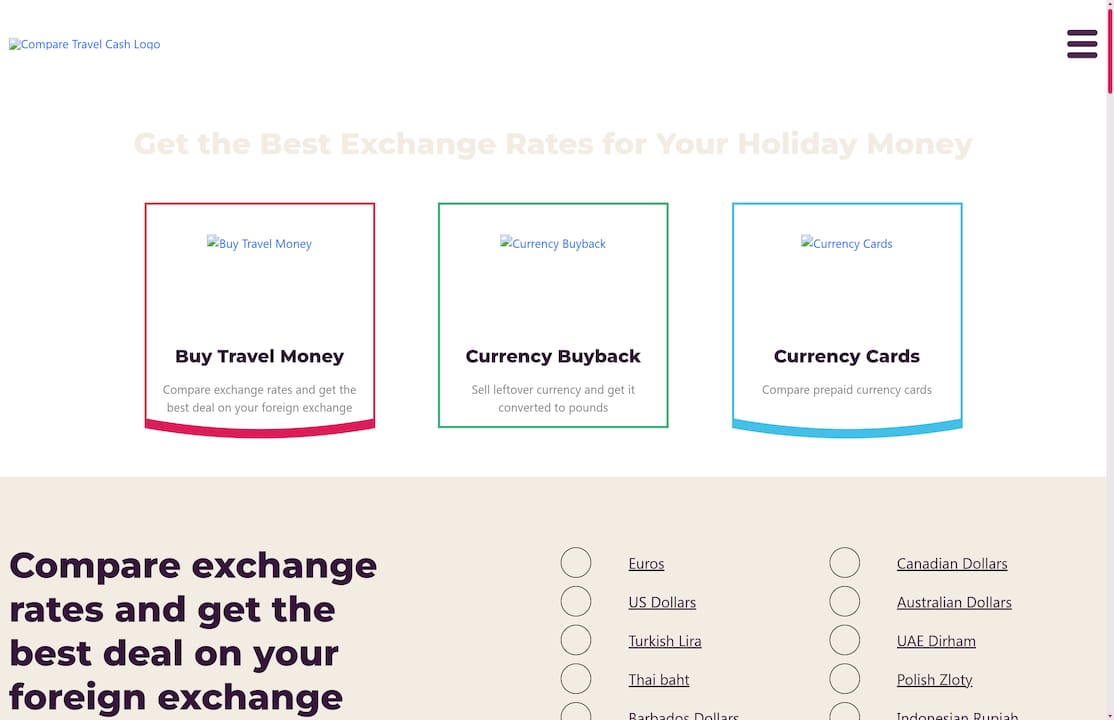
CompareTravelCash.co.uk brings together live rates from multiple providers in one place, covering cash, prepaid cards, and online services. Rather than visiting five different sites to gather quotes, you can run a single comparison and see which provider delivers the most foreign currency for your pounds. Whether you want to check travel money comparisons across the board, browse Hays Travel money rates from a trusted high street name, or explore prepaid currency card deals that lock in your rate ahead of travel, the tools are ready to use. Planning even a few days in advance can make a measurable difference to what you get for your money.
Frequently asked questions
Why is it important to compare currency exchange rates before travelling?
Comparing rates lets you see the true cost including spread markups and hidden fees, so you know exactly what you will receive rather than what a provider is advertising. The all-in cost comparison approach consistently reveals better value options that headline rates alone do not show.
What is Dynamic Currency Conversion and should I accept it?
Dynamic Currency Conversion lets you pay in pounds abroad but usually at a rate set by the merchant, which typically includes a markup. Declining DCC and paying in local currency usually results in a cheaper, more transparent conversion through your own card issuer.
How do hidden fees affect my currency exchange?
Hidden fees most often appear as wider spreads rather than explicit charges, meaning the amount of foreign currency you receive is quietly reduced. The FCA Consumer Duty specifically addresses these hidden costs as a form of consumer harm that fair-value pricing should eliminate.
Are all money transfer apps equally good for sending money abroad?
No. Costs, exchange rates, and privacy standards vary considerably between apps. Consumer Reports testing found Wise and Remitly led on transparency and value, while others buried significant costs in poor exchange rates.
How can I best evaluate currency exchange providers?
Set the current mid-market rate as your baseline, request the final delivered amount from each provider for the same sum, add all fees, and compare the totals at the same time. Best-practice comparison always looks at the final payout figure rather than any single fee or rate in isolation.