Not all foreign currency providers are created equal, and the difference between choosing wisely and defaulting to habit can easily cost you £50 to £200 on a single trip. There are more types of foreign currency providers available to UK travellers today than ever before, from traditional high street banks and airport kiosks to online ordering services, prepaid travel cards, and specialist currency brokers. Each comes with different rates, fees, and trade-offs. This guide cuts through the confusion, comparing your real options so you can make a decision that protects your money and suits your trip.
Table of Contents
- How to choose your foreign currency provider
- Traditional providers: banks, bureaux de change, and airport kiosks
- Digital providers: online ordering, prepaid cards, and multi-currency apps
- Specialist providers: currency brokers and forward contracts
- Comparing provider types: costs, convenience, and suitability
- What most travellers get wrong about buying foreign currency
- Find the best foreign currency deals with Compare Travel Cash
- Frequently asked questions
Key Takeaways
| Point | Details |
|---|---|
| Evaluate cost and convenience | Consider exchange rates, fees, and how easily you can access your currency to choose the best provider. |
| Avoid airport kiosks | They charge steep markups, typically making them the most expensive option for currency exchange. |
| Use digital providers | Prepaid cards and apps generally offer near mid-market rates and greater spending flexibility abroad. |
| Plan for larger sums | Currency brokers and forward contracts help manage exchange rate risk for big transactions or known future payments. |
| Check provider regulation | Always use FCA-authorised firms to ensure your money’s security and avoid scams. |
How to choose your foreign currency provider
Before comparing specific provider types, it helps to know exactly what you are comparing. Four criteria matter most: cost, convenience, security, and timing.
Cost is the biggest variable. Every provider makes money through the exchange rate margin, which is the gap between the mid-market rate (the real rate you see on Google) and what they offer you. Some also charge flat service fees. Currency exchange savings can be significant when you understand both the margin and any added charges. Banks and credit unions often have the best exchange rates and lowest fees but may impose limits depending on the amount exchanged.
Convenience covers how easily you can access the currency. Can you order online? Does it deliver to your door? Is collection fast? These factors matter more when time is short.
Security is about knowing your money is safe. Always check whether the provider is authorised or registered with the Financial Conduct Authority (FCA). Regulated providers offer clearer recourse if something goes wrong.
Timing is often overlooked. Ordering a week before departure gives you time to compare currency exchange options and select better rates rather than accepting whatever is available at the airport.
Key questions to ask before choosing:
- What is the total cost, including all fees, not just the headline rate?
- How quickly do you need the currency?
- How much are you exchanging? (Some providers have minimum amounts.)
- Do you want physical cash, a card, or both?
- Is the provider FCA-regulated?
Pro Tip: Always calculate the effective rate you will receive on the actual amount you are exchanging, not the advertised headline rate. A “zero commission” sign does not mean zero cost; the margin is usually baked into the rate itself.
Understanding these criteria sets the stage for evaluating the main types of foreign currency providers.
Traditional providers: banks, bureaux de change, and airport kiosks
Traditional providers remain the most familiar foreign exchange service types for most UK travellers. But familiarity does not always mean value.
Banks and building societies are a solid starting point. Banks are generally the cheapest place to exchange currency but may charge fees or have minimum exchange amounts. Your existing bank may also offer preferential rates if you are a long-standing customer. The downside is that not all branches stock every currency, and collection can take a few days if the currency needs to be ordered in.
High street bureaux de change vary enormously. Some offer genuinely competitive rates for UK travellers and will match rates if you find a better deal elsewhere. Others, particularly those in tourist-heavy areas, quietly build in a large margin. Checking rates before you walk in, rather than accepting the board price, is always worthwhile.
Airport kiosks deserve a particular caution. Airport kiosks tend to have the worst rates, often 10 to 15% above mid-market, making them the most expensive option. That could mean receiving €85 instead of €100 for the same amount of pounds. The convenience is real, but so is the cost. Airport kiosks should be a last resort, not a first choice.
Common pros and cons of traditional currency providers:
- Banks: Secure, familiar, reasonable rates. May have fees and limited currency availability.
- Bureaux de change: Can be competitive; rates vary. Shop around and look for rate-match guarantees.
- Airport kiosks: Convenient but expensive. Only use them for small, urgent amounts after arrival.
“Knowing which provider type to use for which purpose is the single most effective way to cut currency costs without any extra effort.”
With the traditional providers explored, let’s look at how digital and specialised services change the currency exchange game.
Digital providers: online ordering, prepaid cards, and multi-currency apps
Digital currencies provider options have transformed travel money over the past decade, and for most UK holidaymakers, they now represent the smartest choice.

Online ordering with home delivery or click-and-collect lets you compare rates from multiple providers at once, order at the best available rate, and either receive currency by post or collect it from a local branch or Post Office. Rates are typically sharper than anything you will find in person.
Prepaid travel cards are loaded with currency before you travel. You lock in the rate at the point of loading, spend abroad on the card just like a debit card, and avoid carrying large amounts of cash. You can view your balance in real time and freeze the card instantly if it is lost or stolen. Our guide to prepaid multi-currency cards covers the top options available to UK travellers right now.
Multi-currency apps take this further. Multi-currency cards allow holding and spending in multiple currencies at near mid-market rates, with access in 150+ countries. For frequent travellers or anyone visiting multiple destinations, these apps make managing money abroad genuinely easy.
Digital providers often have fee structures with lower markups than banks or airports and transparent online rates, so you always know what you are paying.
| Provider type | Typical rate vs mid-market | Fees | Delivery options |
|---|---|---|---|
| Online ordering | 1–3% margin | Low or none | Home delivery, click-and-collect |
| Prepaid travel card | 0.5–2% margin | Small load fee possible | Instant card use |
| Multi-currency app | Near 0% | Variable per transaction | App/card abroad |
| Bank | 2–4% margin | Possible flat fee | Branch collection |
| Airport kiosk | 10–15% margin | Often none (margin covers it) | Immediate |
Pro Tip: For getting the best exchange rates, order your travel money online at least five to seven days before departure. This gives you flexibility to choose a rate you are happy with rather than accepting whatever is available the day before you fly.
Beyond digital cards and apps, some travellers require larger amounts or want to lock in rates, leading to currency brokers and forward contracts.
Specialist providers: currency brokers and forward contracts
Currency brokers occupy a different part of the market. They are less relevant for a two-week holiday, but for travellers with planned large payments abroad such as buying property, paying for a destination wedding, or covering extended stays, they offer genuine advantages.
What currency brokers do:
- Specialise in large international transfers, often from £5,000 upwards
- Assign a dedicated dealer who monitors rates and executes transfers on your behalf
- Offer forward contracts, limit orders, and other rate management tools
Forward contracts are the key product. Forward contracts allow locking in an exchange rate up to 24 months ahead, reducing FX risk if timing and amounts are known. If you know you will need €20,000 for a property deposit in six months, you can fix today’s rate now, protecting yourself from any unfavourable movements.
However, forward contracts require deposits and trade away flexibility for certainty, making them suitable only when payment dates are fixed. If your plans change, you may face penalties or lose your deposit.
How to decide if a currency broker is right for you:
- You are exchanging a large sum (typically £5,000 or more).
- You have a firm, fixed payment date in the future.
- You want protection against exchange rate fluctuations rather than speculating on a better rate.
- You understand the deposit requirements and penalty terms before committing.
The importance of competitive rates is magnified at larger amounts, where even a 0.5% rate difference can save or cost hundreds of pounds.
Having explored the main provider types individually, it is now time for a direct comparison to help you decide which fits your trip best.
Comparing provider types: costs, convenience, and suitability
Here is how the main foreign currency exchange methods stack up side by side.
| Provider type | Cost | Convenience | Best suited for |
|---|---|---|---|
| Bank / building society | Low to moderate | Moderate | Small to medium amounts, existing customers |
| High street bureau | Moderate (varies) | High | In-person exchange, larger cash amounts |
| Airport kiosk | Very high | Very high | Emergency last-minute currency only |
| Online ordering | Low | High (home delivery) | Planning ahead, comparing rates |
| Prepaid travel card | Low | Very high | Daily spending, multiple trips |
| Multi-currency app | Very low | Very high | Frequent travellers, multiple currencies |
| Currency broker | Low (for large sums) | Low (setup required) | Large transfers, fixed future payments |
Airport kiosks typically charge 10 to 15% above mid-market rates, the highest among all options. At the opposite end, online ordering and fintech providers outperform traditional alternatives on rates and fees by a significant margin.
Key takeaways from the comparison:
- For most UK holiday travellers, online ordering or a prepaid card is the best currency exchange combination.
- For cash-heavy destinations or markets, pairing a prepaid card with a modest cash order covers both scenarios.
- For large planned payments, a currency broker adds real value.
- For last-minute needs, a high street bureau beats the airport every time.
You can also check currency buy back rates before you travel, so you know what you will get back for any leftover cash when you return. Comparing these rates in advance is a small step that saves money at both ends of the trip. A useful currency rate evaluation guide can also help you interpret the numbers with confidence.
What most travellers get wrong about buying foreign currency
Here is the uncomfortable truth: most people do not choose a currency provider. They just use whatever is there. That instinct is costing them more than they realise.
Travellers often incur the worst FX costs by defaulting to the most convenient providers, such as airport kiosks or bank counters, leading to a 10 to 15% convenience premium. On a £1,000 exchange, that is £100 to £150 straight out of your holiday budget. For a family of four, that gap is meaningful.
The second mistake is treating all provider types as if they serve the same purpose. Choosing the right provider depends largely on your purpose — cash withdrawal versus day-to-day card spending — and understanding different settlement mechanisms. A prepaid card is ideal for card-accepting restaurants and shops. Cash still matters for markets, taxis, and smaller towns. Using one provider for everything often means paying over the odds somewhere.
The fix is simpler than most people expect. Order your cash online a week before you travel. Use a prepaid card for the bulk of your daily spending. Keep a small cash reserve for places that do not accept cards. And check rates using a comparison tool so you are never guessing.
Making use of resources that compare competitive currency exchange rates takes minutes and can save a meaningful sum. The effort-to-reward ratio is exceptional.
Find the best foreign currency deals with Compare Travel Cash
Knowing the types of foreign currency providers is only useful if you can act on it quickly. That is exactly what Compare Travel Cash is built for.
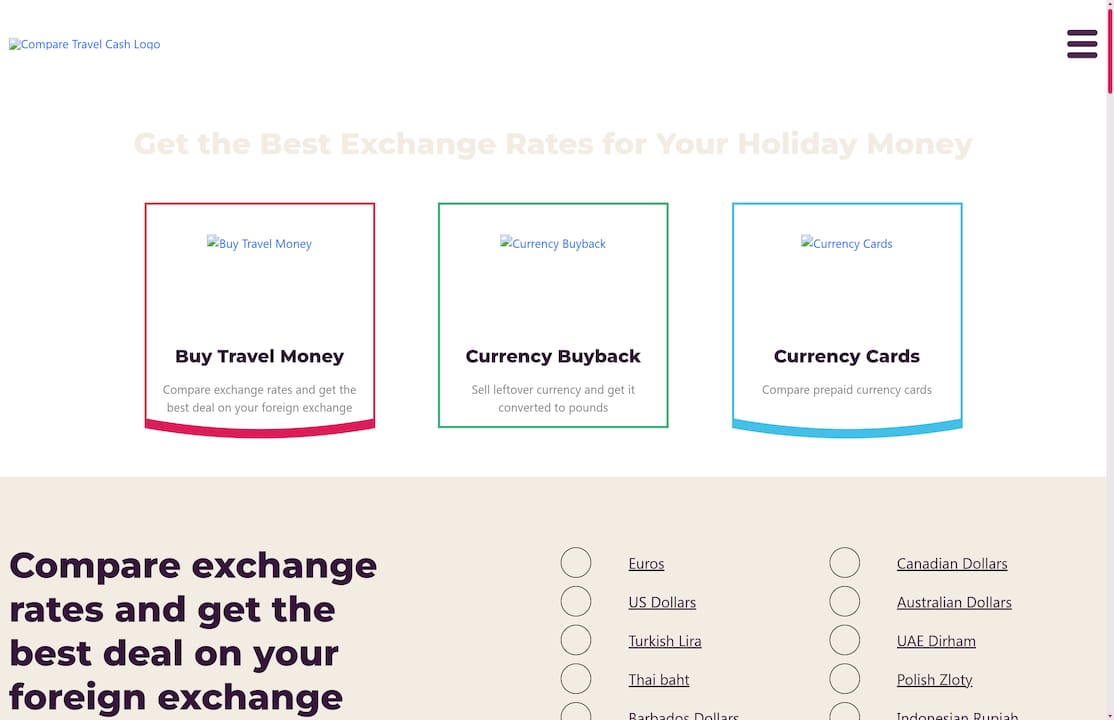
Compare Travel Cash aggregates live travel money rates from banks, bureaux de change, prepaid card providers, and online currency services all in one place. You can see at a glance who is offering the best rate for your chosen currency right now, with no guesswork and no hidden surprises. Browse prepaid multi-currency card deals to find the right card for your trip, or head straight to the compare travel money exchange rates tool to check today’s rates across providers. Securing a better deal for your next trip takes less time than queuing at an airport kiosk.
Frequently asked questions
Which foreign currency provider offers the best rates for cash?
Banks and credit unions are generally the best places to exchange currency, with reasonable exchange rates and the lowest fees, though online providers and prepaid cards now compete strongly for the best overall value.
Are prepaid travel cards better than carrying cash abroad?
Prepaid multi-currency travel cards allow loading currencies at near mid-market rates with transparent fees and broad acceptance, making them ideal for daily spending, though cash remains essential for markets, remote areas, and cash-only businesses.
What are forward contracts and should travellers consider them?
Forward contracts can lock in an exchange rate up to 24 months in advance to hedge against fluctuations, making them useful only when you have a fixed future payment and a confirmed amount to exchange.
Why are airport currency kiosks so expensive?
Airport kiosks are typically the most expensive currency exchange option with rates 10 to 15% worse than high street providers, as the convenience premium is built directly into the exchange rate margin.
How can UK travellers ensure their foreign currency provider is trustworthy?
Always choose FCA-authorised providers and verify their current regulatory status before transferring any money, as the FCA supervises payment firms and can restrict those that no longer meet its standards.