Getting the best exchange rate for your travel money is not complicated, but it does require a plan. Too many UK travellers lose £100s every year by defaulting to airport bureaux de change, relying solely on cash, or falling for sneaky conversion tricks abroad. Mainstream options cost significantly more compared to the savvy methods available today. This guide walks you through the entire process, from understanding your options and preparing before you fly, to executing smart exchanges abroad and troubleshooting the pitfalls that catch even experienced travellers off guard.
Table of Contents
- Understanding the main exchange options for UK travellers
- Preparing for your trip: Selecting the right tools and deals
- Executing your exchange: Step-by-step process abroad and at home
- Avoiding common mistakes and maximising savings
- Our perspective: Why the travel money exchange process is still misunderstood
- Next steps: Compare the best travel money deals for your trip
- Frequently asked questions
Key Takeaways
| Point | Details |
|---|---|
| Smart methods save money | Prepaid and fee-free cards can cut travel exchange costs by up to 15% compared to banks. |
| Decline DCC always | Dynamic Currency Conversion is a major fee trap—choose local currency to avoid extra charges. |
| Blend cards and cash | Use a mix of payment tools to cover all travel scenarios, including cash-only venues. |
| Plan for markups | Avoid weekend conversion markups and ATM fees by timing exchanges and picking the right account. |
| Check limits and acceptance | Know card restrictions for hotels, car hire, and ATM withdrawals before you travel. |
Understanding the main exchange options for UK travellers
Before you book anything, it pays to understand exactly what tools are available to you. Prepaid cards, fee-free cards, online cash, ATMs abroad are the four principal methods UK travellers use today, and each one comes with its own cost structure, convenience level, and risk profile.
Here is a quick comparison of the main options:
| Method | Typical cost | Convenience | Best for |
|---|---|---|---|
| Prepaid multi-currency card | Low to mid | High | Multiple currencies, budgeting |
| Fee-free debit/credit card | Very low | High | Everyday spending abroad |
| Online cash ordering | Low | Medium | Cash-heavy destinations |
| Airport bureau de change | Very high | Very high | Emergency only |
| ATM abroad (local currency) | Low to mid | High | Small cash withdrawals |
The differences in cost between these options are not trivial. Airport bureaux de change routinely apply markups of 10% or more above the mid-market rate. That is the rate you see on Google, the real interbank rate, before any provider adds their margin. By contrast, online versus high street currency providers consistently offer tighter margins and better overall value.
Key pitfalls to watch across all methods:
- Dynamic Currency Conversion (DCC): A card terminal abroad offers to charge you in pounds instead of the local currency. Always decline. It looks helpful but it is not.
- Weekend markups: Some providers, including Revolut, apply a small markup on weekend conversions when the interbank market is closed.
- ATM fees: Some overseas ATMs charge a flat fee per withdrawal, regardless of your card. Withdraw larger amounts less frequently to minimise this.
- Prepaid card inactivity fees: Some prepaid cards charge you if you do not use them for a set period.
Understanding currency rates explained in full helps you recognise when a provider is offering genuine value versus simply hiding a margin inside the rate itself. Always compare the rate you are offered against the mid-market rate before committing.

Preparing for your trip: Selecting the right tools and deals
Now you know the choices, let us walk through how to prepare for your own trip. The smartest approach is almost never a single method. A blended strategy, combining a fee-free card for most spending with a small amount of local cash for emergencies, consistently outperforms relying on one option alone.
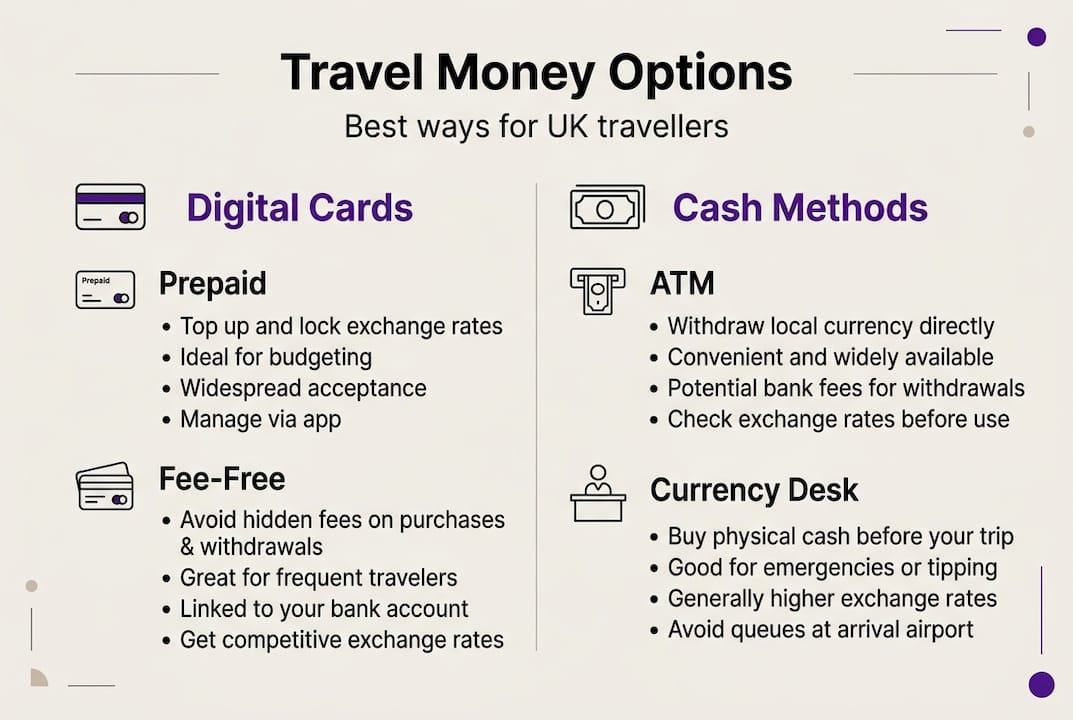
Digital and bank methods beat traditional cash by 5 to 15% on average, which on a £1,500 holiday spend translates to £75 to £225 in savings. That is not small change.
Here is a step-by-step preparation checklist:
- Check your destination’s cash culture. Japan and parts of Southeast Asia remain heavily cash-based. Western Europe and North America are largely card-friendly.
- Choose your primary card. Look for a fee-free debit or credit card with no foreign transaction fees. Compare options using multi-currency card deals before you decide.
- Order cash in advance online. If you need physical notes, order from an online provider at least 3 to 5 days before travel. Rates are almost always better than the airport.
- Load a prepaid card as a backup. A prepaid card lets you lock in a rate and control your budget. Read the cash vs currency card guide to decide if this suits your trip.
- Arrange a backup payment method. A second card from a different network (Visa vs Mastercard) protects you if one is declined.
| Card type | ATM fee | Foreign transaction fee | Weekend markup | Prepaid accepted for car hire |
|---|---|---|---|---|
| Wise debit card | Low per withdrawal | None | Small markup | Sometimes |
| Revolut (standard) | Free up to limit | None | 1% weekend | Rarely |
| Halifax Clarity credit | None | None | None | Yes |
| Caxton prepaid | None | None | None | Rarely |
Pro Tip: Never rely solely on a prepaid card for car hire or hotel check-in deposits. Many rental companies and hotels require a credit card with a verifiable credit limit. Carry a credit card specifically for these situations, even if you use your prepaid card for everything else.
Executing your exchange: Step-by-step process abroad and at home
With your tools ready, let us get into the practical exchange process itself. Preparation is half the battle, but execution is where the real savings are won or lost.
Before you fly:
- Order your cash online and collect or receive it at least 2 days before departure.
- Load your prepaid card at home using a weekday rate to avoid any weekend markup.
- Notify your bank and card providers of your travel dates to prevent fraud blocks.
- Screenshot or note down the mid-market rate for your destination currency.
While abroad:
- Pay by card wherever possible, always in the local currency.
- Always decline DCC when a terminal offers to charge you in pounds. DCC typically adds 3 to 7% on top of the transaction, which is pure profit for the merchant’s payment processor.
- Use ATMs attached to reputable local banks rather than standalone machines in tourist areas. Standalone ATMs often charge higher fees.
- Withdraw a sensible lump sum rather than multiple small amounts to reduce per-transaction fees.
- Keep a small reserve of local cash for markets, taxis, and small vendors who do not accept cards.
Common warning signs to watch for:
- A card terminal that defaults to pounds without asking
- An ATM that displays its own conversion rate before processing
- A hotel offering to convert your bill to sterling at checkout
All three of these are DCC in different forms. The rule is simple: always pay in the local currency and let your card or prepaid provider handle the conversion at a far better rate.
Pro Tip: Avoiding travel money fees starts with knowing your card’s ATM policy before you travel. Some fee-free cards only waive ATM charges up to a monthly limit. Check the small print so you are not surprised mid-trip.
Weekend markups are a genuine concern for prepaid card users. If your card applies a weekend surcharge, top it up on a Friday morning before the market closes rather than on Saturday or Sunday.
Avoiding common mistakes and maximising savings
Even well-prepared travellers can fall victim to unexpected fees. Here is how to avoid the most common traps.
Edge cases including DCC, ATM fees, and prepaid card acceptance for hotels and car hire, as well as the need for a cash blend in parts of the Eurozone and Asia, catch out thousands of UK travellers each year. Awareness is your best defence.
Common mistakes and how to avoid them:
- Using your prepaid card for hotel or car hire deposits. Many providers place a hold of several hundred pounds on the card. Prepaid cards often cannot accommodate this. Use a credit card for deposits and your prepaid card for daily spending.
- Ignoring ATM fee warnings. If an ATM tells you it will charge a fee, you can decline and find another machine. Do not simply accept it out of convenience.
- Exchanging leftover currency at the airport on the way home. The sell-back rates at airports are often even worse than the buy rates. Use a buyback comparison tool to find better rates before you travel home.
- Assuming cards work everywhere. In rural Japan, rural Italy, and many parts of Southeast Asia, cash is still king. Research your specific destination, not just the country.
- Not reading travel money reviews before choosing a provider. Real user experiences often reveal hidden fees or poor customer service that comparison tables do not capture.
Warning: Never accept a hotel’s offer to convert your bill into sterling. Never let an ATM apply its own exchange rate. These are the two most common and costly DCC traps. Decline both, every single time.
Pro Tip: Blend your methods based on your destination. For most European city breaks, a fee-free card covers 90% of spending. For Thailand or Vietnam, plan to use more cash and withdraw from bank-affiliated ATMs to keep fees low.
Our perspective: Why the travel money exchange process is still misunderstood
Despite the wealth of information available, a surprising number of UK travellers still exchange money at the airport or rely entirely on cash drawn from a high street bank. Old habits are hard to break, and the travel money industry has historically done little to make the better options obvious.
The truth is that digital-first methods, whether a fee-free card, a prepaid multi-currency card, or online cash ordering, consistently outperform traditional approaches. The savings are not marginal. On a two-week family holiday, the difference between a poor and a smart exchange strategy can easily exceed £200.
What surprises us most is how many travellers treat currency exchange as an afterthought, something to sort out at the airport when the taxi is waiting. The improvements in comparison technology now available mean that finding a better rate takes minutes, not hours. There is simply no reason to overpay. Awareness and a small amount of preparation are all it takes to save meaningfully, every single trip.
Next steps: Compare the best travel money deals for your trip
You now have a clear, practical process for getting the best exchange rates before and during your trip. The next step is putting it into action with the right tools.
CompareTravelCash.co.uk makes it straightforward to compare live travel money exchange rates from multiple providers in one place, so you can see at a glance who is offering the best deal today. You can also browse currency card deals to find the right prepaid or fee-free card for your destination. If you are heading somewhere specific, check provider-level comparisons such as Marks & Spencer travel rates to see how well-known high street options stack up against online specialists. A few minutes of comparison now can save you a meaningful amount on every trip.
Frequently asked questions
What is the best way for UK travellers to exchange money for foreign trips?
Prepaid cards, fee-free cards, online cash, ATMs are the main methods, and combining a fee-free debit or credit card with a small amount of pre-ordered cash typically delivers the best overall value for most destinations.
Should you always decline a merchant’s Dynamic Currency Conversion (DCC)?
Yes. DCC adds 3 to 7% in unnecessary charges, so always choose to pay in the local currency and let your own card handle the conversion at a far better rate.
Is cash still necessary abroad, and if so, how much should I take?
Cash is essential in Eurozone/Asia regions and cash-only venues, so blend your methods and carry enough for emergencies, typically the equivalent of £100 to £200 depending on your destination.
Do weekend currency markups affect my exchange process?
Weekend FX markup of around 1% applies on some prepaid cards such as Revolut, so plan card top-ups and currency conversions during weekday hours where possible.
Are there situations where prepaid cards are not accepted?
Prepaid cards may not work for car hire or hotel deposits, so always carry a back-up credit card with sufficient available credit for these specific situations.